Early German Immigration and the Delaware Valley
The settlement of Germantown in Pennsylvania represents a remarkable example of early German immigrant culture shaping the social, economic, and moral foundations of colonial America. German migration to the Delaware Valley began decades before the formal founding of Germantown. As early as 1638, Swedish, Finnish, Dutch, and German settlers had established outposts along the Delaware River.
By 1681, William Penn had received a royal charter from King Charles II to establish Pennsylvania, envisioning it as a haven of religious liberty and a model of equitable governance. In 1682, Penn, along with approximately two hundred Quakers, including English, Welsh, Irish, and German adherents, organized a stable government near the site of what would become Philadelphia. Their foundation emphasized religious tolerance, fair dealings with Native Americans, communal responsibility, and orderly land management, attracting skilled and industrious immigrants eager to settle in a colony where faith, family, and labor could flourish.
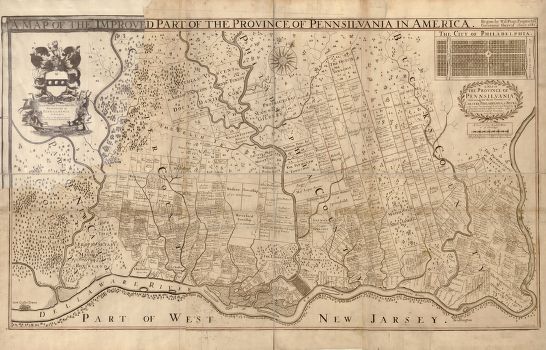
1687 map of Pennsylvania
Contemporary letters and printed tracts reveal both the allure and the risks of migration to Pennsylvania. Johann Christopher Sower, a printer in Germantown, promoted the colony as a land of economic opportunity, religious freedom, and abundant land to his family back in Germany, while Gottlieb Mittelberger cautioned prospective settlers about the dangers of the Atlantic crossing, the uncertainty of frontier conditions, and the financial risks of relocation in his book Journey to Pennsylvania. Such sources shaped migration decisions, providing a mixture of encouragement and practical guidance for European families considering the perilous journey across the Atlantic.
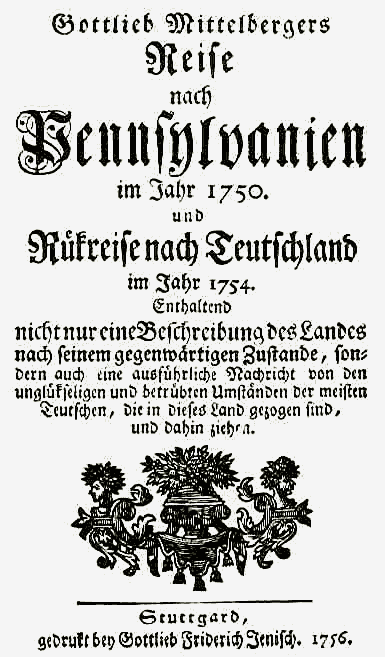
Title Page of Mittelberger’s Journey to Pennsylvania
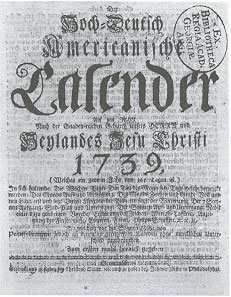
Front page of one of Sauer’s prints
Founding Germantown and Early Community Life
Germantown was founded in 1683 by thirteen families from Krefeld, a small city in the Rhineland. Although later joined by Germans, these original settlers were ethnically Dutch Mennonites, many of whom had converted to Quakerism in the 1670s. They left Europe to escape religious persecution and to pursue opportunities unavailable in the fractured political landscape of the Holy Roman Empire, roughly modern-day Germany. During its early decades, the settlement remained approximately eighty percent German-speaking.
A crucial figure in this process was Francis Daniel Pastorius, a highly educated Pietist from Frankfurt who became the settlers’ agent, organizer, legal advocate, and intellectual leader. Pastorius personally recruited the Krefeld Quakers, purchased land on behalf of investors, and arrived ahead of the group to prepare the site. He initially lived in a small dugout “cave” near the Delaware River and hosted the Krefeld families there when they reached Philadelphia in October 1683.
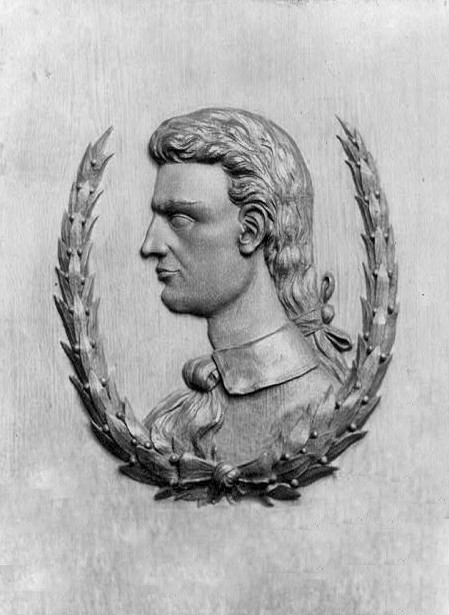
Bas-relief impression of Francis Daniel Pastorius, c. 1897
Upon arrival, the settlers spent the winter living in similar caves while clearing dense woodland for their future homes. With no food reserves and no horses, many walked the two-hour journey into Philadelphia for wage work simply to survive. Their early years were marked by extraordinary hardship, yet they persisted, planting vegetables, grains, and flax in spring, 1684, and beginning linen weaving by late summer.
Many German migrants traveled in family groups, maintaining social cohesion and ensuring the transmission of cultural and religious practices. Others participated in redeeming, a system in which contracts secured ship passage in exchange for labor or deferred payment upon arrival in the colonies. Often, friends, relatives, or fellow settlers would cover the cost of passage, effectively sponsoring newcomers. Germans often redeemed other German-speaking migrants, even strangers. This chain migration revealed the strong desire of colonists to draw in others from Europe.
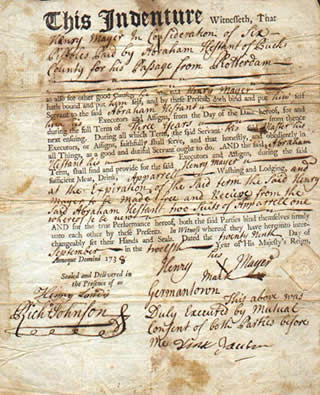
Contract of service in exchange for passage from Bucks County, Pennsylvania, 1738.
Germantown’s layout reflected both practical concerns and cultural traditions. Surveyed by Pastorius, the village followed a linear “ribbon” plan common in Germanic settlements, with long, narrow lots extending back from a central road, allowing families to cultivate both gardens and field crops efficiently while remaining clustered rather than on scattered farms. Settlers combined European building techniques with local materials. Houses were typically timber-framed with steep roofs, their gabled ends facing the street. Community life centered on religious meetings, shared labor, and cooperation in building mills, roads, and communal infrastructure.
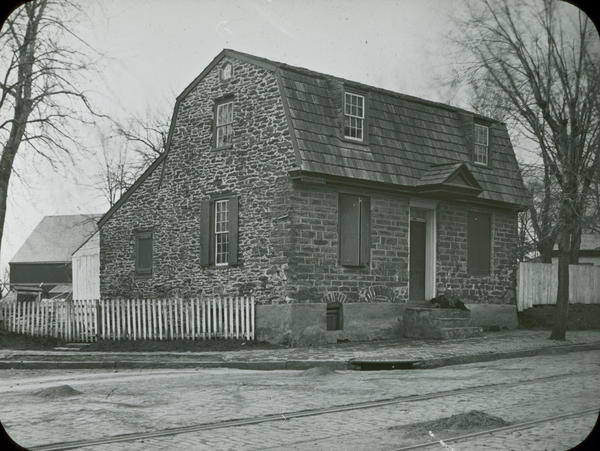
First stone dwelling built in Germantown. Built 1683 by Heivert Papen. Photo taken ca. 1880. Demolished 1883.
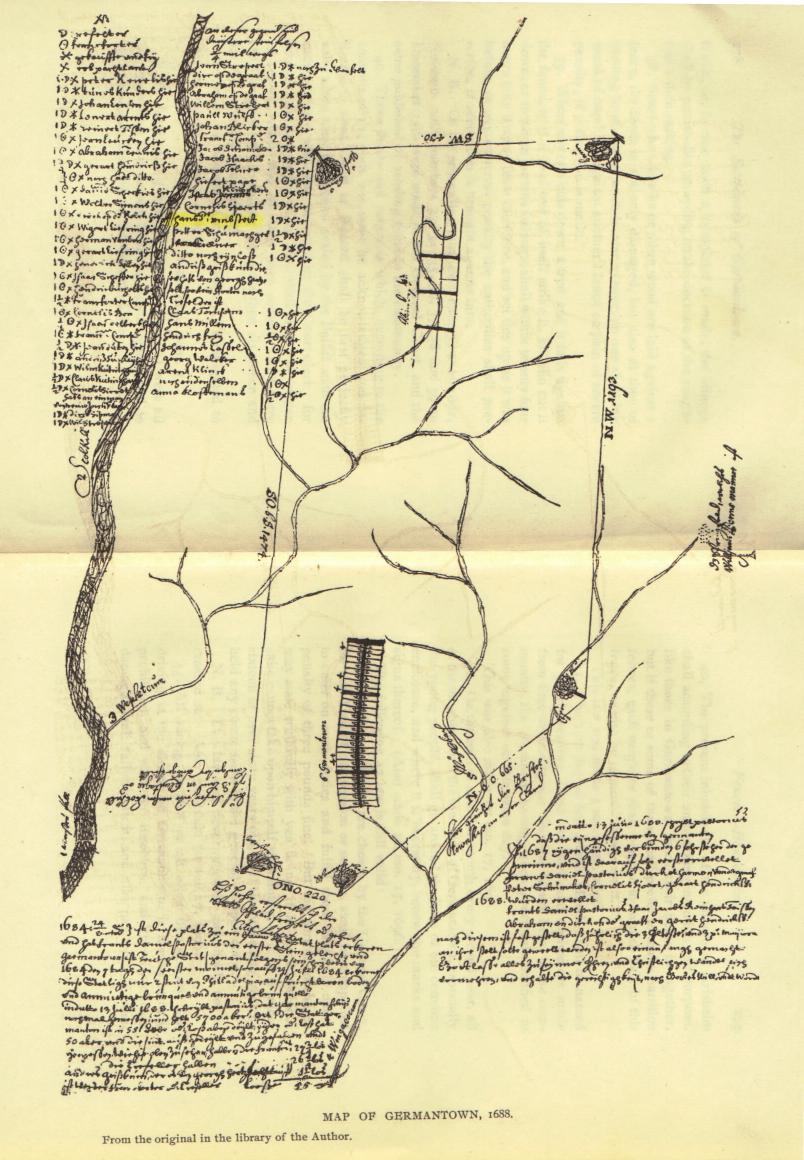
Map of Germantown, 1688
Moral Leadership and Social Reform
From its earliest years, Germantown became associated with moral and social reform shaped by the religious traditions of its settlers, especially Quakers, Mennonites, and German Pietists. Quakers, or the Religious Society of Friends, emphasized inner spiritual guidance, pacifism, fairness, and equality, and believed that every person possessed an “Inner Light.” Mennonites emerged from the Anabaptist tradition and stressed nonviolence, community responsibility, and simple living as expressions of Christian faith. Pietists believed in leading deeply devout, disciplined, and morally upright lives.
These overlapping values shaped Germantown’s public conscience. In 1688, four residents, Francis Daniel Pastorius, Garret Hendricks, Derick op den Graeff, and Abraham op den Graeff, published what is widely recognized as the first formal anti-slavery petition in colonial America. Rooted in theological commitments to nonviolence, equality, and spiritual dignity, the petition condemned slavery as incompatible with the Bible and the principles of conscience and equality. While the petition did not immediately change colonial policy, it circulated widely in Quaker networks and became a touchstone for later abolitionist movements in the 19th century. It also established Germantown’s reputation as a community willing to confront moral and social injustice at a time when many prominent Friends, including William Penn, continued to own slaves.
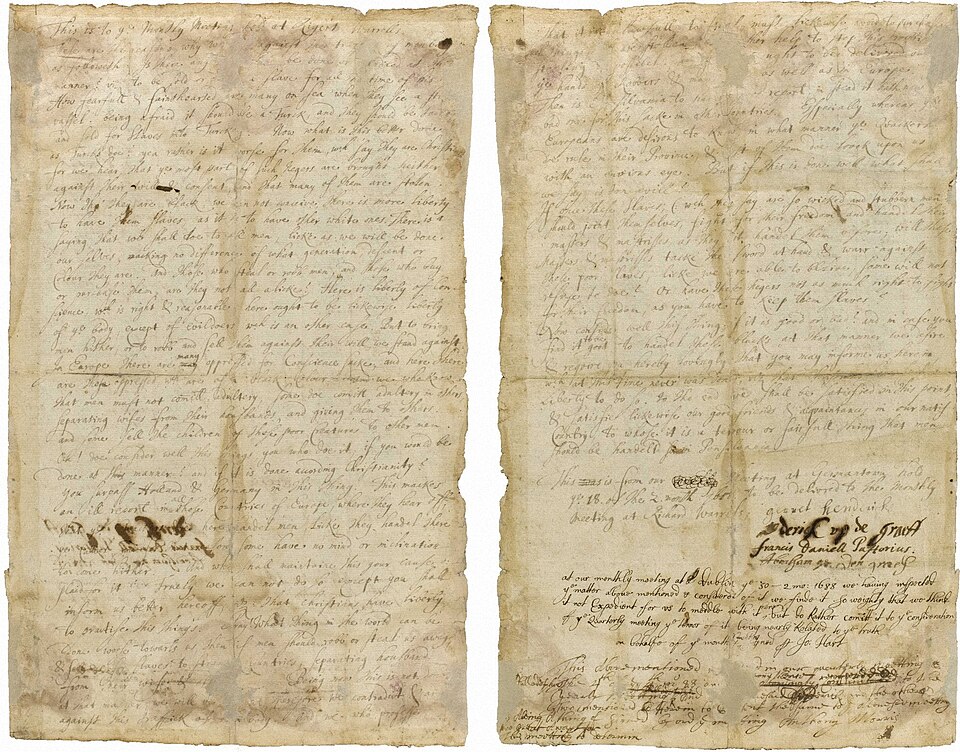
Germantown Petition Against Slavery
Germantown as a Textile and Paper Making Hub
Linen production quickly became central to Germantown’s identity. Many settlers, including Abraham op den Graeff, brought extensive knowledge of weaving from Krefeld, a city renowned for its textile production. Op den Graeff established one of the colony’s first linen industries, modeled after the standards of his native city. He received the first Governor’s Award from William Penn for producing the finest linen in Pennsylvania, signaling Germantown’s emergence as a center of high-quality textile manufacture. Over subsequent decades, the town became known for consistently well-crafted linen and yarn, supporting both domestic consumption and intercolonial trade.
So central was the linen trade to these early settlers that it features on the town seal. Grapevines, flax, and spooled thread occupy a three-leaf clover with the words “Vinum Linum et Textrinum” across a ribbon above. Wild grapes had been found and vineyards established in the first year of settlement.
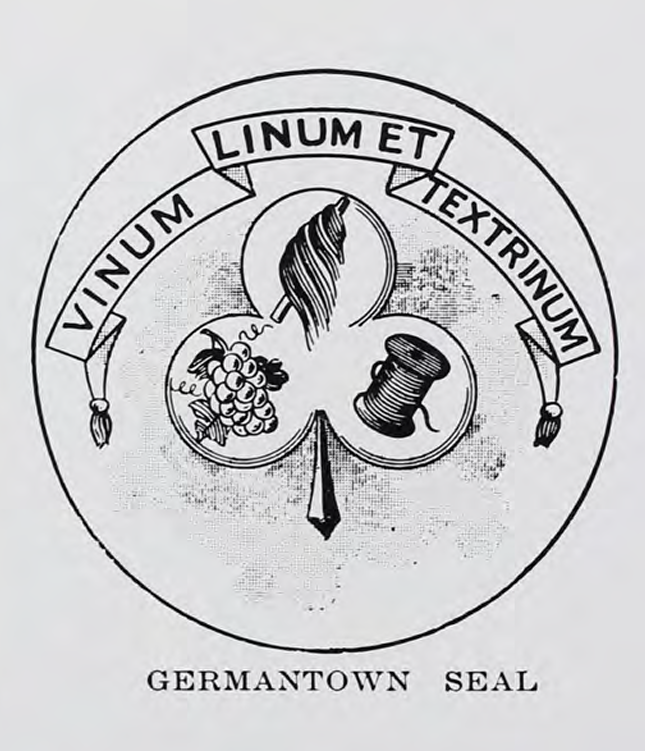
Germantown Seal, designed by Francis Daniel Pastorius
The Linen Making Process
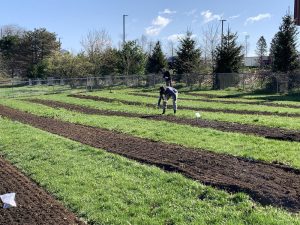
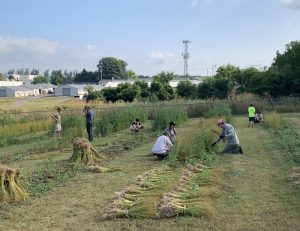
Linen production was a highly specialized, labor-intensive process that required the participation of the entire community over several months. It began with planting flax in well-prepared fields during early spring. Flax required rich soil and careful cultivation, and thrived under German farmers who brought generations of experience. After roughly 100 days, the plants matured and were harvested by pulling them from the ground to preserve the fibers’ full length.
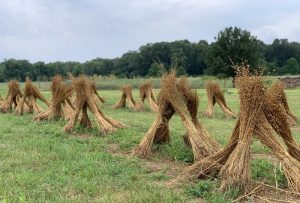
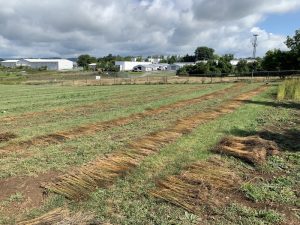
The harvested flax was bundled and dried for up to a month. Once dried, seeds were removed through batting using a ripple comb. After seed removal, the flax underwent retting, a controlled rotting process that loosened the inner fibers from the woody outer stalk. In Germantown, settlers typically relied on dew-retting, laying the flax in the fields and letting moisture slowly break down the pectins binding the fibers, a process that could take weeks. Flax was then thoroughly dried in the sun, a process that could take up to twenty days.
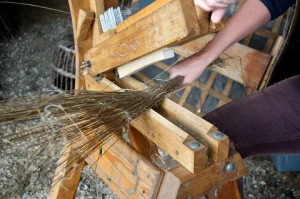
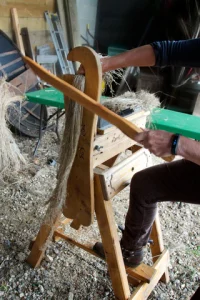
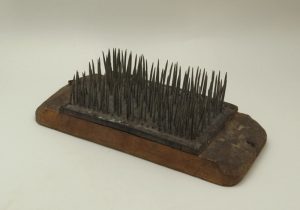
Workers proceeded to scutch, striking and scraping the stalks to remove the brittle outer bark and reveal the long interior fibers. To further refine the fibers, workers hackled them, drawing the flax repeatedly through a series of metal combs to separate coarse tow from the fine, silky strands needed for high-quality linen. Women spun the fibers into thread using spinning wheels. The smoothness and consistency of the thread determined the eventual quality of the cloth. The spun thread then went to the loom to be made into cloth, a demanding process that required precision, rhythmic coordination, and intimate knowledge of tension and pattern. Floor looms, table looms, and tape looms were all operated by hand in the Colonial period. Finally, linen was bleached in the sun, creating the pale, smooth fabric prized by colonial consumers. Children often assisted in seed removal and fiber sorting, while men handled field labor. This communal and intergenerational labor created a tightly woven network of local labor.

Another important but often overlooked industry in Germantown was papermaking, introduced with the creation of North America’s first paper mill. In 1690, Mennonite settlers William Rittenhouse and his son Nicholas established a mill along the Wissahickon Creek. Their operation quickly became essential to printers in Philadelphia and beyond, reducing dependence on costly European imports and complementing Germantown’s linen-based economy. Because paper in this period was made from linen and cotton rags, Germantown’s linen-producing center made it an ideal location for the industry.
The Rittenhouse mill remained the only paper mill in the colonies until 1710, when William DeWees, Nicholas Rittenhouse’s brother-in-law, founded a second mill in Germantown. The Rittenhouse operation also produced the paper for the first European-language Bible printed in America, published in Germantown in 1743. German printing remained influential in Pennsylvania for decades to come. The very first publisher to report the existence of the Declaration of Independence was the Henrich Miller in Pennsylvanischer Staatsbote (Pennsylvania State-Courier), on July 5th, 1776. He would print a German translation of the document on July 9th.
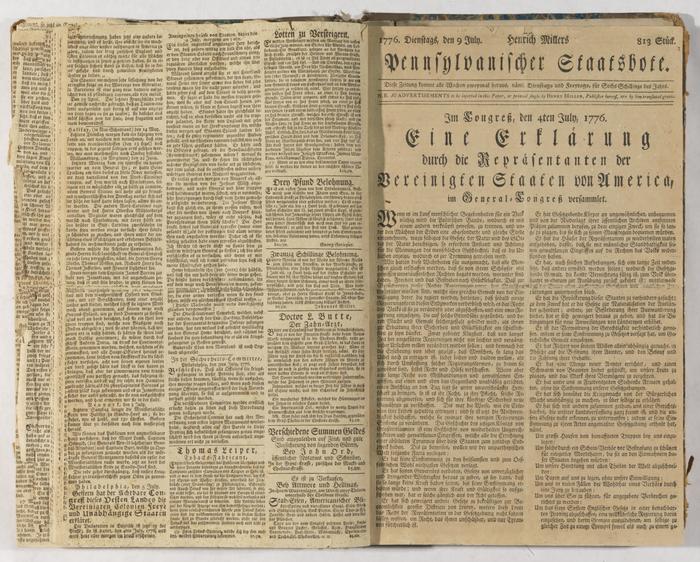
Front page of the July 9, 1776 edition of the German-language newspaper Pennsylvanischer Staatsbote
Other small industries, including gristmills, expanded rapidly along the Wingohocking and Wissahickon Creeks as well, further strengthening Germantown’s economic connections to Philadelphia and nearby settlements.
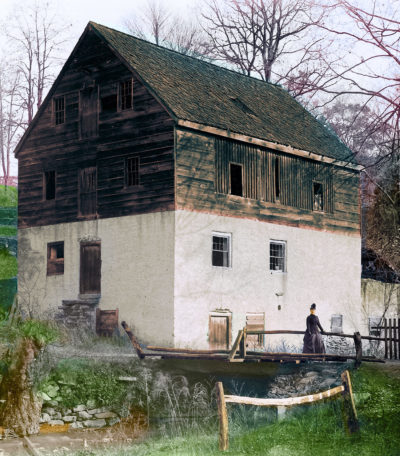
Second Rittenhouse mill, built 1702
German-American Networks Beyond Germantown
While Germantown became a culturally and commercially influential center, it was only one part of a much broader colonial and transatlantic network of linen production. Flax cultivation and linen making were already well-established industries throughout northern Europe, and these traditions carried over into North America. Households across New England and the Chesapeake produced linen as part of the domestic textile economy, and European imports continued to supply the colonies even as local production grew.
Germantown stood out not because it invented linen manufacture, but because it had a relatively dense concentration of skilled weavers, bleachers, and spinners who adapted Rhineland techniques to local conditions. Other German-settled communities across the Mid-Atlantic participated in similar processes. They produced linen and woolen textiles for household use and for sale, contributing to regional markets and supplementing broader colonial textile trade.
The labor and goods produced by these communities circulated through port cities including Philadelphia, New York, and Baltimore, where locally woven textiles coexisted with European imports. Their output did not dominate colonial markets, but it formed an important part of a diversified economy.
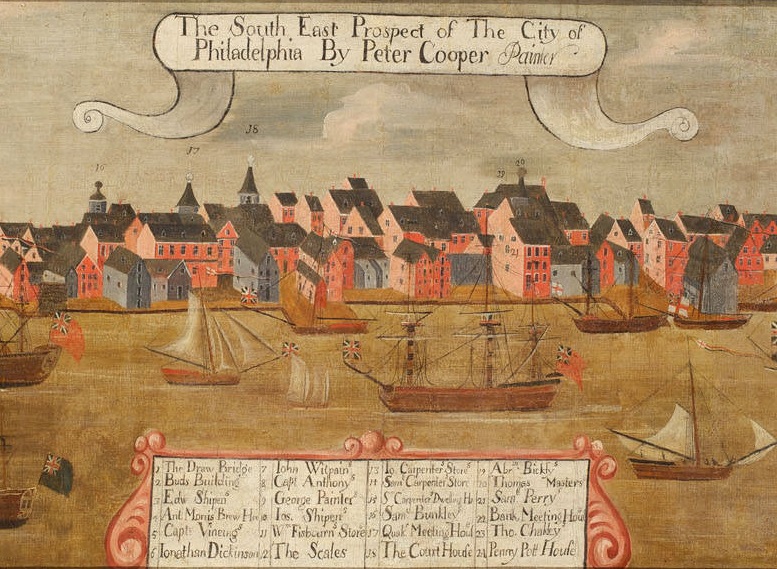
Port of Philadelphia ca. 1720
On the frontier, in areas like Fort Pitt and along the Susquehanna River, households relied heavily on homegrown flax for clothing and household textiles. The skills, trade networks, and communal labor practices that were visible in Germantown migrated with German settlers into these regions, reinforcing other colonial traditions of textile production.
Evolving Community and Legacy
Religiously, Germantown was diverse from its earliest decades. A log Quaker meetinghouse was built ca 1686, replaced by a substantial stone meetinghouse in 1705. Mennonites constructed their own log meetinghouse in 1706, and a small community of mystical Pietists, the “Hermits of the Wissahickon,” settled nearby in the 1690s, enriching the region’s spiritual landscape. Before the construction of these meetinghouses, religious activities were conducted in school houses.
By the mid-eighteenth century, German-speaking populations were significant not only in Philadelphia but also in urban and rural centers along the Atlantic seaboard. Germantown’s combination of religious tolerance, skilled craft, moral activism, and communal organization created a model of German-American identity, influencing settlements across the colonies. Its artisanship shaped regional trade, while civic and religious practices connected German immigrants to broader social networks. Moral initiatives, including the 1688 anti-slavery protest, positioned the town as a pioneering voice in discussions of human rights, ethics, and social justice.
Despite its strong German character in the early years, Germantown gradually diversified over the late eighteenth and early nineteenth centuries, as English, Irish, free Black, and other groups settled in the town. While original families maintained aspects of German tradition, the community evolved into a multicultural hub. Meanwhile, German immigrants, now mainly Lutherans, continued to arrive in the United States, founding new settlements in Pennsylvania, New York, the Ohio Valley, and the Midwest. These communities carried forward the skills and social values exemplified in Germantown, ensuring that German-American culture continued to influence the nation.
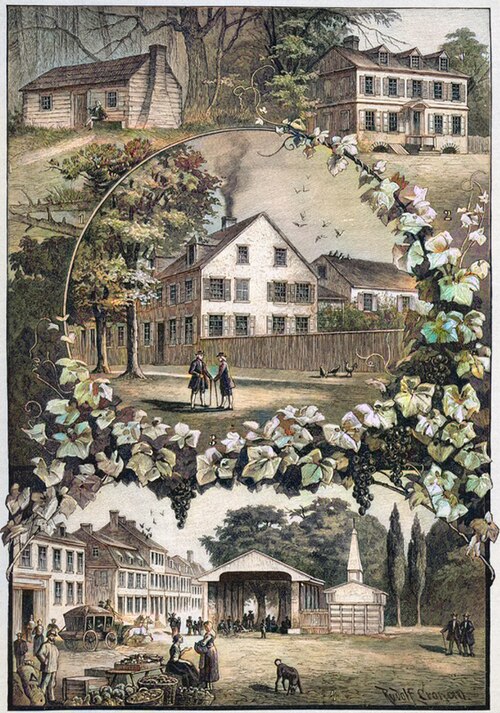
1895 depiction of “Old Germantown” with Pastorius and Sower family residences and marketplace.
Bibliography
Corson, Barbara. “Flax to linen at the Colonial Pennsylvania Plantation.” A Year on the Field. Last modified August 21, 2023. https://www.yearonthefield.net/post/flax-to-linen-at-the-colonial-pennsylvania-plantation.
Crown, Daniel. “The German-Language Newspaper That Got the Scoop on American Independence.” Atlas Obscura. Last modified July 3, 2019. https://www.atlasobscura.com/articles/german-language-newspaper-declaration-independence-day-signing.
Galtfelter, Charles H. The Pennsylvania Germans: A Brief Account of their Influence on Pennsylvania. University Park, Pa.: Pennsylvania Historical Association, 1990.
Geiser, Karl Frederick. Redemptioners and Indentured Servants in the Colony and Commonwealth of Pennsylvania. New Haven, Conn.: Tuttle, Morehouse & Taylor, 1901. https://archive.org/details/redemptionersind00geis.
Germantown Mennonite Historic Trust. “Early Settlers & the Weaving Industry.” The Historic 1770 Germantown Mennonite Meetinghouse. http://www.meetinghouse.info/early-settlers–the-weaving-industry.html.
Graves, Donald, and Michael Colby. “An Overview of Flax and Linen Production in Pennsylvania.” Pennsylvania Folklife 35, no. 3 (1986): 108-26. https://digitalcommons.ursinus.edu/cgi/viewcontent.cgi?params=/context/pafolklifemag/article/1111/&path_info=Pennsylvania_Folklife___Spring_1986.pdf.
Hood, Adrienne D. The Weaver’s Craft : Cloth, Commerce, and Industry in Early Pennsylvania. University of Pennsylvania Press, 2003.
Kelley, Courtney. “A Brief History of Germantown Yarns.” Kelbourne Woolens. Last modified November 10, 2018. https://kelbournewoolens.com/blogs/blog/a-brief-history-of-germantown-yarns.
Mittelberger, Gottlieb. Journey to Pennsylvania in the Year 1750 and Return to Germany in the Year 1754. Translated by Carl Theodor Eben. Philadelphia: John Joseph McCevy, 1898. Originally published as Gottlieb Mittelbergers Reise nach Pennsylvanien im Jahr 1750 und Rückreise nach Deutschland im Jahr 1754 (Gottlieb Friderich Jenisch, 1756). https://archive.org/details/gottliebmittelbe00gott.
Mormul, Michelle. “Flaxseed and Linen.” The Encyclopedia of Greater Philadelphia. Last modified 2012. https://philadelphiaencyclopedia.org/essays/flax-and-linen/.
Morris, David. “Still Waters: The Import of German Immigration to the United States.” Library of Congress. September 22, 2022. https://blogs.loc.gov/international-collections/2022/09/german-immigration-loclrblogint/.
Randall, Betty. “Germantown, Pennsylvania.” Indiana University Indianapolis Libraries. Last modified November 16, 2007. https://library.indianapolis.iu.edu/static/collections/kade/germantown.html.
Robert C. Williams Museum of Papermaking. “History of Papermaking.” Georgia Tech. https://paper.gatech.edu/papermaking-united-states-america.
Sower, Johann Christopher. “An Early Description of Pennsylvania. Letter of Christopher Sower, Written in 1724, Describing Conditions in Philadelphia and Vicinity, and the Sea Voyage from Europe.” The Pennsylvania Magazine of History and Biography 45, no. 3 (1921): 243–54. http://www.jstor.org/stable/20086449.
Whitman, Randal L. “The Settlement of Germantown 1683-1719 and the beginning of Germantown Meeting.” Last modified 2020. https://gmm.gfsnet.org/wordpress/wp-content/uploads/2020/12/The_Settlement_of_Germantown_in_1683.pdf.
Young, David W. “Historic Germantown: New Knowledge in a Very Old Neighborhood.” The Encyclopedia of Greater Philadelphia. Last modified 2009. https://philadelphiaencyclopedia.org/essays/historic-germantown-new-knowledge-in-a-very-old-neighborhood-2/.