The Continental Tailoring Company, also known as Continental Tailors, operated within Chicago’s flourishing garment industry during the late nineteenth and early twentieth centuries. In the decades following the Great Fire of 1871, the city rebuilt itself as a powerhouse of manufacturing, and clothing production became one of its most enduring sectors. By the late nineteenth century, Chicago was the nation’s second-largest producer for men’s clothing, responsible for roughly fifteen percent of the total American output. Competing with New York and Philadelphia, Chicago’s firms sought to distinguish themselves through craftsmanship and quality, carving out a reputation for well-made garments that balanced refinement with affordability.
The 1910s, however, were marked by turbulence as much as innovation. Labor unrest, most notably the 1910 strike at Hart, Schaffner & Marx, exposed the industry’s deep structural tensions and ushered in a decade of collective bargaining and unionization. The eventual formation of the Amalgamated Clothing Workers of America (ACWA) in 1914 institutionalized these efforts, giving workers a national platform. At the same time, when the United States entered World War I in 1917, the city’s clothing industry was swept into the war economy. Uniform contracts and military orders brought short-term prosperity but also accelerated a broader transformation: material shortages and labor demands pushed the trade decisively toward standardized, ready-made garments, further eroding the prominence of traditional bench tailoring. Yet amid this industrialization, firms like the Continental Tailoring Company continued to champion the made-to-measure tradition, preserving the craftsmanship and individuality of the bench tailor within an increasingly mechanized trade.
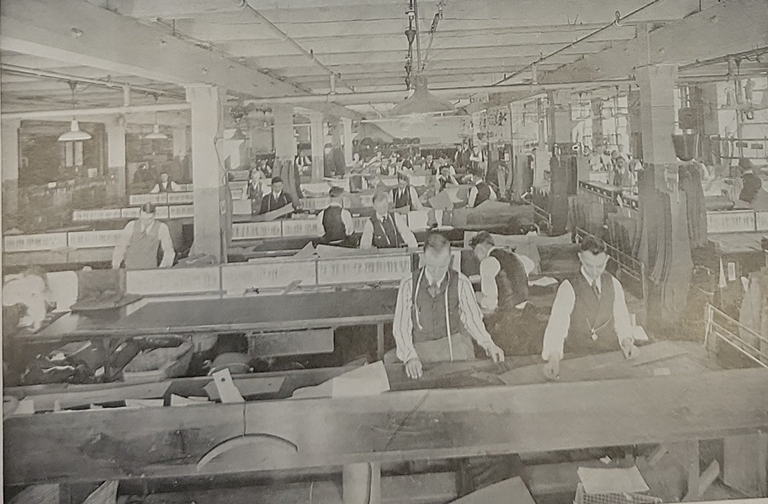
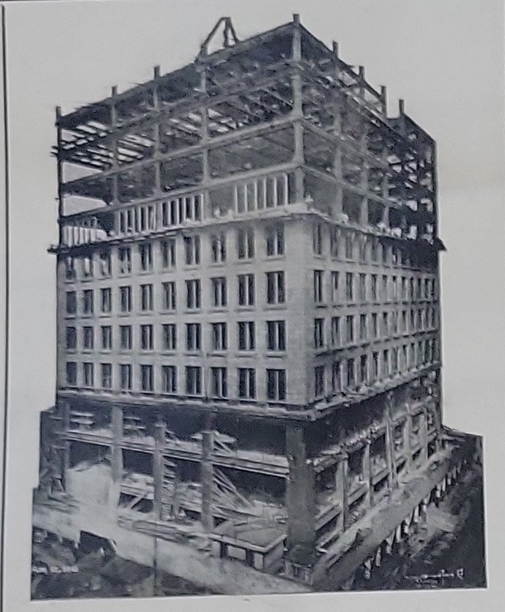
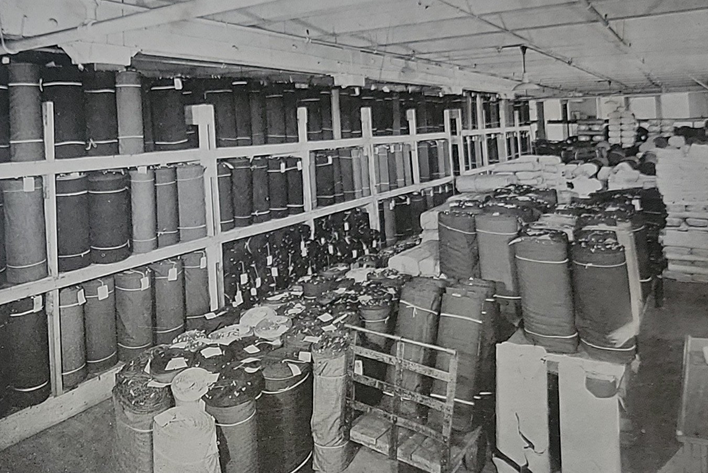
Operated under Morris, Goldschmidt & Co., the firm maintained large facilities on Jackson Boulevard, West Quincy Street, and Adams Street, at the heart of Chicago’s garment district. The firm’s headquarters at 700 West Jackson Boulevard, then called the Continental Building, symbolized the modern, vertically integrated tailoring enterprise: an urban factory that merged design, production, and distribution under one roof. Led by Louis Morris and Adolf Goldschmidt, the company cultivated a clientele of upwardly mobile men who valued precision tailoring and refined modern style.
Continental Tailoring’s marketing success was in their relationships with dealers. Most dealers in made-to-measure clothes carried multiple lines from several companies, sometimes one for high-quality tailoring and another for low-priced suits, perhaps another for the middle ground. However often it was the case that these dealers were carrying multiple lines in direct competition with one another. In November 1915, the company launched a cooperative advertising campaign that blurred the line between manufacturer and retailer. Continental paid for local newspaper advertisements that featured their own imagery and slogans but carried the names of individual dealers.
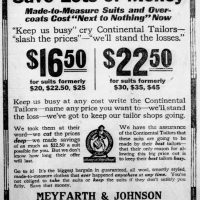
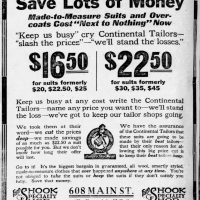
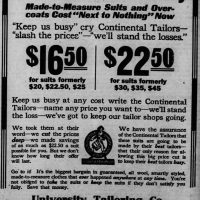
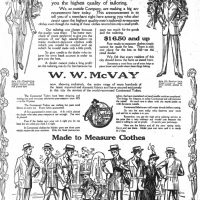
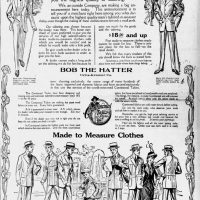
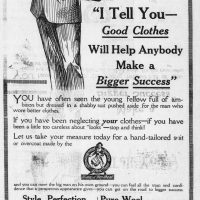
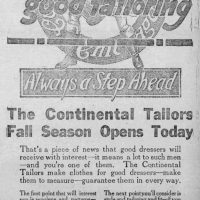
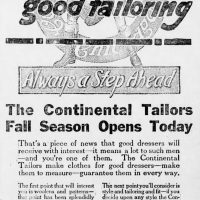
This gesture of “shared publicity” cultivated loyalty without formal exclusivity. Many dealers, in practice, abandoned competing lines in favor of Continental’s. Continental Tailors also put local dealers in contact with L.R. Merril, the Chicago-based cartoonist doing their own ads, to produce accompanying advertisements customized for that dealer. Such marketing ingenuity positioned the firm not just as a producer of clothing, but as a producer of identity, where purchasing a suit was an act of participating in the promise of modern, self-made success. In an era increasingly moving towards standardized mass production, Continental Tailoring stood as a bridge between the artisanal heritage of the bench tailor and the modern world of industrial fashion. Its sample books and advertising not only sold garments, they sold an ideal: that craftsmanship and individuality could still define the modern American man. Continental Tailoring’s success endured into the 1920s, until the economic disruptions of the Great Depression undermined large-scale custom operations across the industry.
Continental Tailoring Co. was one of many early twentieth-century made-to-measure firms that distributed sample books as part of an expanding visual and material culture of fashion marketing. Unlike mass-market catalogs, which were produced in large quantities and mailed directly to consumers, sample books were selective and tactile advertising tools. Trade catalogs in this period ranged from technical product lists to elaborate visual guides designed to market manufactured goods to both wholesalers and the public. Continental’s sample book represents the upper end of this spectrum—lavishly produced, richly illustrated, and designed to sell not only a product but an experience of refinement and modernity.
These sample books were typically distributed to department stores, mercantiles, men’s clubs, and specialty clothiers, where they remained on display for multiple seasons. They functioned as immersive sales aids, featuring fabric swatches that customers could touch, compare, and evaluate alongside printed illustrations of available suit models. The process blended craftsmanship with efficiency: customers could visit their local dealer, select the fabric and style they preferred, have their measurements taken, and send those details to Continental’s Chicago headquarters, where the garment was constructed and shipped back to the retailer.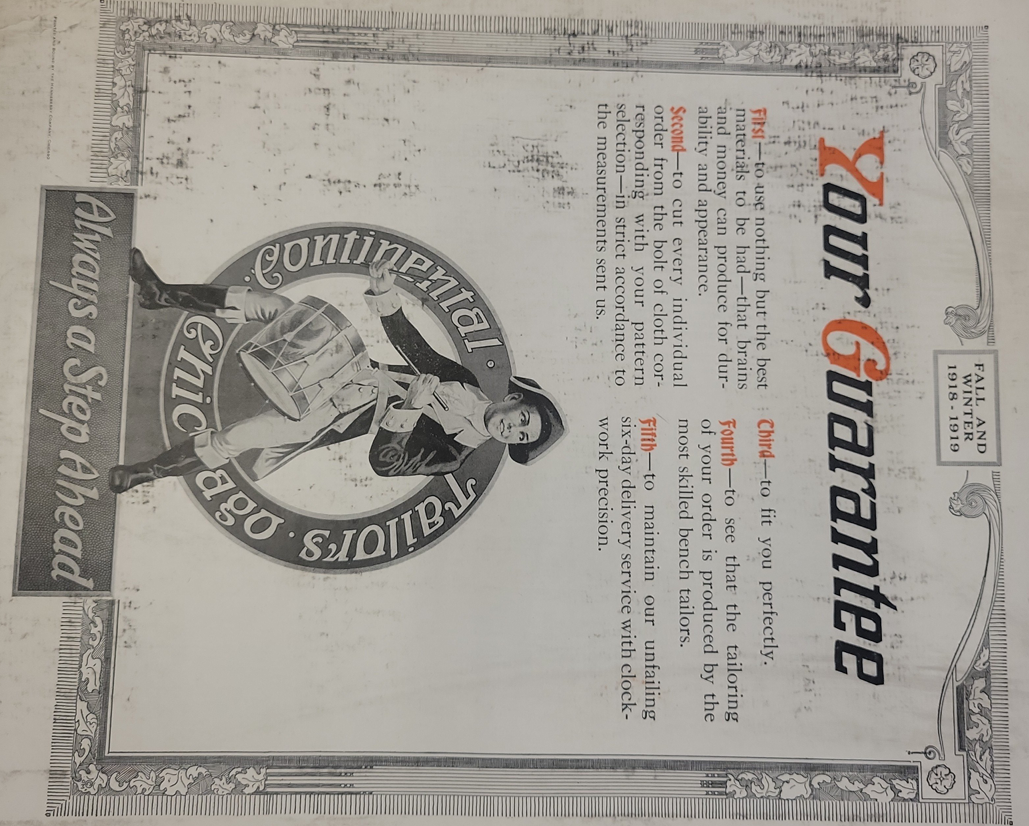
The illustrated fashion plates elevated the experience beyond mere transaction, embedded within them were narratives of ambition, leisure, and technological progress. Each plate paired Continental’s latest designs with scenes of modern life—automobiles, gliders, phonographs, football games, boardrooms, dockyards, National Parks, and leisure pursuits—that projected a distinctly aspirational vision of masculinity and success. These images linked the brand to ideals of progress, discipline, and national identity in the postwar era, framing the Continental customer as industrious, confident, and fashionably up-to-date.
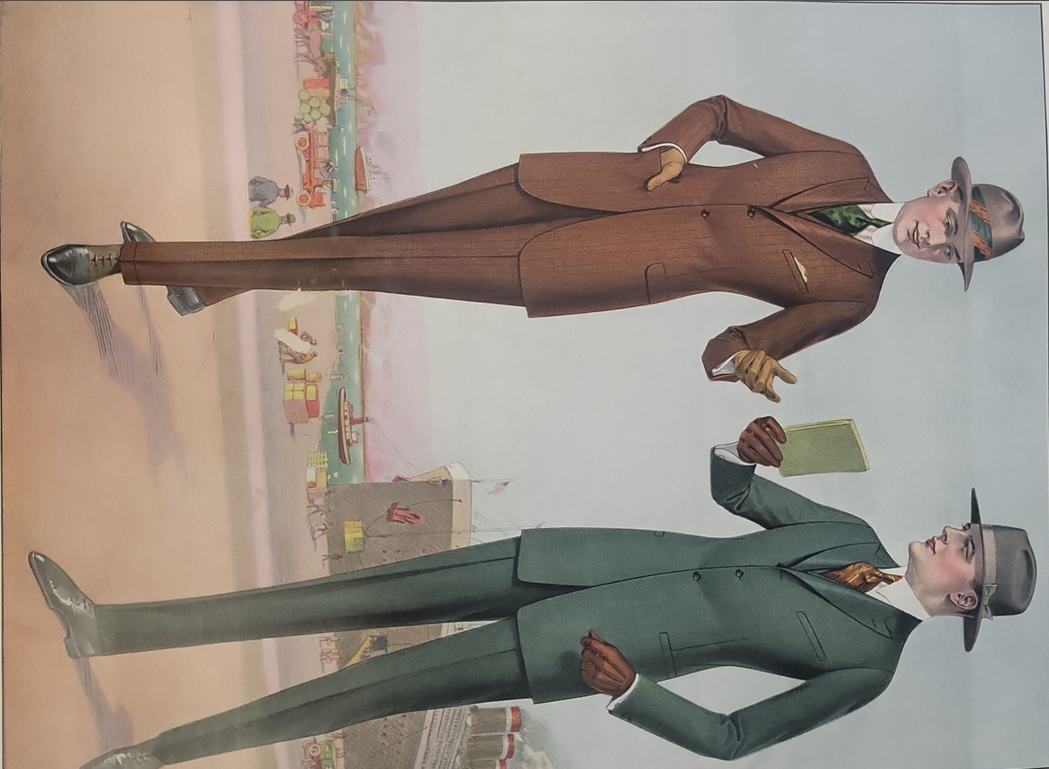
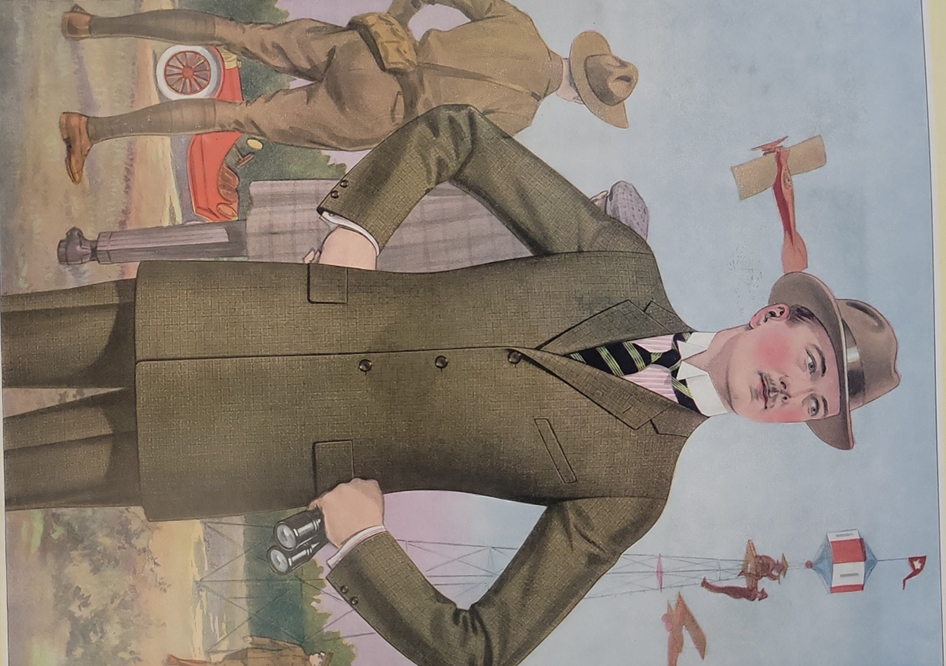
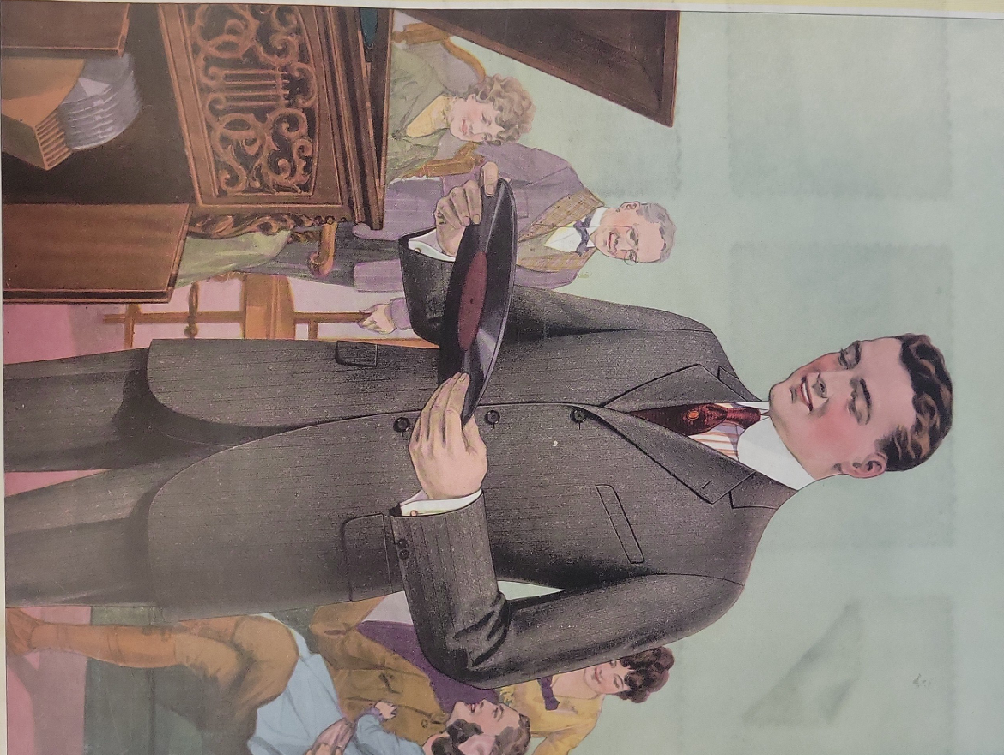
Through this combination of sensory engagement and visual storytelling, Continental Tailoring reinforced its image as a purveyor of refined, modern style. Its made-to-measure garments, marketed toward younger, upwardly mobile men—college students, junior executives, and professionals—embodied the promise of respectability through affordability. In the shifting landscape of wartime and postwar fashion, the Continental samplebook stood at the crossroads of craftsmanship and commerce, bridging the fading world of the bench tailor with the emerging culture of industrialized style.
War Affects Supply and Style:
When the United States entered the First World War in April 1917, the impact on the domestic clothing industry was immediate. Within months, the federal government sought to harness civilian production for the war effort. On December 15, 1917, the Council of National Defense launched a campaign to conserve textiles for military use. Through its Commercial Economy Board, the Council circulated questionnaires to manufacturers, asking which design elements could be sacrificed in the name of efficiency. The responses reflected a new wartime pragmatism: garments were to be shorter, simpler, and less wasteful. Double-breasted coats and vests, symbols of prewar luxury, were discouraged, while recycled wool replaced virgin fiber reserved for uniforms. Though compliance was voluntary, the appeal to patriotism proved effective; by the government’s own estimate, roughly ninety-five percent of the industry adopted the new restrictions.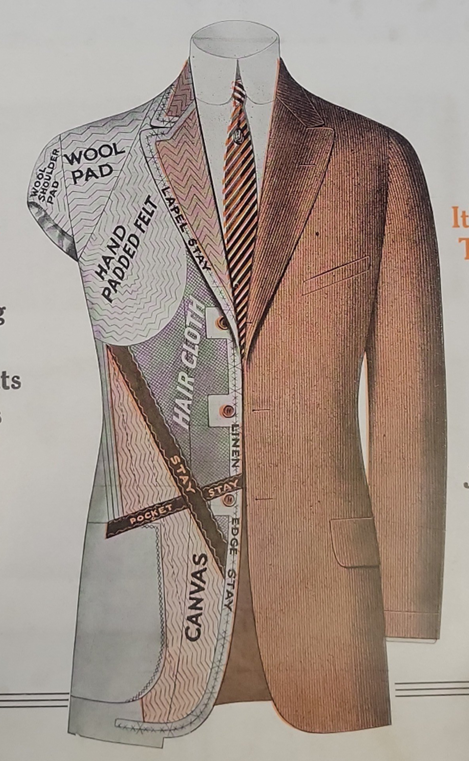
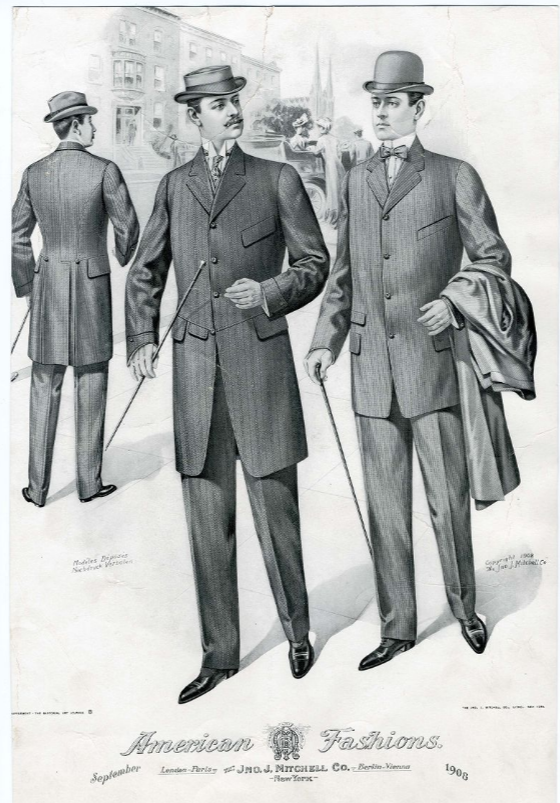
These policies reshaped not only material production but also the aesthetics of American menswear. Fashion, once characterized by seasonal experimentation and abundance, became a medium through which restraint and national duty were performed. The oversized, heavily padded suit coats favored by prewar figures such as Theodore Roosevelt and William Howard Taft, nicknamed “Bull Moose” and “Big Bill” for both their politics and personalities, fell out of favor. In their place emerged a leaner, more disciplined silhouette: natural shoulders, tapered sleeves, and a higher, more defined waistline. Trousers followed suit, narrowing dramatically. As one editor for American Mercury observed, “no gentleman would accept a pair of trousers from his tailor if he could get into them with his shoes on.”
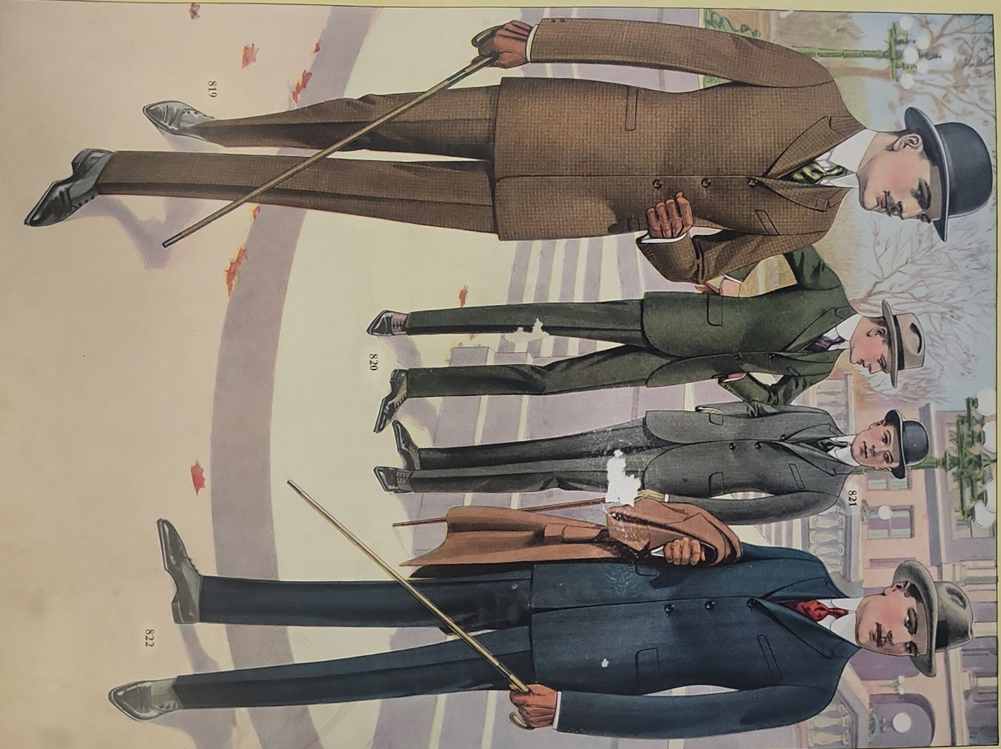
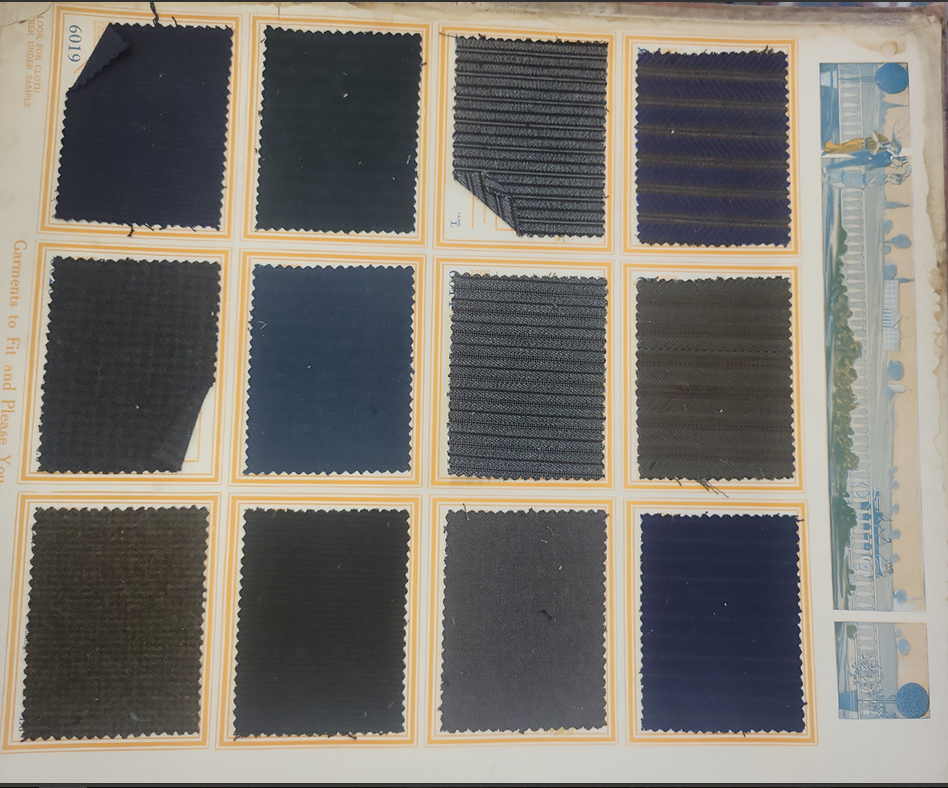
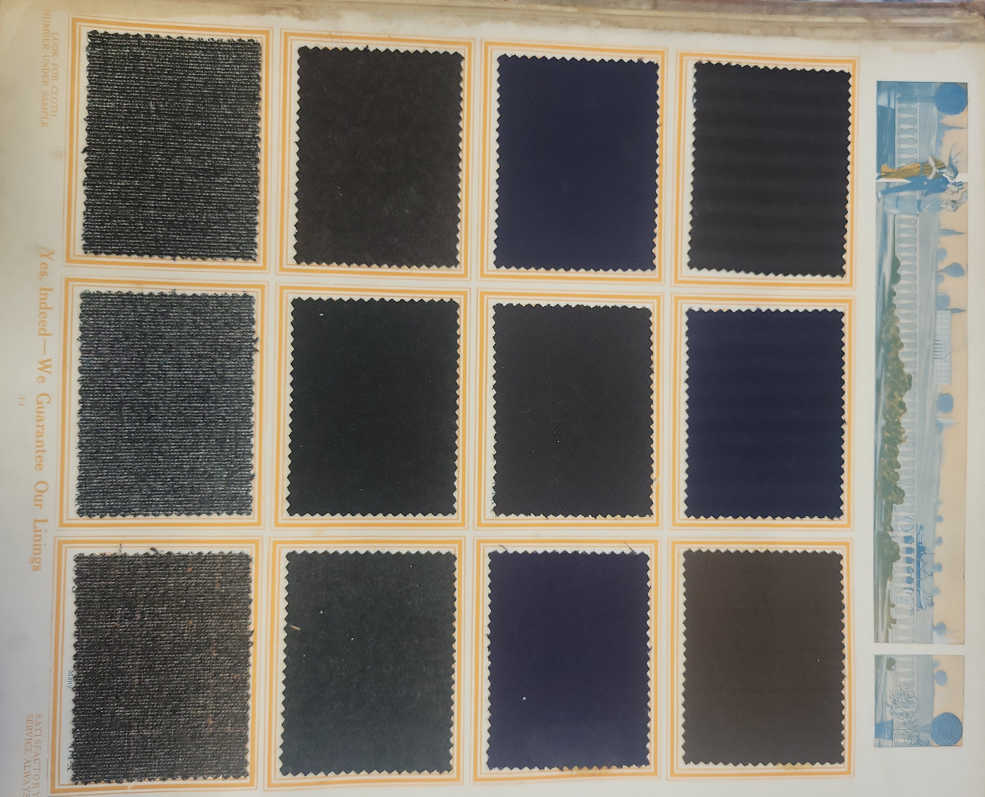
The war also curtailed efforts to expand the color palette of men’s clothing. Late Edwardian fashions had flirted with richer hues, purples, greens, browns, and reds, but the outbreak of war disrupted global dye production. Germany, the world’s leading supplier of synthetic dyes, redirected its chemical industry toward munitions. This practical scarcity of dyes coincided with shifting social expectations. In a time of rationing and mourning, bright colors could seem frivolous, even unpatriotic. Somber tones, navy, gray, khaki, and black, became not merely practical choices but visible markers of moral and national seriousness. Yet colorful options did not disappear entirely, as evidenced by several striking swatches preserved in the Continental Tailors sample book.
Despite widespread cooperation with federal conservation efforts, the limits of regulation were soon apparent. Unlike during the Second World War, no centralized agency existed to control prices. With demand far outstripping supply, manufacturers and retailers were free to set their own rates. The result was a surge in costs that placed even modest clothing beyond the reach of many Americans. By 1920, the Rochester-based Hickey-Freeman Company defended its rising prices as the inevitable result of higher wages and material scarcity. Newspapers reported that an average men’s suit, $20 before the war, would soon cost over $60—a threefold increase in just a few years.
The Continental Tailors sample book for the 1918–1919 fall and winter season categorized fabrics into thirty-seven price classes, each determined by the quality and cost of the cloth itself. Full suits ranged from $18.50 to $61, a spread that mirrored the stratified but rapidly shifting postwar consumer market. These prices expose the tension between inflation and aspiration in wartime Chicago, a city where the tailoring trade, once defined by abundance of skilled bench labor and fine materials, was now constrained by shortages, cost-cutting, and patriotic restraint.
Though these changes were born of necessity, clothing companies like Continental Tailoring marketed the simplified silhouettes as the essence of modern fashion. The rhetoric of “utility” and “efficiency” became fashionable in themselves, allowing consumers to view patriotic restraint not as deprivation, but as style. Continental’s made-to-measure suits, produced in volume but cut to individual measurements, embodied a modern ideal: quality tailored to the ordinary man. The company’s advertisements and sample books presented thrift not as compromise but as good citizenship, an efficient, disciplined form of dressing that matched the spirit of wartime productivity.
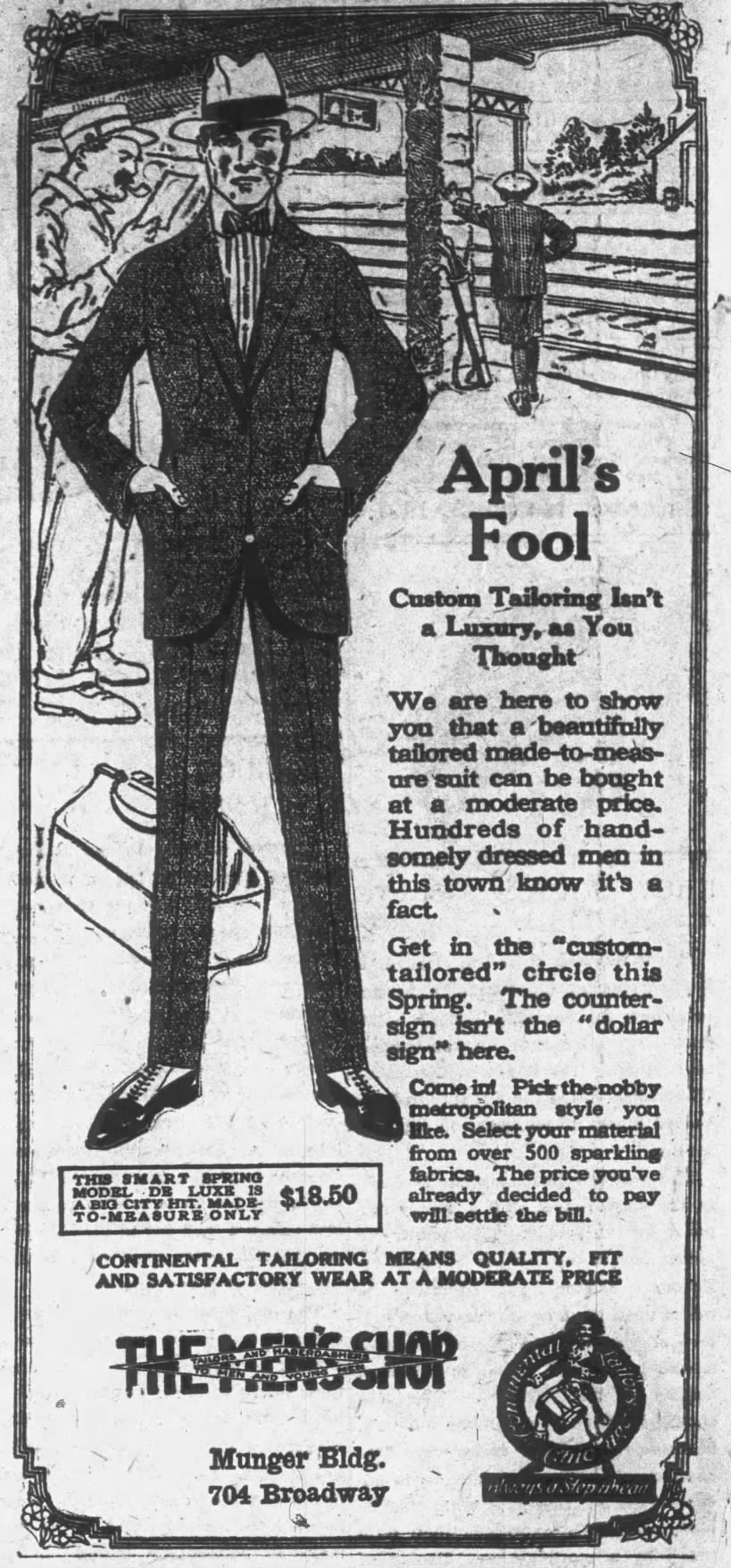
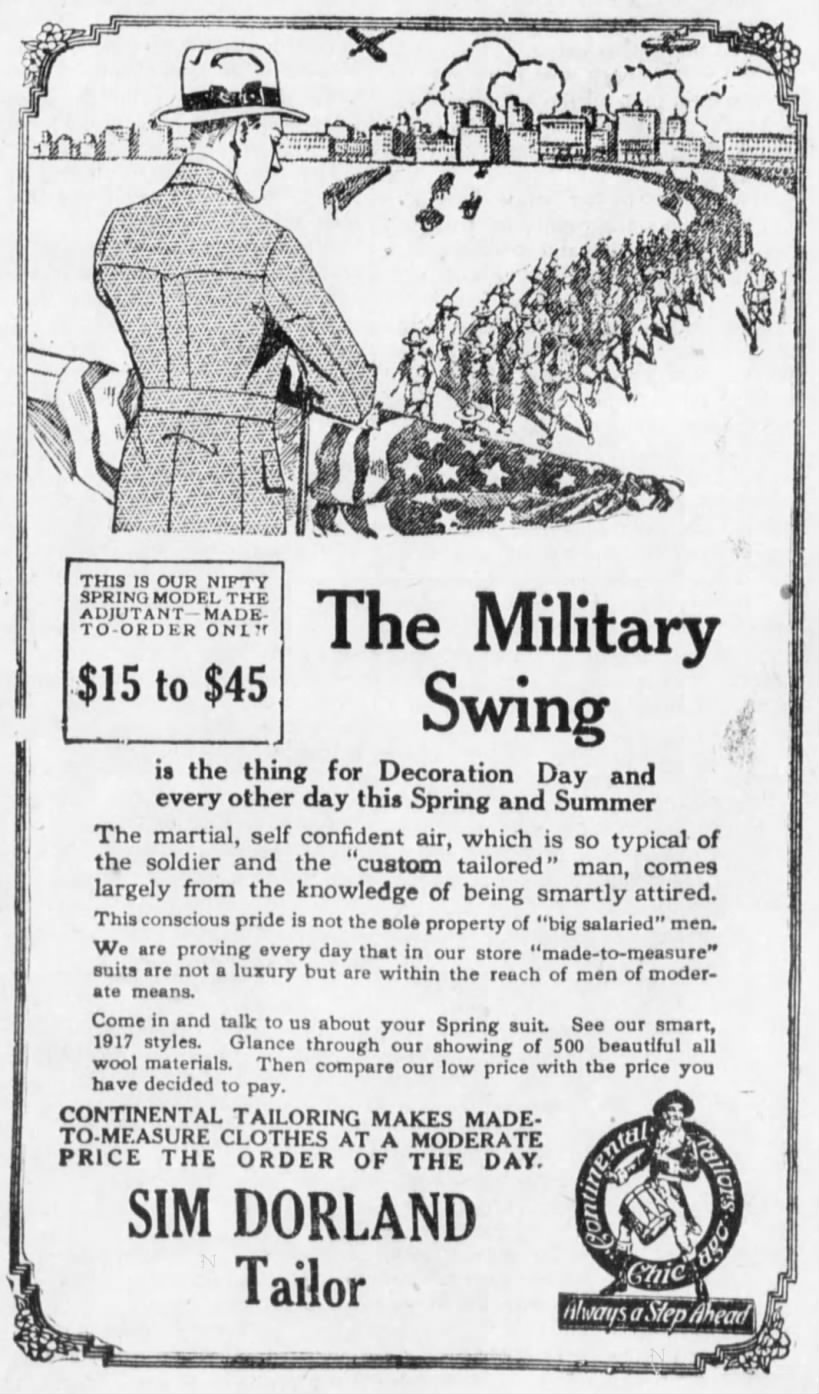
The affordable suit became a moralized commodity, proof that one could be both fashionable and patriotic. Continental’s messaging aligned perfectly with a broader cultural redefinition of masculine respectability. The oversized, heavily padded coats of the prewar elite gave way to leaner, more functional silhouettes that suggested energy, restraint, and purpose, the visual language of the self-made, industrious American man.
Bibliography
Amalgamated Clothing Workers of America, Research Dept. The Clothing Workers of Chicago 1910-1922. Chicago: The Chicago Joint Board, Amalgamated Clothing Workers of America, 1922. https://hdl.handle.net/2027/uc1.$b39176.
Bae, Youngsoo. “Clothing and Garment Manufacturing.” Encyclopedia of Chicago. Chicago Historical Society. Last modified 2005. http://www.encyclopedia.chicagohistory.org/pages/300.html.
Blue Book of Chicago Commerce 1918-1919. Chicago Association of Commerce, 1918. https://hdl.handle.net/2027/uiug.30112051370689.
“Careful Dealer Co-operation That Is Earning a Rich Reward.” Judicious Advertising, 25-29. https://hdl.handle.net/2027/uiug.30112077179437.
Chicago Examiner (Chicago). “Real Estate Transfers.” November 11, 1911. https://www.newspapers.com/article/chicago-examiner-move-in-to-700w-jackson/182397929/.
Chicago Tribune (Chicago). “New Illinois Corporations.” May 16, 1890. https://www.newspapers.com/article/chicago-tribune-second-source-for-date-m/182397043/.
Cobrin, Harry A. The Men’s Clothing Industry: Colonial Times Through Modern Times. New York: Fairchild Publications, Inc., 1970.
Continental Tailors, and Bob the Hatter Ochs-Kramer Co. “Give Credit.” Advertisement. The Daily Times (Davenport, Iowa), March 9, 1915. https://www.newspapers.com/article/the-daily-times-ad-3/182399289/.
Continental Tailors, and Ford Shook Specialty Shop. “Save Lots of Money.” Advertisement. Fort Worth Star-Telegram (Fort Worth, Texas), December 17, 1915. https://www.newspapers.com/article/fort-worth-star-telegram-ad-4/182399496/.
Continental Tailors, and H.J. Loeb Men’s and Boy’s Furnisher. “The Continental Tailors Fall Season Opens Today.” Advertisement. The Punxsutawney Spirit (Punxsutawney, Pennsylvania), August 25, 1916. https://www.newspapers.com/article/the-punxsutawney-spirit-ad-1/182399037/.
Continental Tailors, and Lathrop & Emerson. “The Continental Tailors Fall Season Opens Today.” Advertisement. The Daily Ardmore (Ardmore, Oklahoma), August 25, 1916. https://www.newspapers.com/article/the-daily-ardmoreite-ad-1/182398966/.
Continental Tailors, and Lewis Tailoring & Cleaning Works. “The Continental Tailors Fall Season Opens Today.” Advertisement. Hutchinson News (Hutchinson, Kansas), August 25, 1916. https://www.newspapers.com/article/hutchinson-news-ad-1/182398907/.
Continental Tailors, and Meyfarth & Johnson. “Save Lots of Money.” Advertisement. Jackson Citizen Patriot (Jackson, Michigan), January 10, 1916. https://www.newspapers.com/article/jackson-citizen-patriot-ad-4/182399462/.
Continental Tailors, and M.J. Skofstad. “I Tell You.” Advertisement. Lawrence Daily Journal (Lawrence, Kansas), November 20, 1915. https://www.newspapers.com/article/lawrence-daily-journal-world-ad-2/182399108/.
Continental Tailors, and R.W. Hoppe. “The Continental Tailors Fall Season Opens Today.” Advertisement. Green Bay Press-Gazette (Green Bay, Wisconsin), August 25, 1916. https://www.newspapers.com/article/green-bay-press-gazette-ad-1/182398943/.
Continental Tailors, and University Tailoring Co. “Save Lots of Money.” Advertisement. Colombia Missourian (Columbia, Missouri), December 16, 1915. https://www.newspapers.com/article/fort-worth-star-telegram-ad-4/182399496/.
Continental Tailors, and Winter Bros. “I Tell You.” Advertisement. New Castle News (New Castle, Pennsylvania), October 22, 1915. https://www.newspapers.com/article/new-castle-news-ad-2/182399145/.
Continental Tailors, and W.W. McVay. “Give Credit.” Advertisement. Journal Gazette and Times-Courier (Mattoon, Illinois), February 26, 1915. https://www.newspapers.com/article/jg-tc-journal-gazette-and-times-courier/182399254/.
Dockham’s American Report and Directory of the Textile Manufacture and Dry Goods Trade 1918-1919. 26th ed. Boston: Dockham Publishing Company, 1919. https://hdl.handle.net/2027/nyp.33433108193313.
Herringshaw, Mae Felts, ed. Herringshaw’s City Blue Book of Biography; Chicagoans of 1919. Chicago: Clark J Herringshaw, 1919. https://hdl.handle.net/2027/nyp.33433102118837.
Hill, Daniel Delis. American Menswear : from the Civil War to the Twenty-first Century. 2nd ed. Texas Tech University Press, 2024.
The Inter Ocean (Chicago). “New Corporations.” May 16, 1890. https://www.newspapers.com/article/the-inter-ocean-founding-date-continenta/182396899/.
McCoy, Michelle, and Andrea P. Telli, eds. “Trade Catalog Collection.” Chicago Public Library. Last modified 2022. https://www.chipublib.org/fa-trade-catalog-collection/.
Sanborn Fire Insurance Map from Chicago, Cook County, Illinois. Sanborn Map Company, Vol. 1, North And West Division, 1906. 83. Map. https://www.loc.gov/item/sanborn01790_018/.