The Distinctive Unit Insignia and Shoulder Sleeve Insignia of the 28th Infantry Division, Pennsylvania National Guard is a red Keystone, the symbol of the state of Pennsylvania. Shoulder sleeve insignia are emblems worn on the shoulders of US Army uniforms to identify the primary headquarters to which a soldier is assigned.
The 28th Infantry Division the oldest division-sized element in the United States Army. Some of the units within division trace their lineage to a battalion that Benjamin Franklin established, The Pennsylvania Associators (1747–1777). The division itself was officially established in 1879 and was later redesignated as the 28th Division in 1917 and the entry of the United States into the First World War.
It was originally designated the “Keystone Division,” formed from units of the Pennsylvania Army National Guard and the Commonwealth being known as the “Keystone State.” During World War II, it was given the nickname the “Bloody Bucket” division by German forces.
In July 1944, six weeks after D-Day, the Twenty-Eighth landed in Normandy and entered combat in French hedgerow country, pushing the German defenders back inch by inch. In August, the Division moved on Paris, from which the Germans readily retreated. By 19 August, 833 German prisoners were in the hands of the Twenty-Eighth. As a result of their victorious experiences, noting the fierceness of the Twenty-Eighth’s attacks, the Germans nicknamed the division the “Bloody Bucket,” after its red keystone shoulder patch.
The new nickname was not officially promoted—it actually was frowned upon by Army authorities—many in the 28th Infantry Division still proudly use it. Today though, the use of the World War II moniker is discouraged as it is believed it does not give justice to the Soldiers who fought in the Hürtgen Forest, and the 28th Infantry Division goes by the name given to it by General Pershing during World War I: The “Iron Division.”
Over the decades, there have been 27 different military colleges which opened in Pennsylvania, though few remain. These institutions helped to maintain the United States Army’s Officer Corps. Cadets as these schools wore, and continue to wear, uniforms patterned after what was worn by U.S. Army and Pennsylvania National Guard personnel of the day. In the Shippensburg University Fashion Museum and Archives, two such specimens are in the archive.
The uniforms of the U.S. Army have changed over the decades as fabrics, styles, and utility changed. Conversely, the uniform of the Pennsylvania Military College did not, demonstrating heritage, tradition, and regimentation key to young people becoming military leaders.
The shoulder sleeve insignia can trace its lineage to 1917, the division to 1879. It was also featured in the movie “When Trumpets Fade,” about the battle in the Hürtgen Forest. The Keystone of the Pennsylvania National Guard is far more than just the “Bloody Bucket”
The Shippensburg University Fashion Museum and Archives contains over a dozen examples of U.S. Army uniforms from the 20th Century, as well as two specimens from the now closed Pennsylvania Military College, at one time a top-tier preparatory program for U.S. Army officers.
Click on any of the photos below for a larger version of the image.
 |
 |
 |
|---|
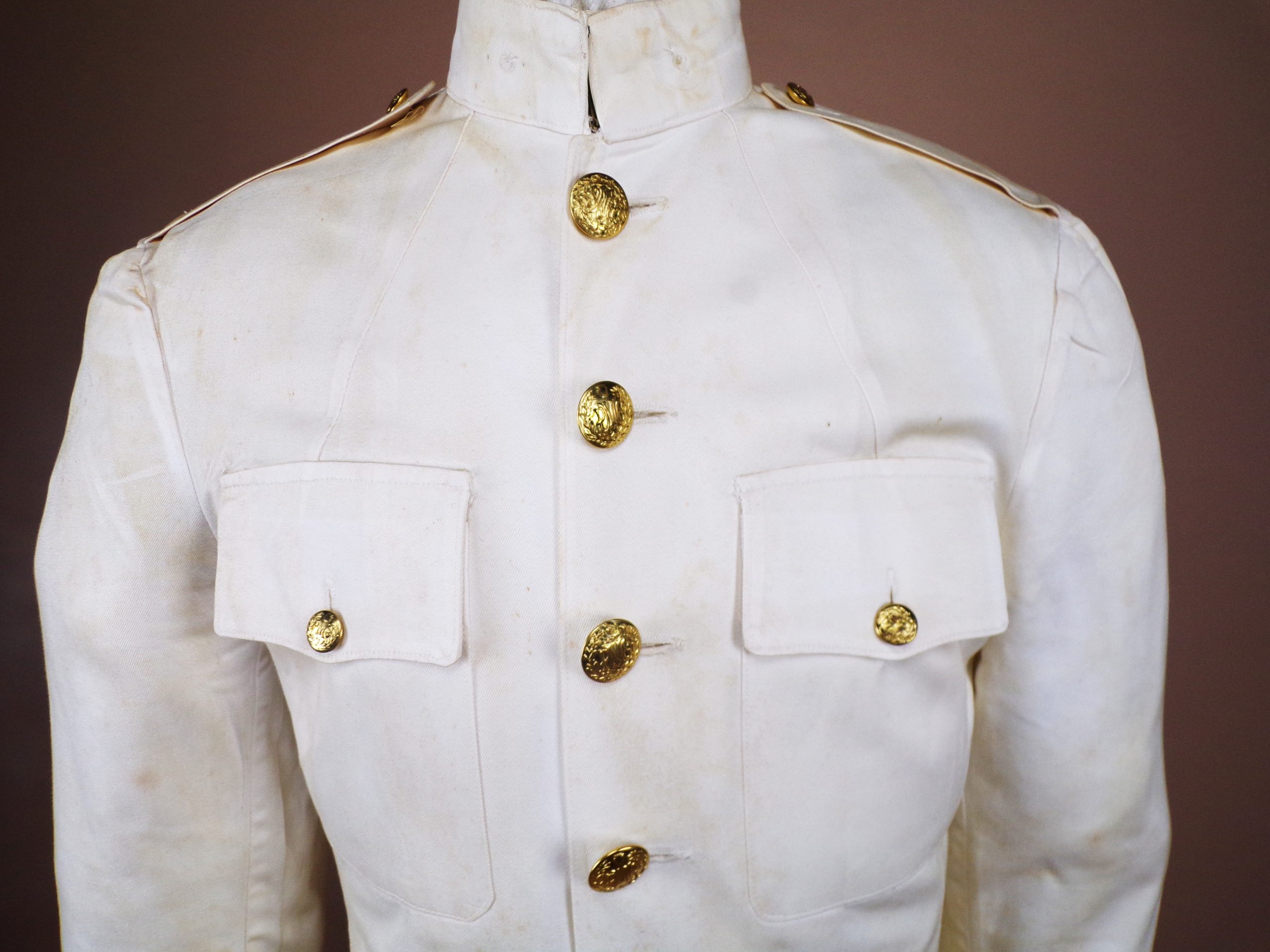
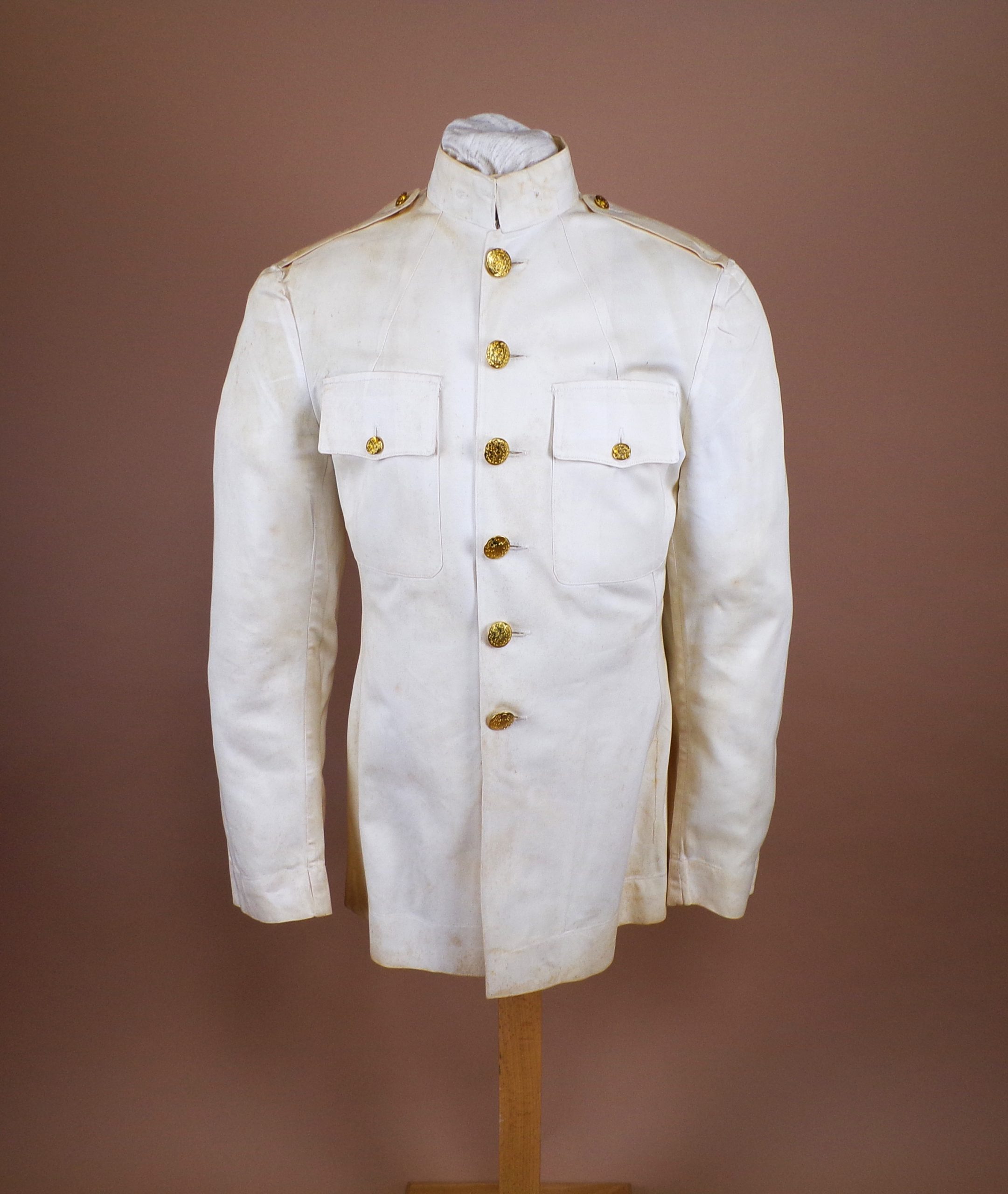
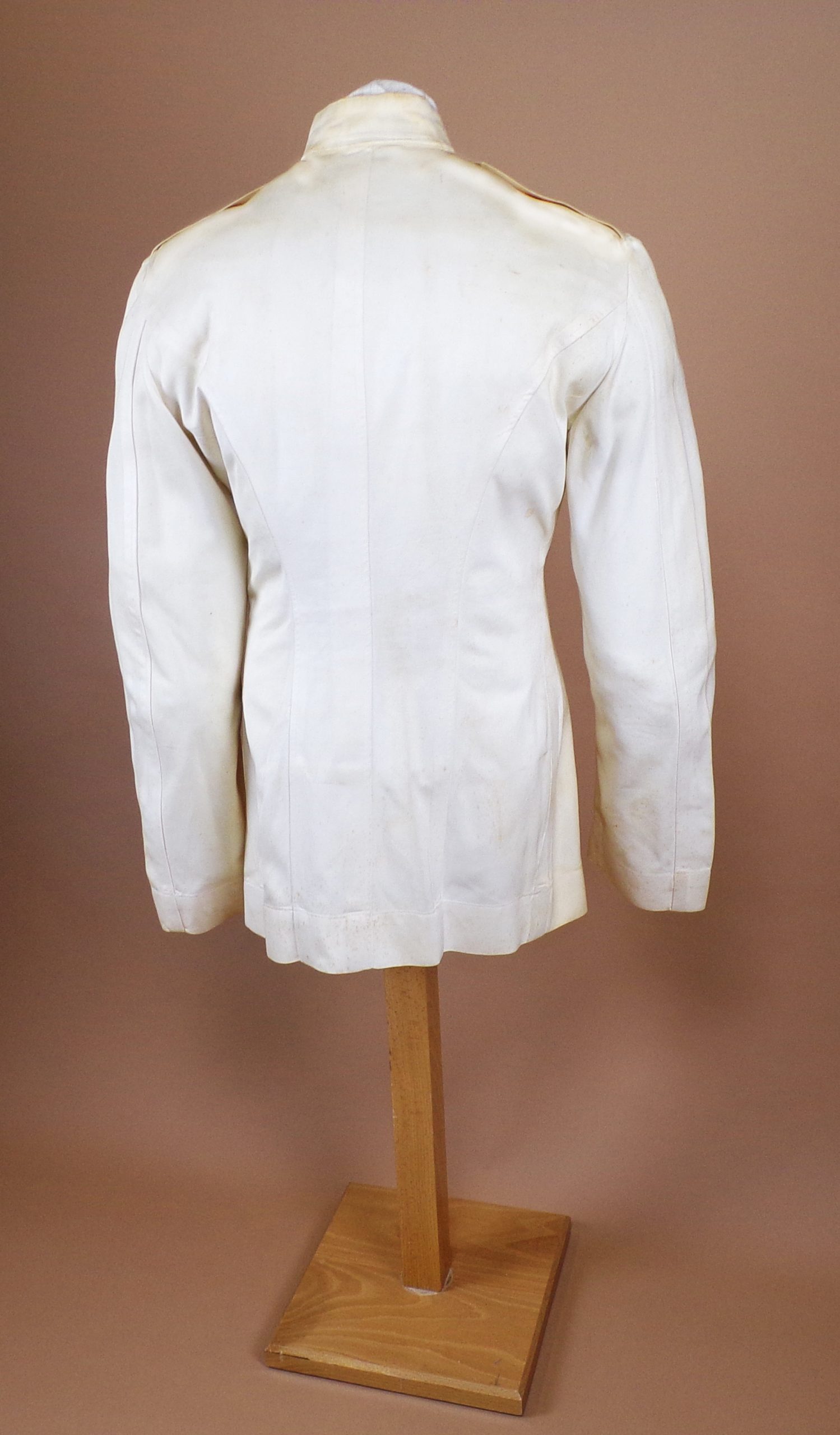
The pictured item, a “Dress White” shirt from the Pennsylvania Military College (PMC), is estimated to have been made at some point between 1890 and 1930. Its fabric consists mostly of cotton and linen, with six brass buttons down the middle and one in each breast pocket, reading “PMC.” The shirt shares many similarities with the U.S. Military Academy’s dress whites, and with the formal uniforms worn by ranking officers of the United States Military around this time. Pictured below is such an example: a Major from the Marine Corps during the Second World War, wearing his dress white uniform.
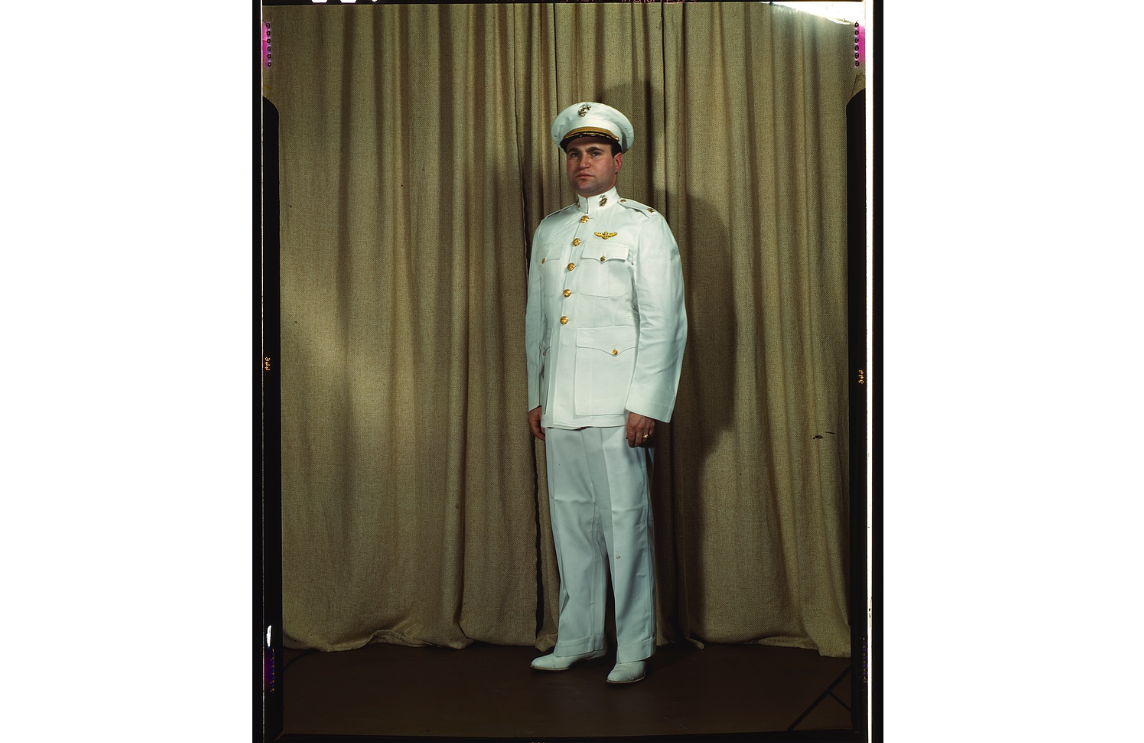
Courtesy of the Library of Congress.
While the style is certainly indicative of the time in which it was made, the PMC dress white also represents a grim period in United States history. Its estimated time of creation falls squarely in the rise of the Jim Crow Era, following the Plessy v. Ferguson trial of 1896, in which the Supreme Court reinforced the States’ ability to enact segregation laws that severely damaged the quality of life for African Americans nationwide.
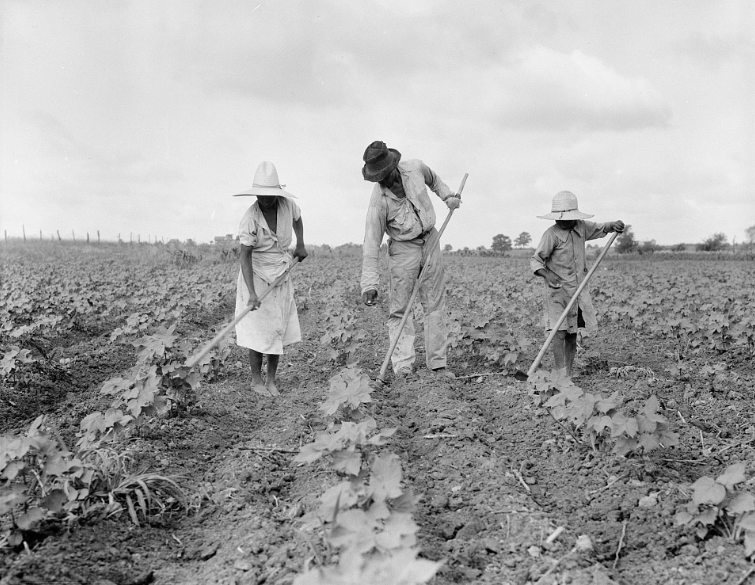
Cotton, in particular, became an all-too familiar field of oppression for African Americans in this time. The top cotton-producing States in the Union were still in the Deep South, with many of the major plantations having been inherited by the descendants of former slave-owners (Dattel, “Cotton and the Civil War.”). Due to Jim Crow laws preventing African Americans from legally fighting against injustices (US Department of Agriculture. “Black Farmers in America, 1865-2000”, 4), it became all too easy for African American labor to be exploited in places such as Georgia and Alabama – two of the three highest-producing cotton States in the Union.
According to the 1900 Census, African Americans in Georgia – the second-highest cotton-producing State (1900 Census: Bulletin 98, 2) – were roughly 47% of the total population (1900 Census, Volume 1, Part 3, page cxi), and a majority of the agricultural labor force (1900 Census Special Reports: Occupations at the Twelfth Census, 157), yet constituted only 11% of the total farm-owners in the State (1900 Census: Bulletin 181, 5). Cotton farms in particular were predominantly worked by African Americans in Georgia, with a majority being cash tenants who paid rent to live and work on farms, share tenants who paid rent with a share of what they harvested, or mixed-contract tenants (1900 Census: Bulletin 181, 5). These conditions were consistent across the South, such as in Alabama – the third-highest cotton-producing state – where three-fourths of all cash tenants were African American (1900 Census: Bulletin 155, 5). It was also not uncommon for African American farmers to be caught into debt traps and forced to work for White farmers to pay off their debts (US Department of Agriculture. “Black Farmers in America, 1865-2000”, 4).
In short: while the dress shirt from the Pennsylvania Military College may be of a fine design that reflects the trends of its era, it is also reflective of the Jim Crow Era. It is not unlikely that the cotton used in the production of this shirt was grown and harvested by exploited African American labor. This a phenomena that one should consider when viewing any historical item in the United States – that they can often be an example of a wider-spread historical trend, rather than just be an isolated object. The next object in our inventory, the PMC’s “Delta” Uniform jacket is very much an example of this as well in its own way.
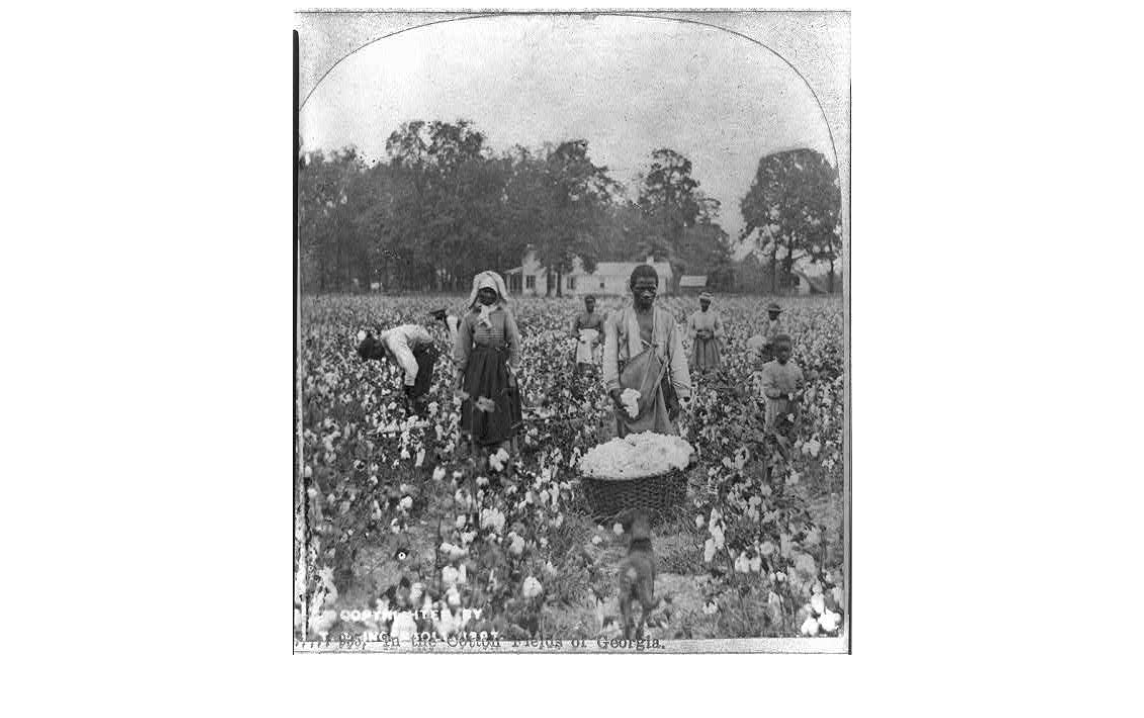
African American Cotton Farmers in Georgia, circa 1898 – Two Years After Plessy v. Ferguson. Photo courtesy of the Library of Congress. |
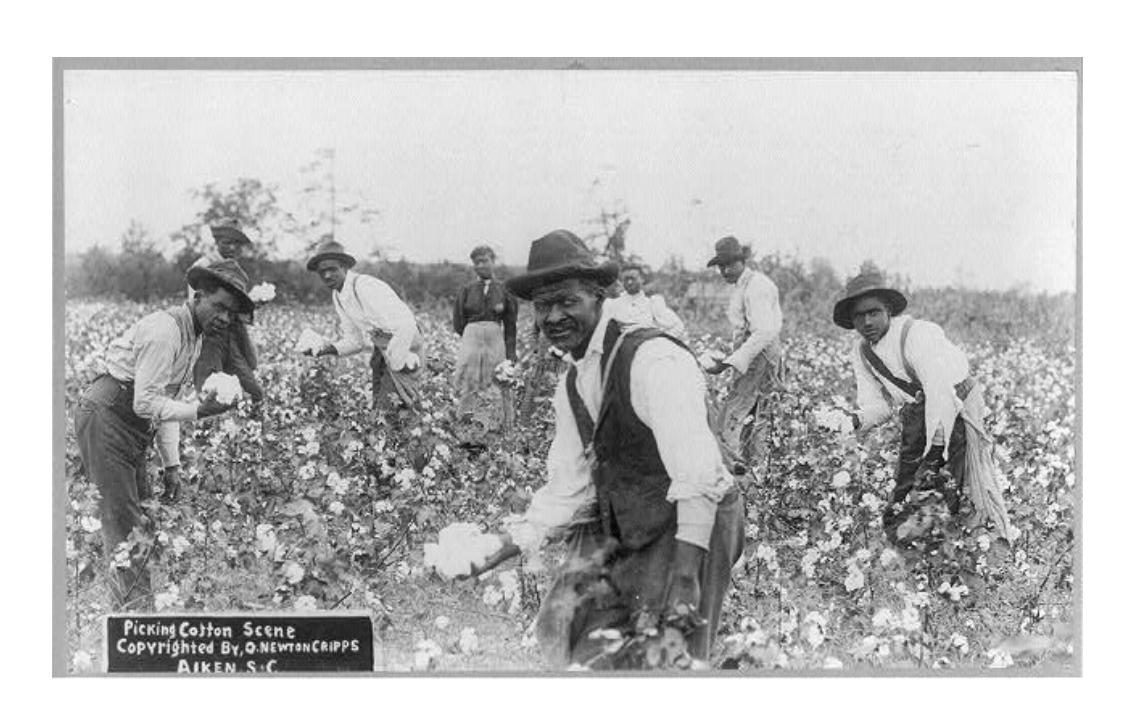
African American Cotton Farm Workers, South Carolina, circa 1902. Photo courtesy of the Library of Congress. |
African American Tenant Farmer and His Family Hoeing Cotton in Alabama, circa 1936. Photo courtesy of the Library of Congress. |
||
|---|---|---|---|---|
 |
 |
 |
|---|
 |
 |
|---|
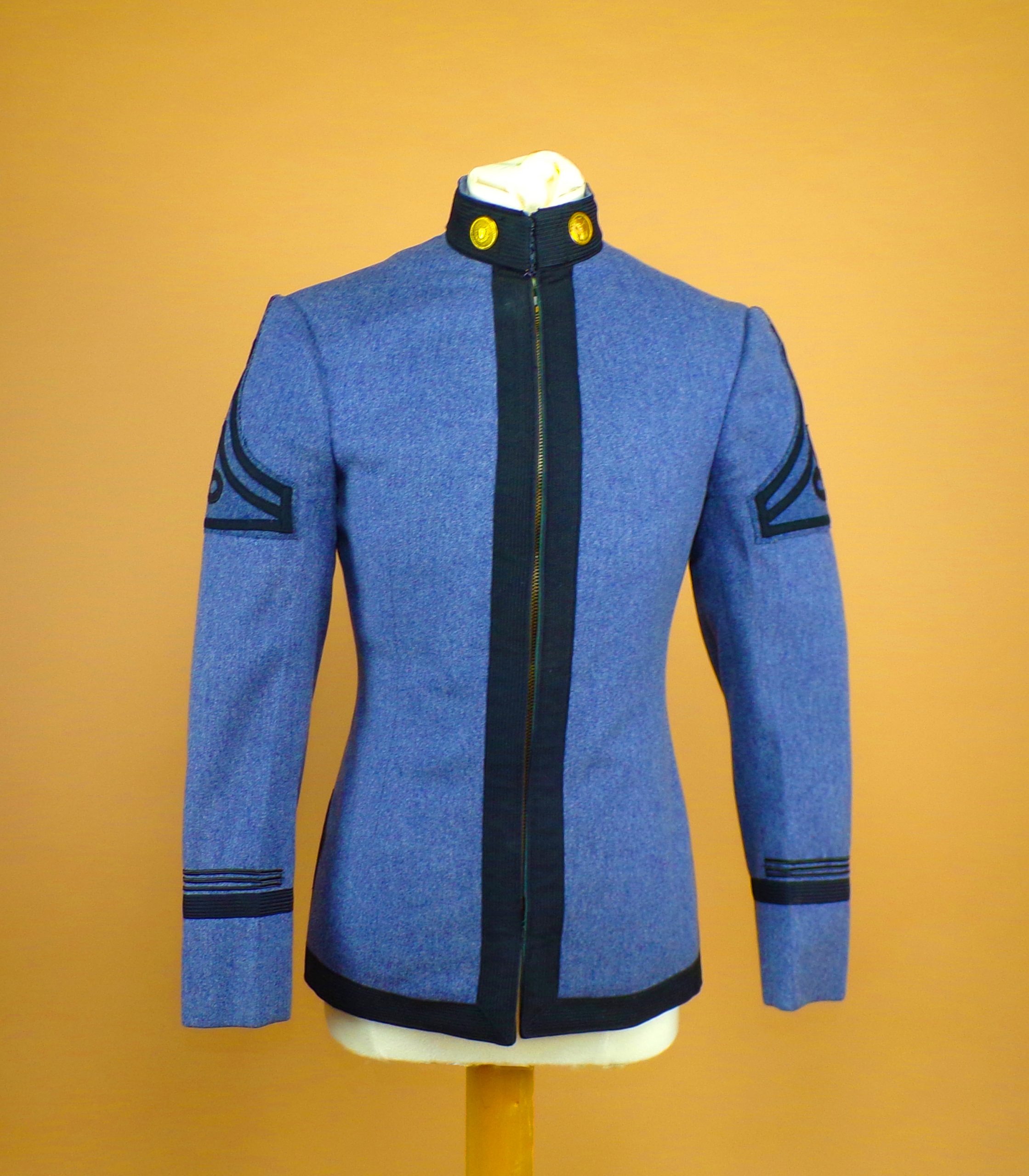
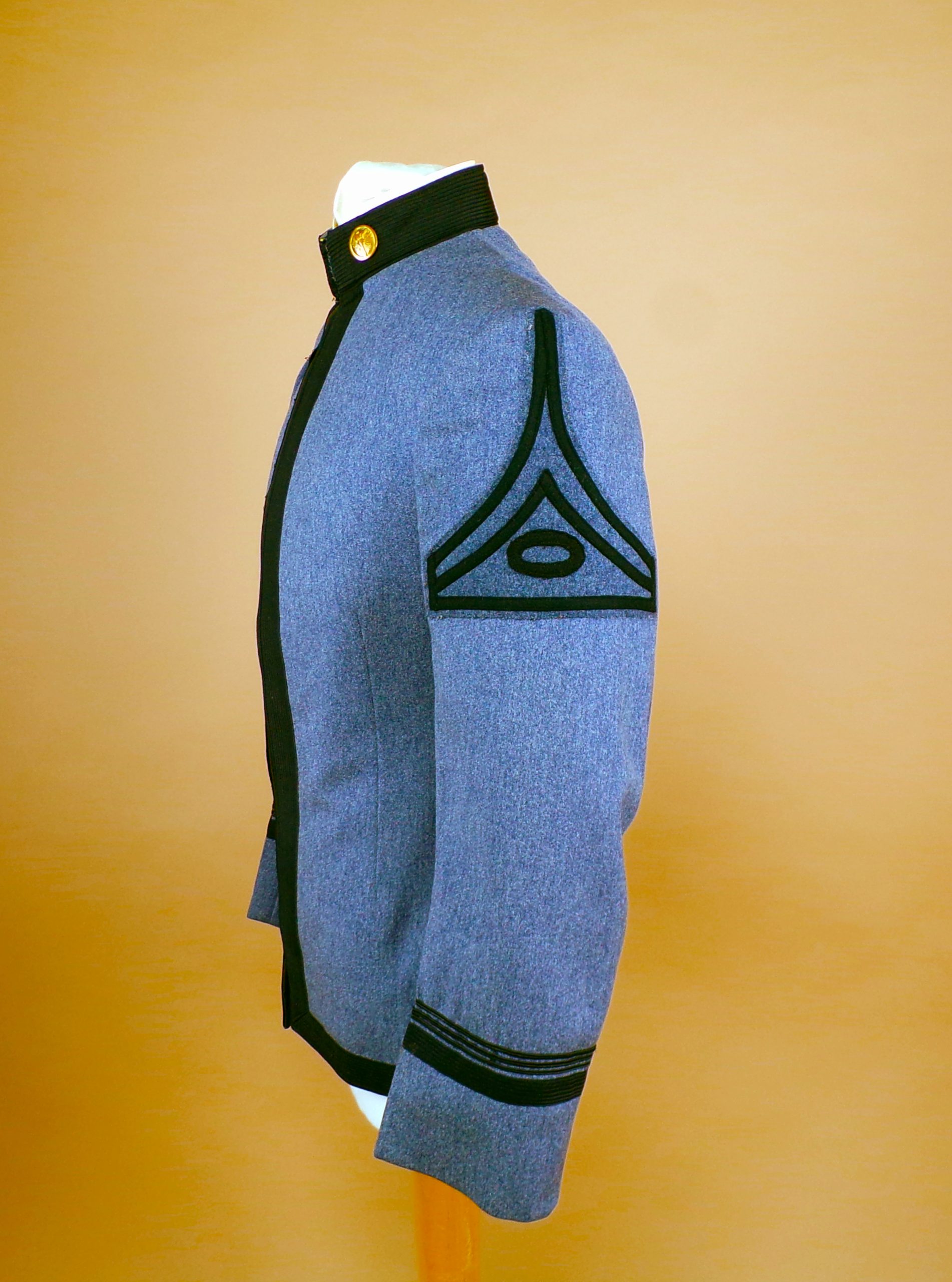
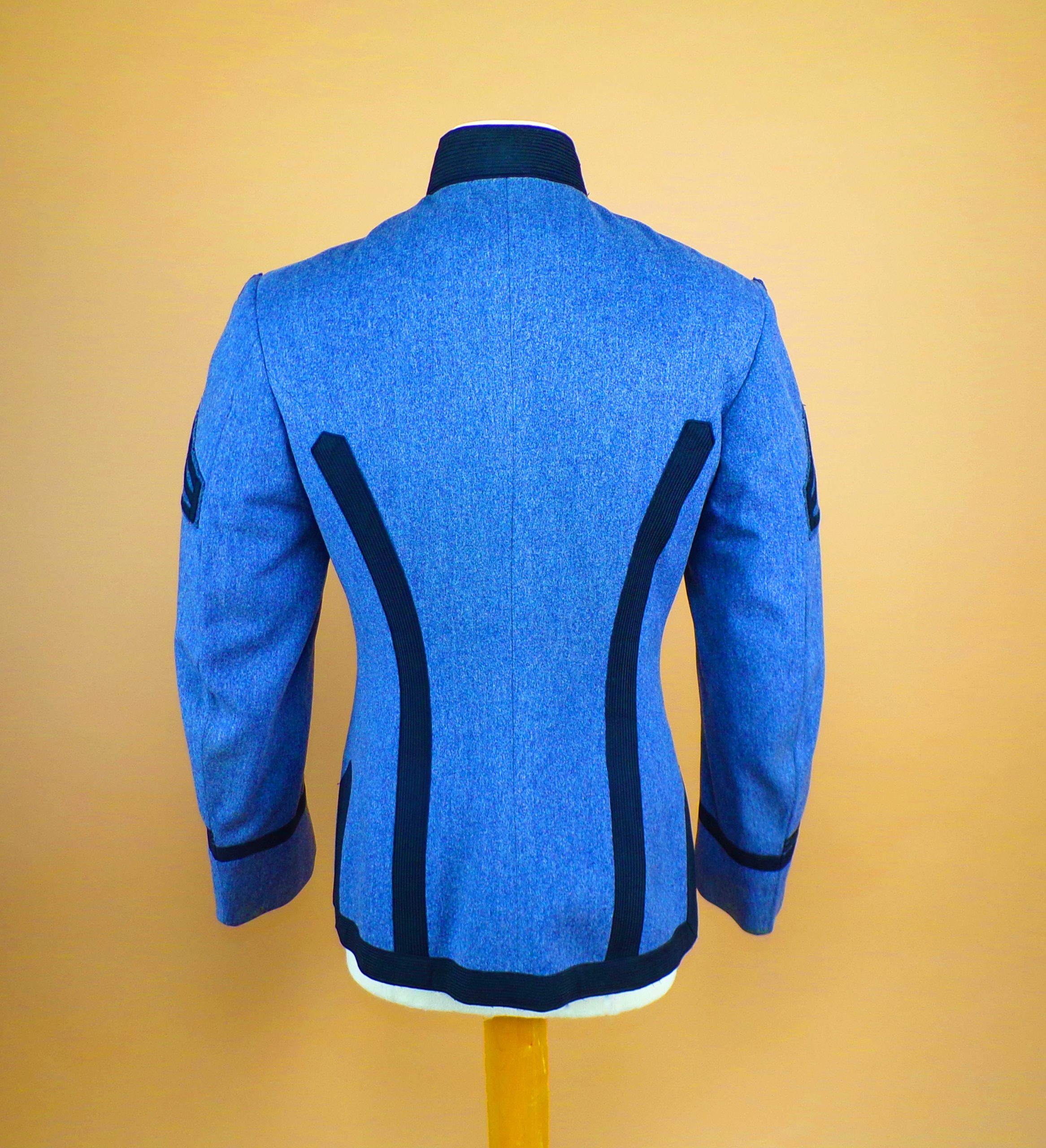
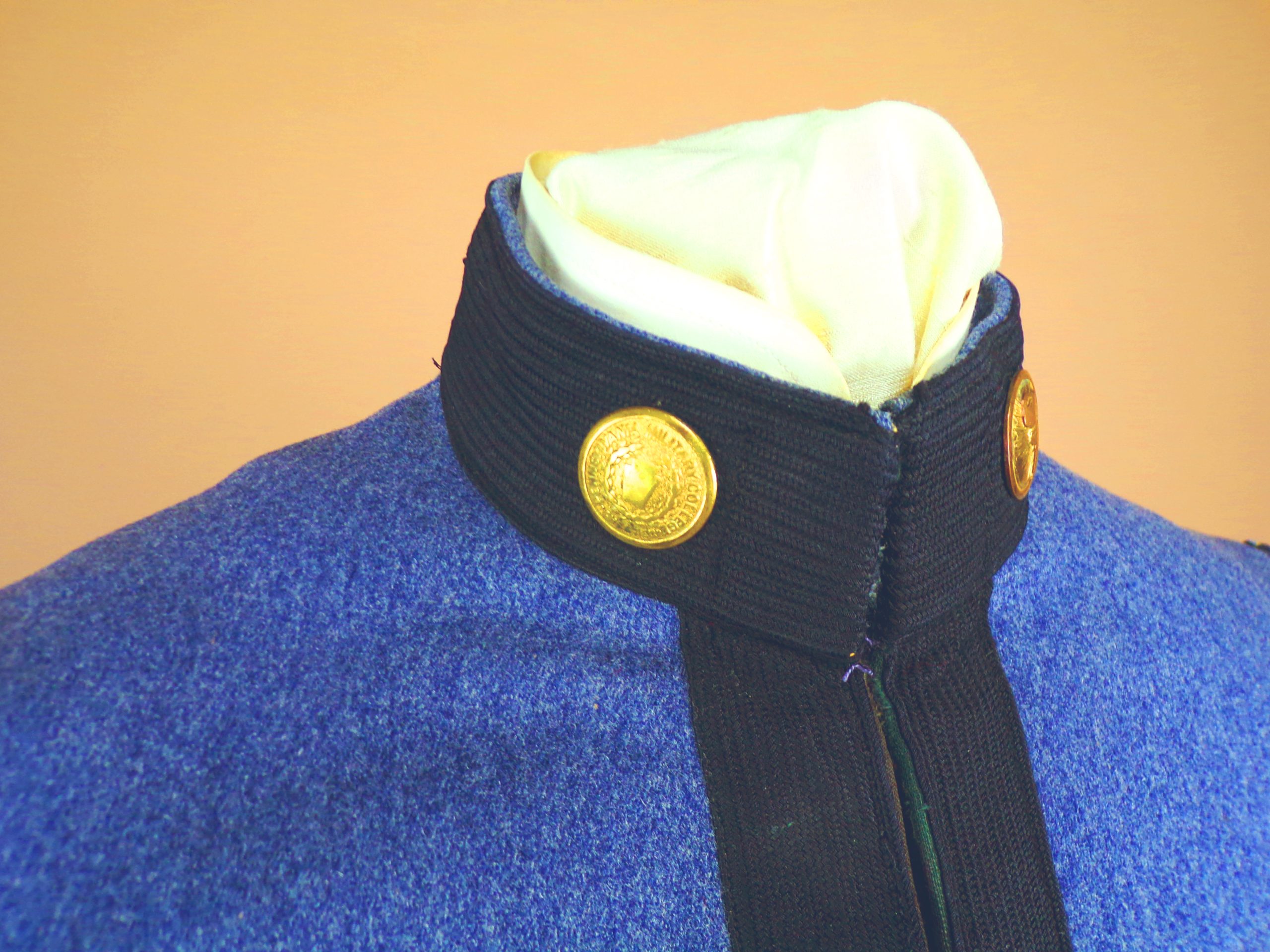
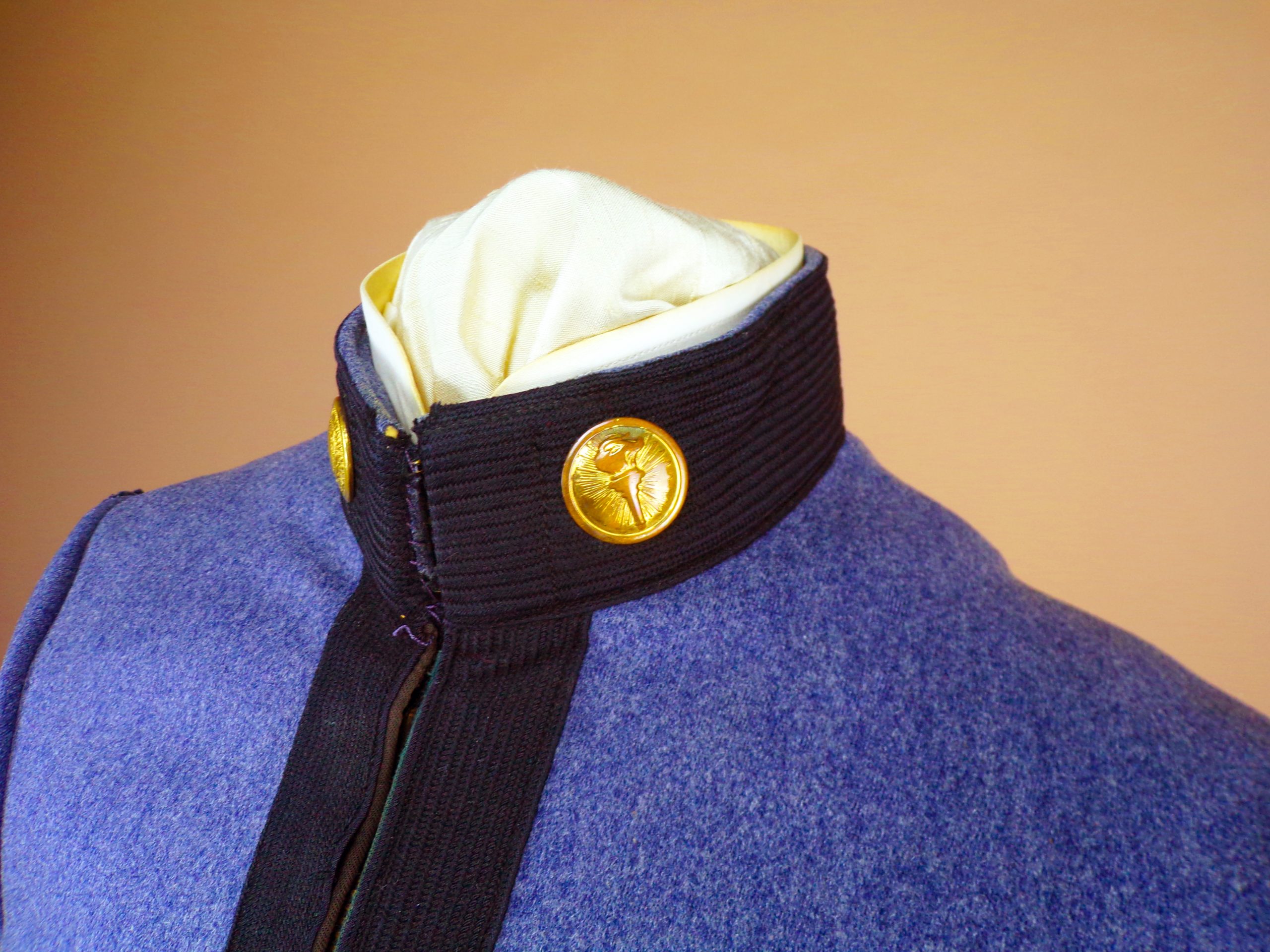
The above item, the “Delta” uniform jacket worn by cadets at the Pennsylvania Military College until its closing in 1972, is relatively more modern than the dress white featured before. Dated to 1960, the jacket is almost entirely felt wool, with two brass buttons at the collar signifying it as being from the PMC (note the keystone on the right-hand button), and a zipper down the middle of the jacket hidden by the vertical black stripes. The wool was supplied by Charlottesville Woolen Mills, a Virginia company, and the jacket was sewn on campus; each uniform was tailor-made for the cadet who wore it (The Friends of PMC, “Cadet Uniforms”). This type of jacket was well-suited for the cold winter weather of the Northeast, and kept the cadets warm through the frigid months of the Fall and Spring semesters when they carried out their responsibilities.
Each cadet was also expected to have a a “cadet gray” dress uniform of high collared, tailed coat with both gray and white trousers. The daily dress for classes and on campus consisted of a collared, long sleeved, gray cotton dress shirt, black tie, and the gray woolen trousers. Cadets wore their dress gray uniform trousers and a gray flannel shirt, later replaced by lighter weight material.
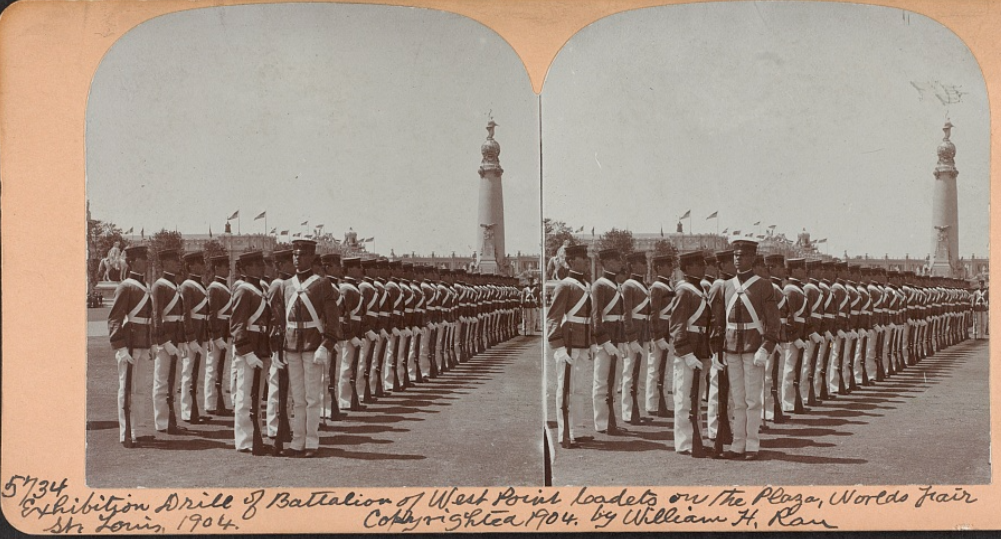
Despite dating to 1960, much closer to the present, the design of the jacket harkens to a then-longstanding design trend of winter jackets in military academies and colleges nationwide. No better example exists of the United States Military Academy’s (shortened hereon to USMA) dress grey jacket from this time period, a woolen coat with nearly identical features – save for the buttons. The below picture, a stereograph dated to 1904 – over half a century before the delta jacket was tailored and sewn for the PMC cadet – features USMA cadets wearing similar grey blouses performing a parade at the St. Louis, Missouri World’s Fair.
Courtesy of the Library of Congress.
Not only does this image help one to understand the origins of the jacket’s design and how the uniform as a whole looked, but it also shines a light onto a similar revelation as one could find in the dress white shirt. These pieces of clothing, and any historic object that someone might come across, are almost never items of their own isolated nature. They are deeply connected to other parts of history, whether that connection be to the exploitation of African Americans in the United States or to the firmly-established traditions, trends, and fashion norms shared by the United States’ many military academies.
As one continues through this article, keep in mind that the clothing featured is more than just a piece of apparel. It is a story: of the laborers who sweated to harvest the fabric; of the tailors who measured the soldiers, sailors, marines, and airmen, and sewed their uniforms; of the service members themselves who wore the uniform in their pursuit to serve and protect their country; and of the long, over-arching history of the military as a whole, in all its theatres and decades.
|
For additional information on the topics on this page, please visit the sites indicated to the right. |
|
|
|---|---|---|
Examples of uniforms of the U.S. Army worn by the Soldiers of the 28th Infantry Division and cadets of the Pennsylvania Military College not contained within the Fashion Archives collection.
|
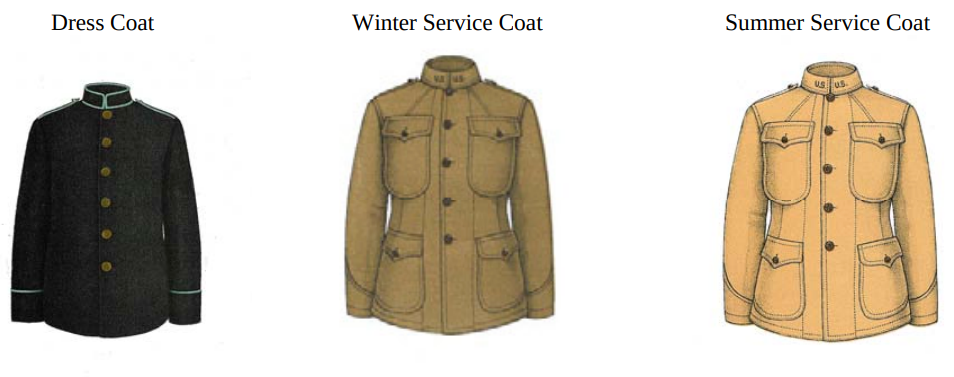
Shown to the right is a selection of enlisted uniform coats as depicted in the supplement accompanying the Regulations of the Army of the United States, 1908. The enlisted soldier now had a dress winter service dress. summer service dress, fatigue uniform and, tropical service dress. The new winter service coat was made of olive drab wool, with a five button front closure, four patch pockets, and a stand and fall collar. Each sleeve had a pointed cuff applied of the same color and material as the coat. The service coat was retailored from the 1902 version, with a straighter stand and fall collar and bellows pockets. |
1908 | 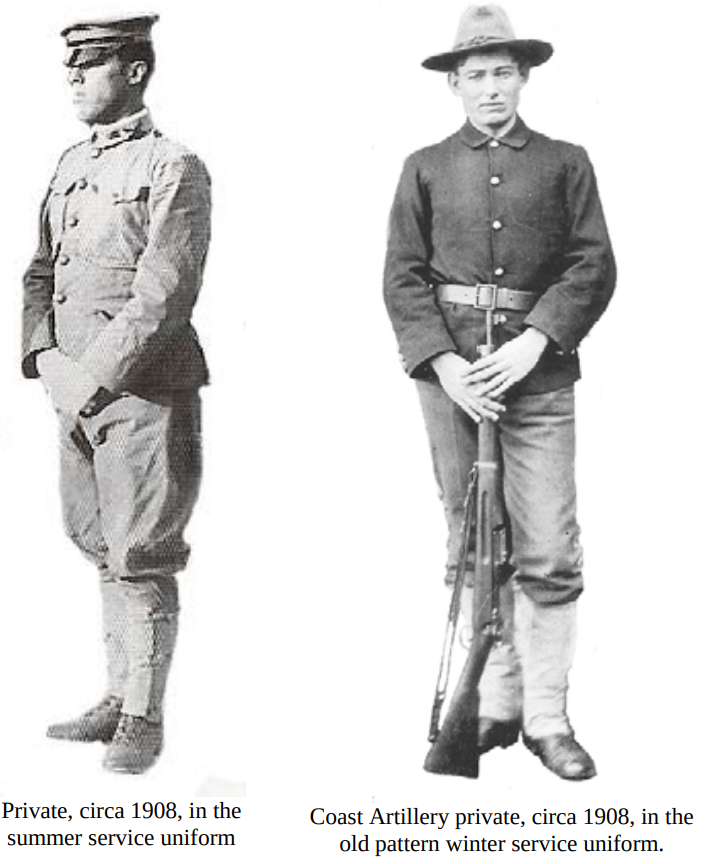 Courtesy of the United States Army Courtesy of the United States Army |
||
|---|---|---|---|---|
Courtesy of the United States Army |
1911 |
On 26 December 1911 the War Department again published Regulations for the Uniform of the United States Army. This publication provided guidance on how to wear the uniform. A second publication entitled The Uniform Specifications was published on 25 January 1913. This second publication specified exactly what the uniform would consist of. The summer service uniform was made of olive drab cotton drill and was unlined. The coat was single breasted with five removable bronze general service buttons in front. The buttons were a new pattern of bronze metal with a rimmed edge and lines behind the U.S. Coat-of-Arms. The coat had a standing collar; shoulder loops, plain cuffs; and four pockets in front, each with a flap secured by a small bronze general service button. Breeches of corresponding material and color were issued as part of the uniform. The winter service uniform was made of olive drab wool. The standing collar coat was lined, but in all other ways matched the summer uniform. Matching wool breeches had belt loops but the adjustment belt used previously in the back, was eliminated. |
||
|
World War I broke out in August 1914 and almost immediately began to have an impact on Army uniforms. Most notable was the color change to the wool service uniform because of the non-availability of German dyed wool. American manufacturers could not match the German formula for the olive drab color. The United States entered the war on 06 April 1917, and issue of the dress uniform was suspended. With millions of men entering the service, the tailoring of the wool service coat was simplified. |
1914 thru 1917 | 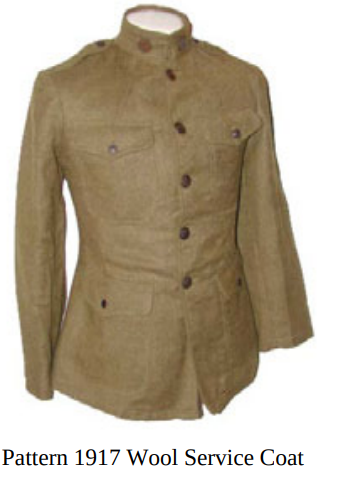
Courtesy of the United States Army |
||
Courtesy of the United States Army |
1926 |
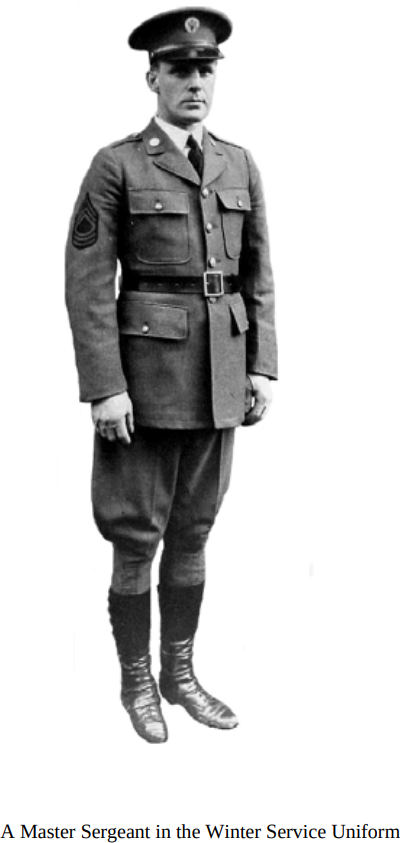
In December 1926, the look of both the summer and winter service coats was changed. The new coats were single breasted with four bright brass general service buttons, a roll collar and notched lapels. The winter coat could be worn with either the wool shirt or the khaki shirt along with a black four-fold service necktie. The summer coat was worn with the khaki shirt and the black service necktie.The rest of the uniform remained the same; a service hat or cap, russet leather garrison belt, breeches and spiral puttees or leggings depending on the type of unit and order of dress. The new uniform was intended for both field and garrison use. |
||
|
Class size begins increasing as a result of higher enrollments in the early 1940s. This growth coincides with the country’s preparations for World War II, when PMC offers a shortened war curriculum specifically to prepare young men for military service. This new program will bring relief to the school’s period of financial hardship caused in part by the Great Depression. |
1940 | 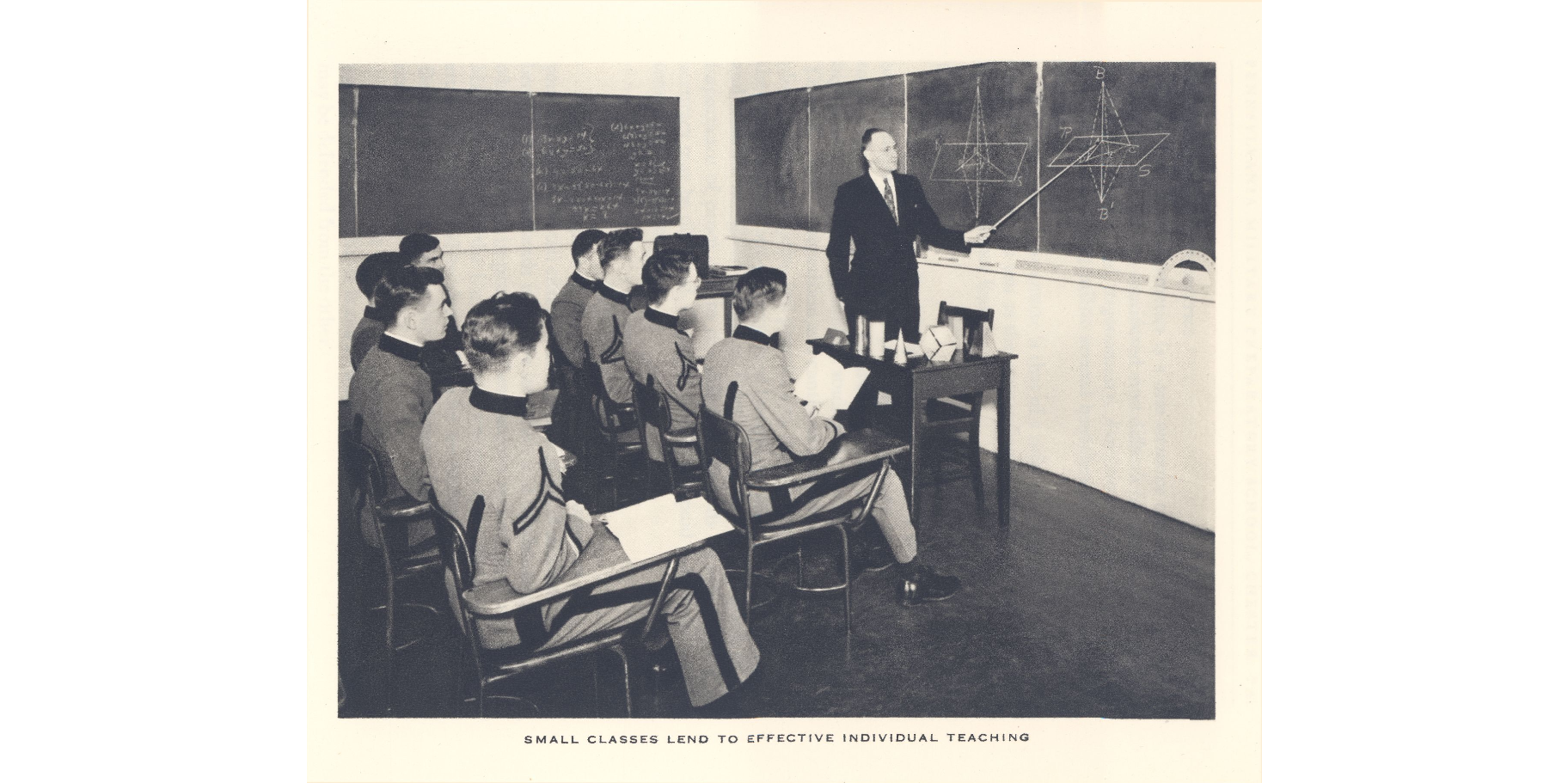
Courtesy of Widener University |
||
|
Courtesy of the United States Army |
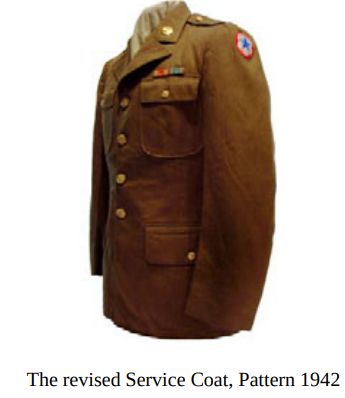
1942 |
By the beginning of 1942, the service coat was no longer seen as a field garment and was relegated to garrison and off-duty wear. In June the “Revised Service Coat” was adopted. It no longer had the bi-swing back and the lower pockets became a simplified interior type with an exterior flap.
|
||
|
The M-1943 uniform consisted of a waist length wool field jacket and trousers, both in olive drab shade 7. The new uniform was rarely used in the field, but by the end of 1944 it began replacing the four pocket coat and light shade trousers as the Army’s service uniform, and would come to typify the American soldier of the early 1950s. |
1943 | 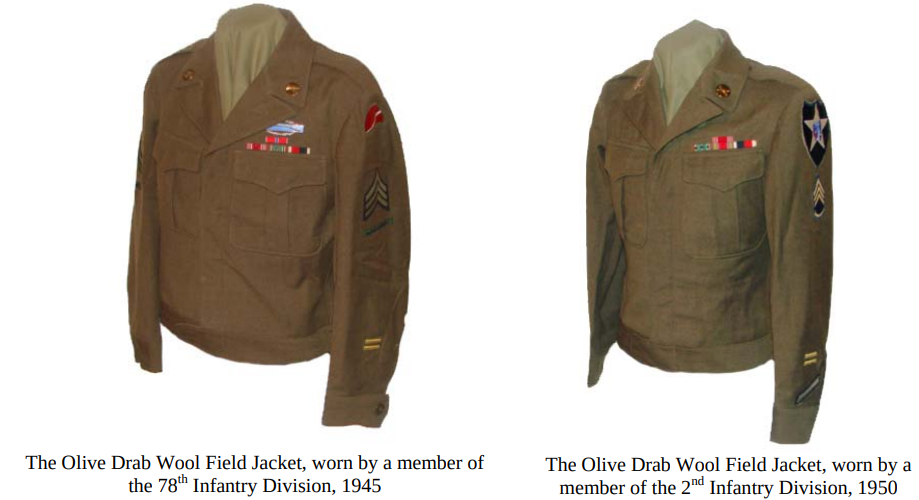
Courtesy of the United States Army |
||
Courtesy of the United States Army |
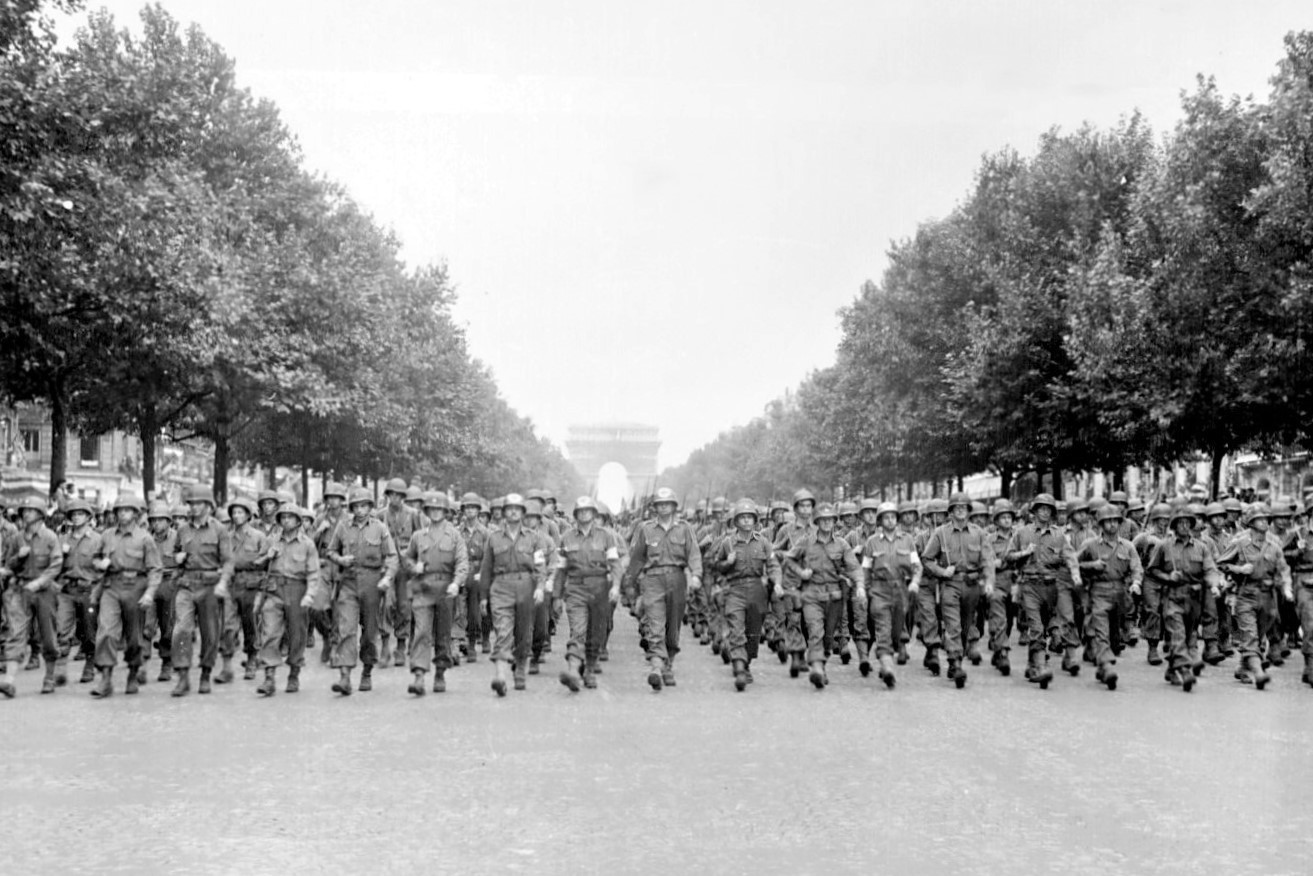
1944 |
Soldiers from the 28th Division march down the Champs-Elysées in Paris during a “victory parade” on 29 August 1944, during World War II. (U.S. Army Signal Corps photo) These Soldiers are wearing the M-1938 Uniform which was made of wool and Combat Boots with leather and web leggings. |
||
|
Soldiers from the 28th Infantry Division advance through the Hürtgen Forest in Germany on 02 November 1944, during the Battle of Hürtgen Forest. (U.S. Army photo by PFC G. W. Goodman) These Soldiers are wearing the M-1941 Uniform which was made of wool and flannel with poplin. Many soldiers of the 28th Infantry Division stopped wearing the division patch on their shoulders, after captured German prisoners told them to either remove it or smear mud on it, because they aimed for the bright red patch.
|
1944 | 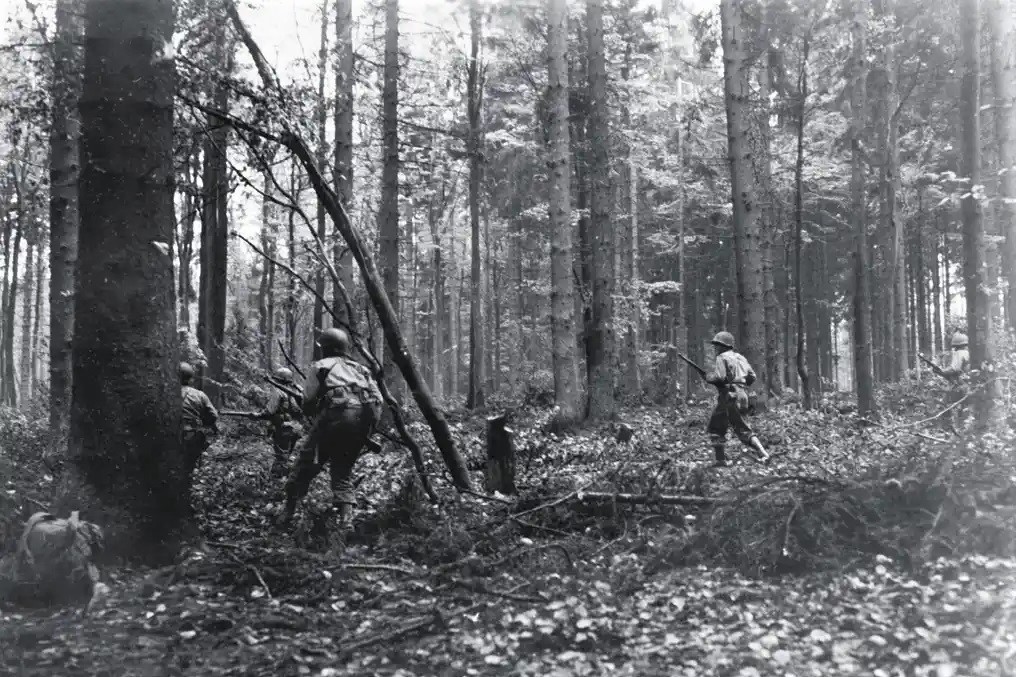
Courtesy of the United States Army |
||
Courtesy of the United States Army |
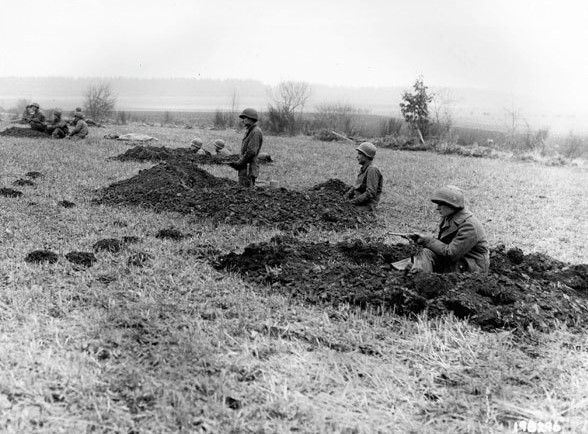
1944 |
Soldiers of the 28th Infantry Division who had been regrouped into security platoons for defense of Bastogne, Belgium, man fighting positions on 20 December 1944. Some of these Soldiers lost their weapons during the German advance in this area. (U.S. Army Signal Corps photo by Tech 5 Wesley B. Carolan) These Soldiers are wearing the M-1941 Uniform with overcoats, which were made of thick wool and flannel with poplin. |
||
|
In 1948, President Truman issues an executive order desegregating the Armed Services, and by 1953 the Department of Defense integrates its military schools. Pennsylvania Military College admits Charles Lowrie to the Prep School in 1954. In this photo, Lowrie is wearing the cadet Bravo uniform. |
1954 | 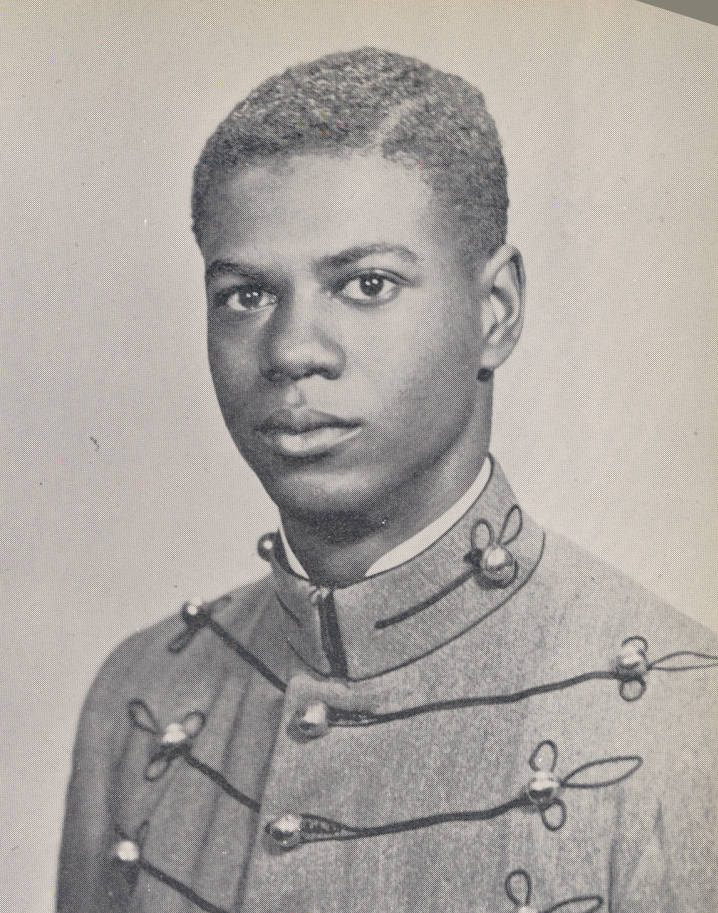
Courtesy of the Widener University |
||
Courtesy of the United States Army |
1954 |
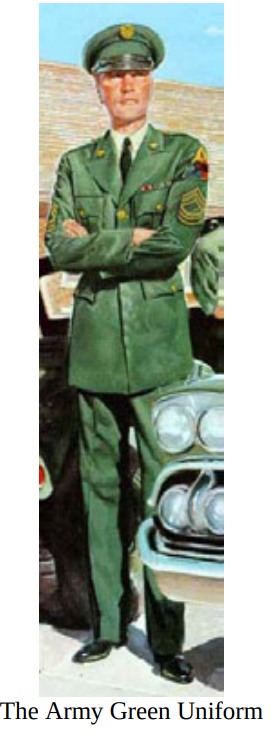
In 1954 the Army began to make changes to the uniform that it had been contemplating since just after the end of World War II. Although the changes were begun in 1954, it would take until the end of the decade before they were fully implemented. On 02 September 1954 the adoption of the Army Green Uniform in shade 44 was announced in Circular 102, but it was not until late 1957 before issues began to inductees. The green uniform became mandatory service dress in September 1961. The new coat was single breasted with four bright brass general service buttons in front, a roll collar and notched lapels. The uniform was to be worn with a light tan shirt, a black four-fold service necktie, black socks, black low quarter shoes and an Army green service cap with a black visor and chinstrap, or the Army green garrison cap piped in dark green. |
||
|
In this photo, the cadets at the Pennsylvania Military College demonstrate the wear of the various uniform sets proscribed by school regulations. The only uniform set not presented is the “Dress White” combination. |
1955 | 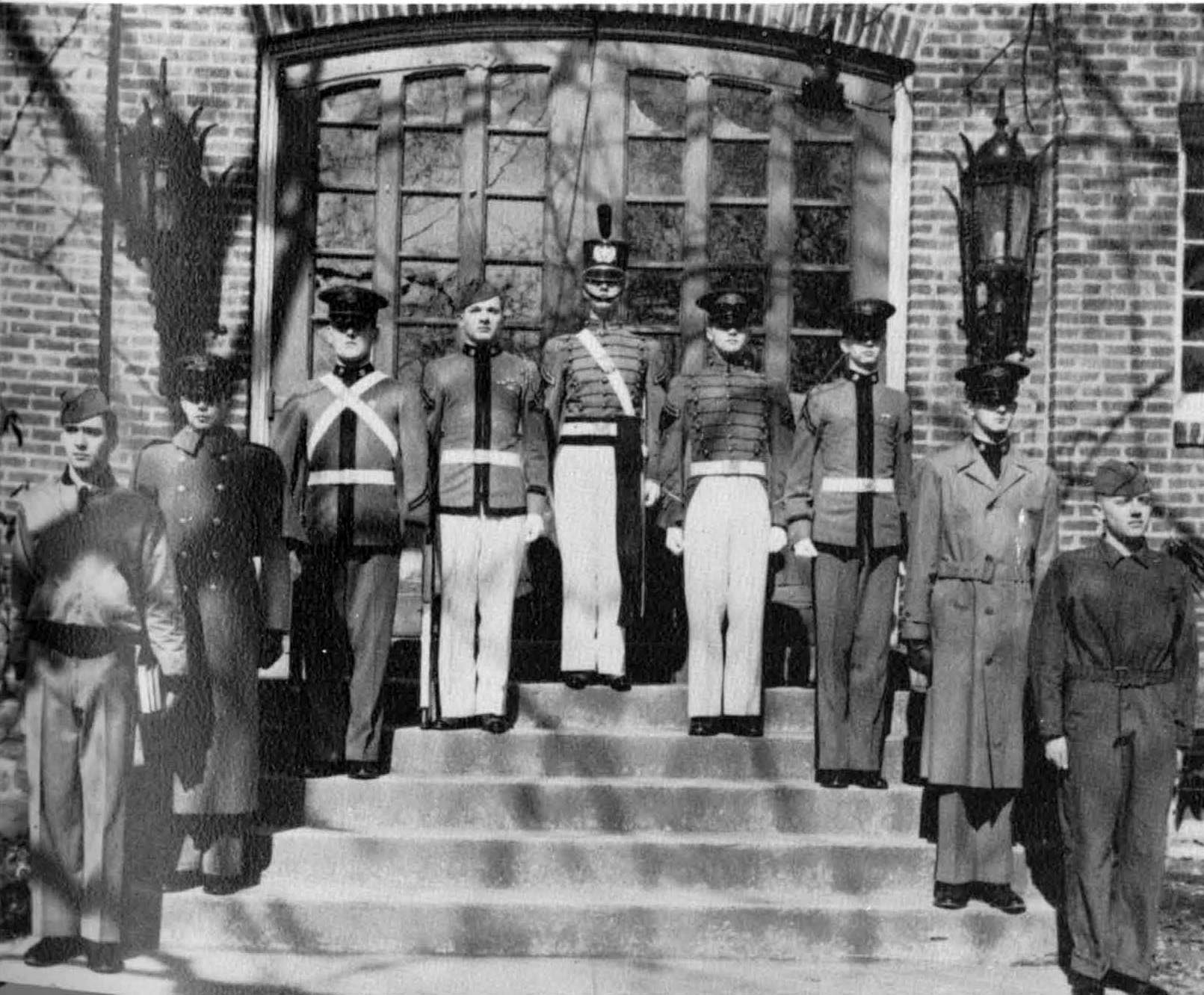
Courtesy of Friends of PMC |
||
Courtesy of the United States Army |
Vietnam Era |
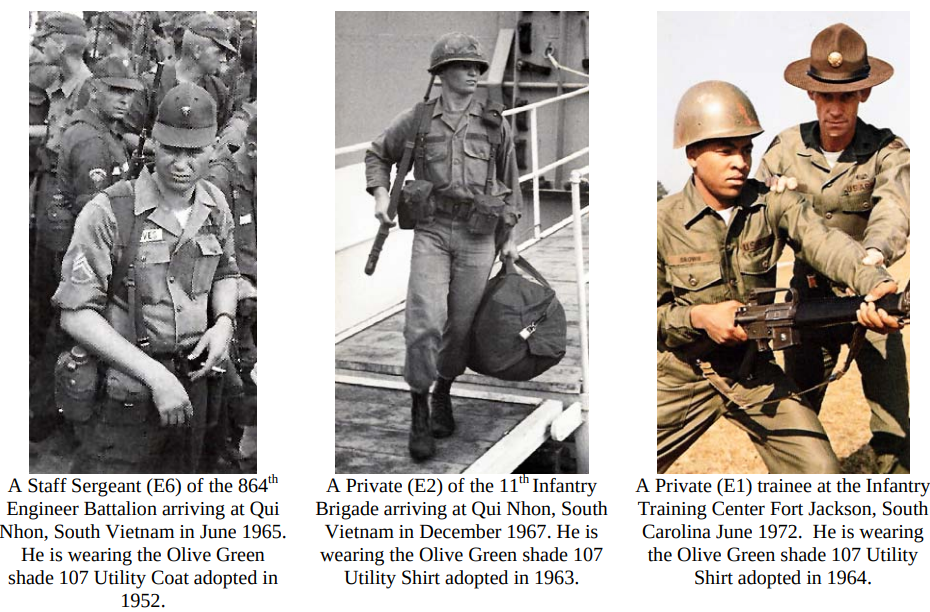
An olive green shade 107, cotton utility uniform as introduced in 1952 gradually replacing the herringbone twill (HBT) uniform adopted in World War II. Specifications for the utility jacket were dated 30 August 1952, and the matching cotton utility trousers were dated 21 November 1952 with production beginning in 1953.An olive green shade 107 cotton sateen shirt replaced the utility jacket under specifications dated 12 April 1963. |
||
|
The M81 Woodland Pattern Battle Dress Uniforms being modeled in early 1980. The US Army steps back from the olive drab color of uniforms for the first time since World War I, and create the Battle Dress Uniform (BDU) in Woodland and Desert Camouflage. These would be issued to everyone. This uniform was descended from the tropical combat uniform of the Vietnam War and consisted of a coat with matching trousers, and a field cap. They were made initially of 50-50 nylon and cotton twill, but would later have a hot weather version made in 100% Ripstop Cotton. |
1981 | 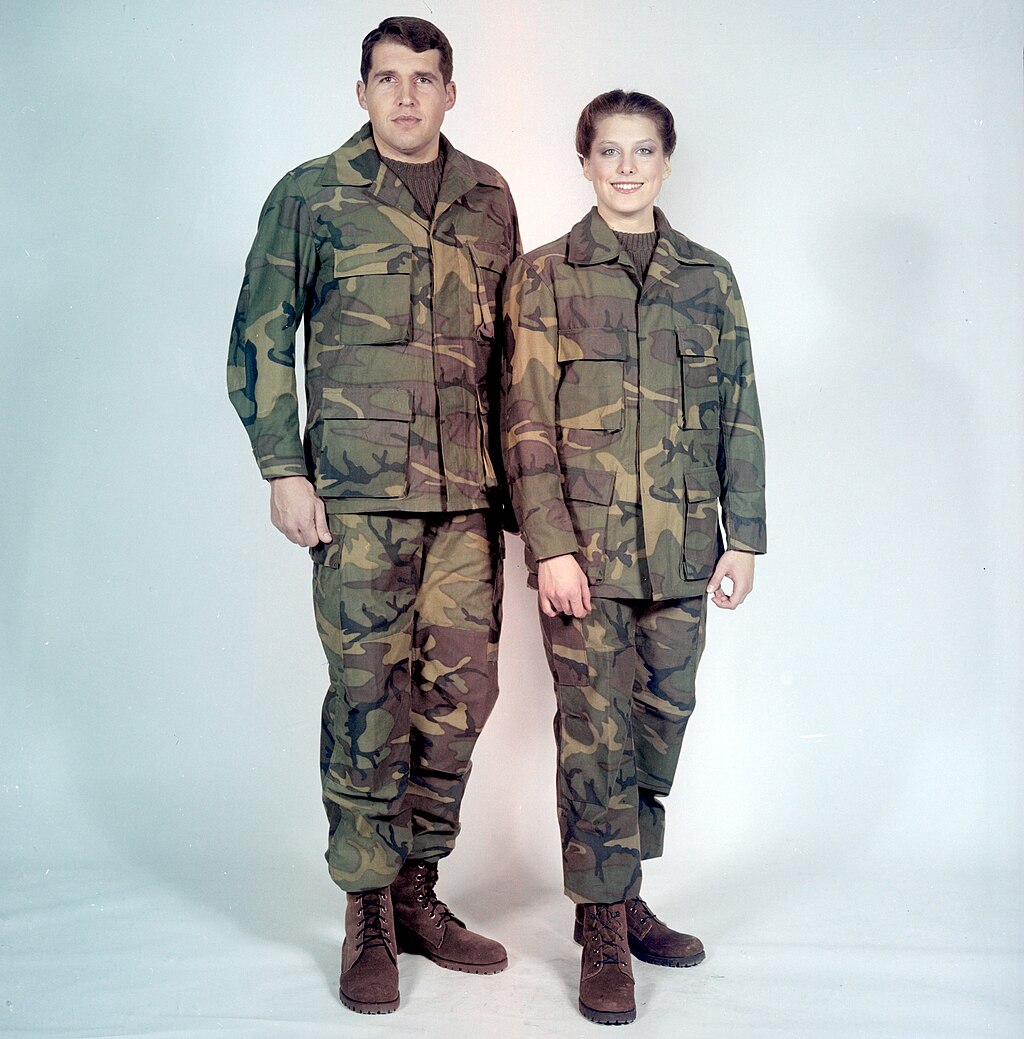
Courtesy of the United States Army |
||
Courtesy of the United States Army |
1981 |
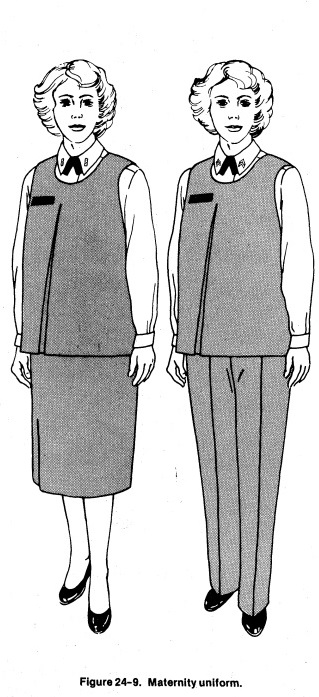
The US Army Regulation depicted the first maternity uniform authorized for wear. Starting in 1975 was the first time women could be pregnant and be in the US Army. In 1981 the Army released the first maternity uniform to allow women to keep serving in a uniform while pregnant The uniform tunic was made of 100% polyester twill, with a durable press finish. The skirt and slacks had an elastic waistband with 100% knitted nylon stretch front panel. |
||
|
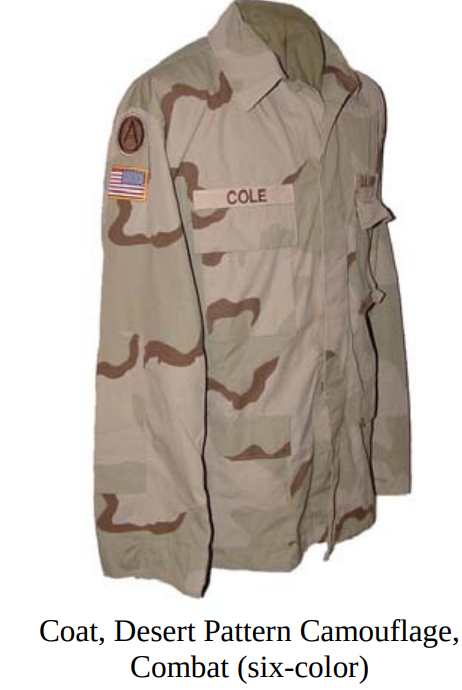
The Army introduces a Desert Camouflage Uniform (DCU) at the same time as the woodland pattern BDU, but issue was limited to special operations troops, and soldiers assigned to exercises in the Middle East such as Operation BRIGHT STAR in Egypt. The uniform was virtually the same as the BDUs but in a six-color tan, brown and black desert camouflage pattern. Six-color DCUs have come to typify the American soldier in the 1991 Persian Gulf War, though due to |
1988 | 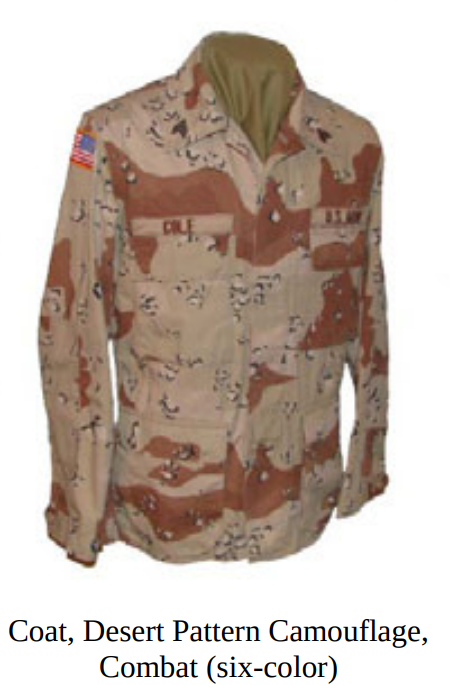
Courtesy of the United States Army
|
||
Courtesy of the United States Army
|
1991 |
The Army began issuing a new three color Desert Camouflage Uniform in July. This uniform was worn by troops participating in Operation ENDURING FREEDOM and Operation IRAQI FREEDOM from 2002 to 2006, when it was replaced by the Army Combat Uniform. |
||
|
The Image of the maternity BDU’s authorized for wear under Army Regulation. The US Army releases new BDU’s in AR 670-1 of 1992, including a maternity version of each uniform type. |
1992 | 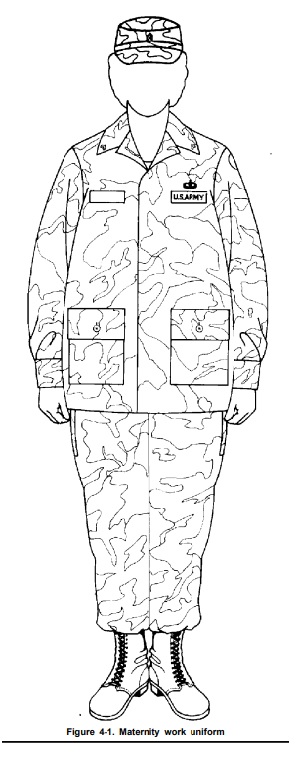
Courtesy of the United States Army
|
||
|
Courtesy of the United States Army |
2016 |
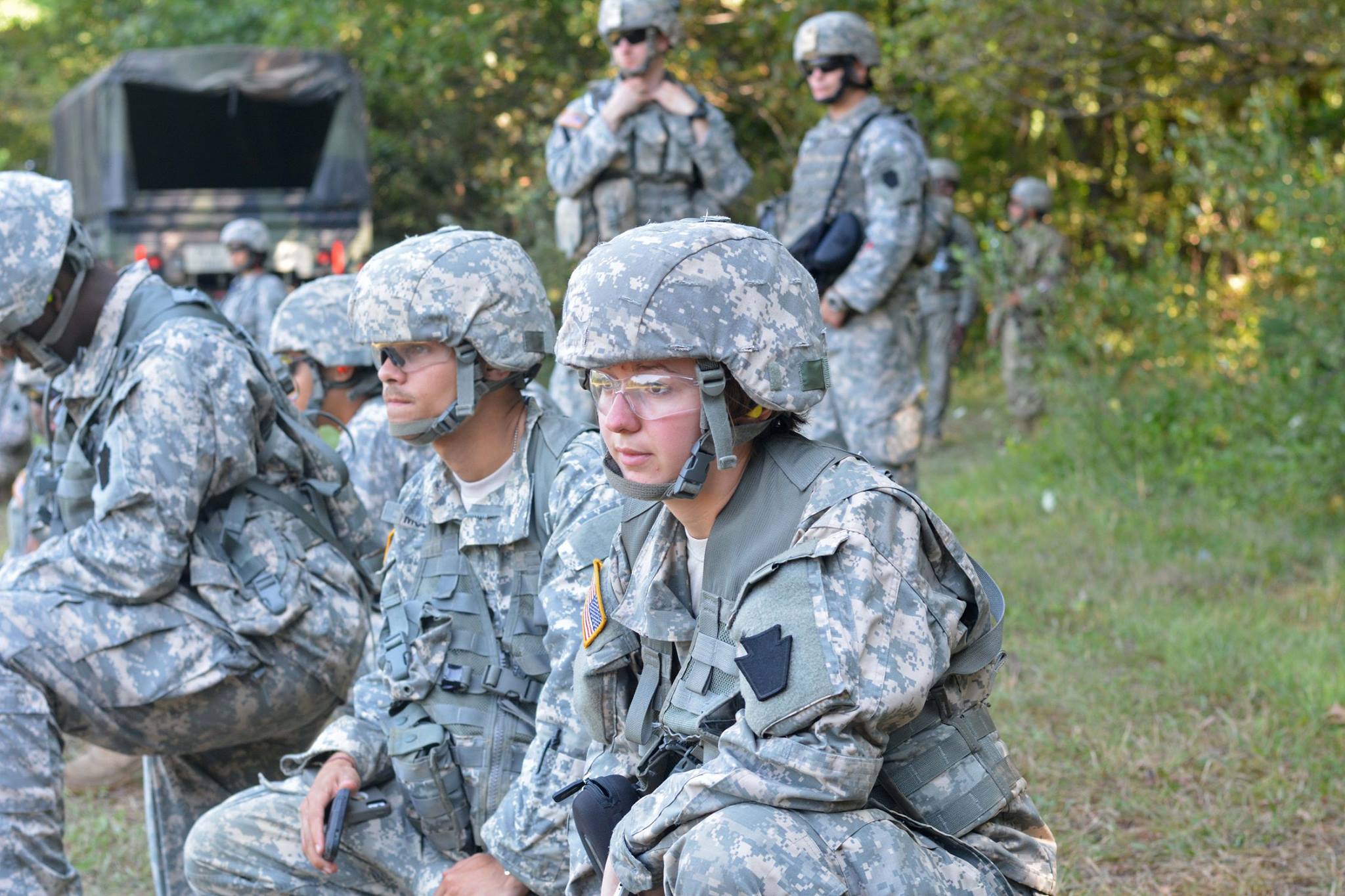
Soldiers from Alpha Company, 128th Brigade Support Battalion, 2nd Infantry Brigade Combat Team, 28th Infantry Division, participated in sling load operations on August 9, 2016 at Ft. Indiantown Gap. (U.S. Army National Guard photos by Capt. Robert Prah/Released) The Soldiers are wearing the Army Combat Uniform in the Universal Camouflage Pattern, also known as the ACU. The Universal Camouflage Pattern (UCP) used a pixelated pattern of tan, gray and green and was intended to work in desert, woodland, and urban environments. Made of a 50-50 cotton and nylon blend called NYCO, the pattern was fully phased out and replaced by the Operational Camouflage Pattern on 30 September 2019. |
||
|
On 15 August 2020, U.S. Soldiers attached and augmented to the 28th Expeditionary Combat Aviation Brigade are ceremonially welcomed to the brigade and granted the keystone patch, the shoulder sleeve insignia for the 28th ECAB, during a patch ceremony at their mobilization station. (Photo by Capt. Travis Mueller 28th Expeditionary Combat Aviation Brigade) The Soldiers are wearing the Operational Camouflage Pattern (OCP) uniform. This uniform is made of NYCO and was brought into service with the U.S. Army in 2014. On 31 July 2014, the Army announced a transition to the OCP would begin being issued in uniforms in summer 2015. |
2020 | 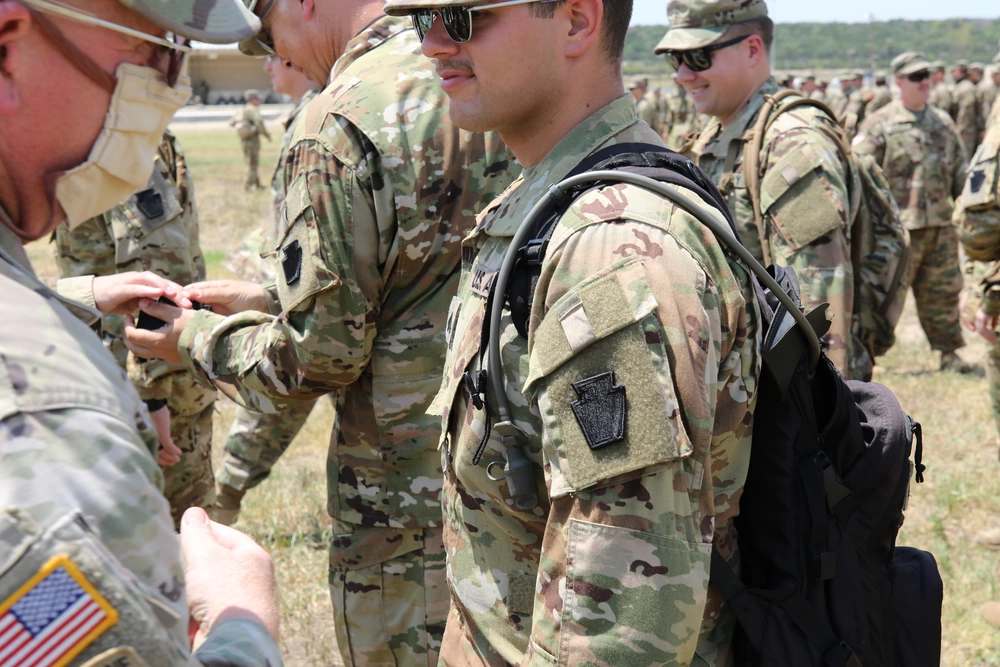
Courtesy of the 28th Infantry Division
|
||
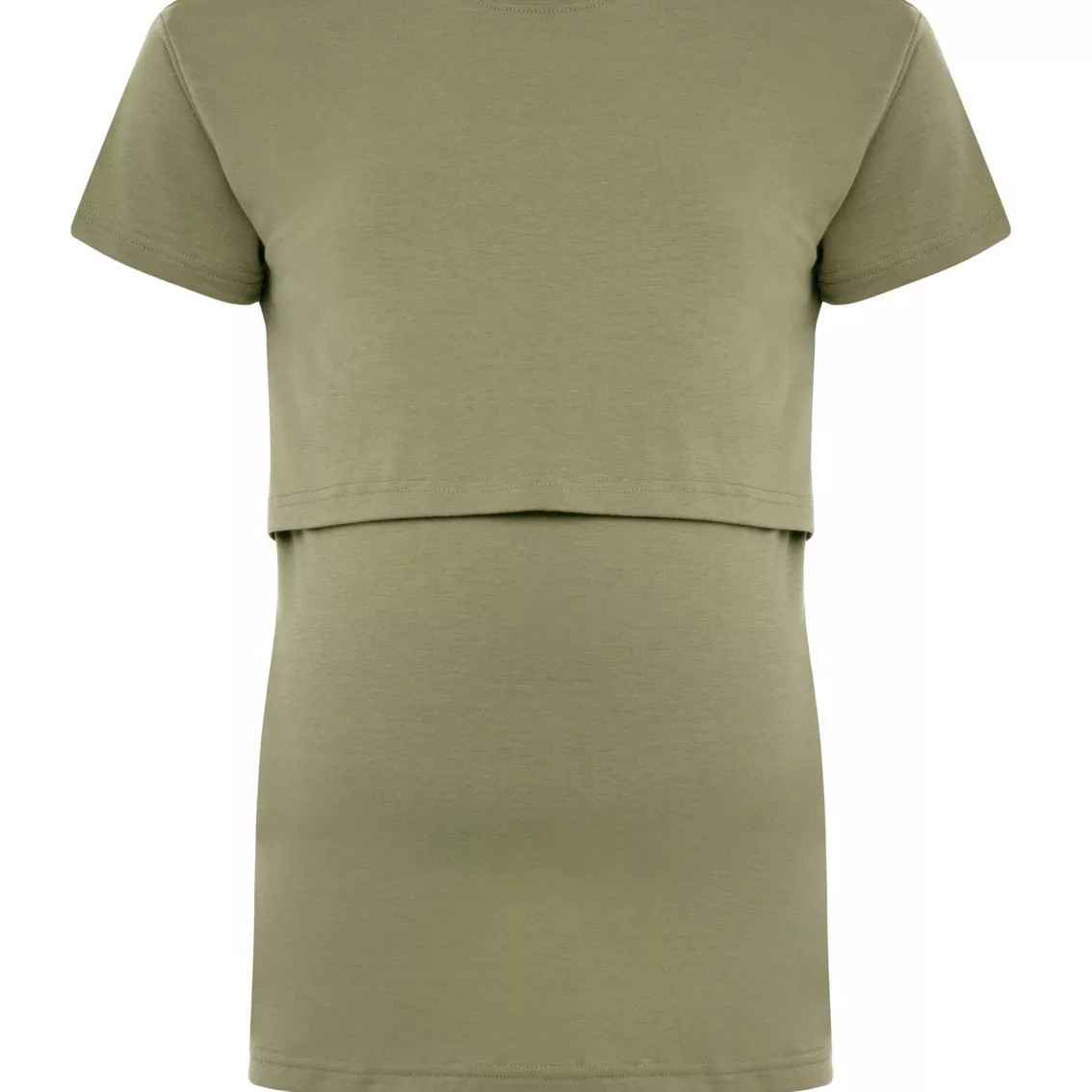
US Army standard Nursing T-Shirt for the OCP Uniform available at the Post Exchange. Courtesy of the United States Army. |
2023 |
In April of 2023, the US Army launched an initiative to provide maternity uniforms to pregnant soldiers free of charge Army wide. These articles included: Maternity PT uniforms, Maternity T-Shirts and Nursing T-Shirts. By September of 2023, 204 soldiers had participated in the program, saving the soldiers hundreds of dollars in uniform expenses. |
“28th Infantry Division.” Pennsylvania National Guard, 2024. https://www.pa.ng.mil/Army-National-Guard/28th-Infantry-Division/.
Cole, David. “Survey of U.S. Army Uniforms, Weapons and Accoutrements,” November 2007. https://www.history.army.mil/html/museums/uniforms/survey_uwa.pdf.
Coulter, John Alfred, “History of Military Schools of the United States: Origin, Rise, Decline, Resurgence, and Potential in Future Public Secondary Education” (2013). Theses & Dissertations. 265. https://athenaeum.uiw.edu/uiw_etds/265
Cripps, O. Newton. Picking Cotton Scene. Aiken, South Carolina. ca. 1902. Photograph. https://www.loc.gov/item/2012648376/
Dattel, Eugene R. “Cotton and the Civil War.” Mississippi History Now. July 2008. https://www.mshistorynow.mdah.ms.gov/issue/cotton-and-the-civil-war
Facebook. “28th Infantry Division.” Pennsylvania National Guard, 2023. https://www.facebook.com/28thID/.
Herman, William R. Exhibition drill of battalion of West Point cadets on the plaza, World’s Fair, St. Louis, 1904 digital file from original stereograph. ca. 1904. Photograph/Stereograph. https://www.loc.gov/resource/stereo.1s03746/
Hollem, Howard R. Marine Corps Major in dress white uniform, W[orld] W[ar] II. ca. 1941-1945. Photograph. https://www.loc.gov/resource/fsac.1a34994/
Ingersoll, T. W. In the cotton fields of Georgia. Georgia, United States. ca. 1898. Photograph. https://www.loc.gov/item/2001695457/
Jordan, Kelly C., and John A. Coulter. “A Brief History of the Military School in America.” AMCSUS. Arnold, MD: The Association of Military Colleges and Schools of the United States, 2016. https://amcsus.org/resources/a-brief-history-of-the-military-school-in-america/.
Lange, Dorothea. A Negro tenant farmer and several members of his family hoeing cotton on their farm in Alabama. Alabama, United States. July, 1936. Photograph. https://www.loc.gov/item/2017768065/
Ross, Toni. “History and Traditions.” NCO Journal, 2019, 1–3. https://www.armyupress.army.mil/Portals/7/nco-journal/images/2019/October/Traditions/history-and-traditions.pdf.
Stewart, Richard W., ed. American Military History, Volume 1: The United States Army and the Forging of a Nation, 1775-1917. United States Army: Center of Military History, 2005. https://www.history.army.mil/books/amh-v1/.
The Friends of PMC. “Pennsylvania Military College.” Pennsylvania Military College, 2024. https://pennsylvaniamilitarycollege.org/.
United States Department of Defense. “28th Infantry Division.” Defense Visual Information Distribution Service, 2024. https://www.dvidshub.net/unit/28thID.
U.S. Army Center of Military History. “Artwork and Photography,” 2014. https://www.history.army.mil/artphoto.html.
US Census Bureau. “1900 Census: Bulletins.” Last modified September 16, 2022. https://www.census.gov/library/publications/1900/dec/bulletins.Agriculture.html#list-tab-774097664
US Census Bureau. “1900 Census Special Reports: Occupations at the Twelfth Census.” Last modified October 8, 2021. https://www.census.gov/library/publications/1904/dec/occupations.html
US Census Bureau. “1900 Census: Volume I. Population, Part 1.” Last modified November 7, 2023. https://www.census.gov/library/publications/1901/dec/vol-01-population.html
US Department of Agriculture. “Black Farmers in America, 1865-2000: The Pursuit of Independent Farming and the Role of Cooperatives.” Reprinted October 2003. https://www.rd.usda.gov/files/RR194.pdf
Widener University. “Widener University Digital Collections.” University Archives Digital Collection, 2019. http://digitalwolfgram.widener.edu/digital.