Many young women dream of the day when they marry the man of their dreams with their best friends by their side as bridesmaids. On August 28, 1946, Lorraine Harris Humer stood beside Kathleen Briner Meals as she married Donald Meals, a World War II veteran who served in the European Theater. In the years following the Second World War, hundreds of thousands of couples married in what is today called a ‘big white wedding.’ The wedding industry, as it is known today, was born following World War II, as soldiers rushed home and married their sweethearts or found a sweetheart to marry in an extravagant ceremony with large wedding parties by their sides and a church full of friends and family. However, due to shortages, brides and bridesmaids had to improvise what their dresses were made from, leading many to wear dresses made from old Army parachutes.
American Bridal History
In pre-industrial America, weddings were a community event where a neighborhood came together to aid a couple in establishing a household for themselves through barn raisings and quilting parties. The process typically took longer than one afternoon, and occasionally, ministers were not present, and a couple moved in together and declared themselves married. Enslaved people were prohibited from marrying one another the way that free people were. They frequently marked their marriage through “jumping the broom” or a “Parson Blanket” marriage, where the groom laid his sleeping blanket next to his bride to declare their marriage. The tradition of exchanging rings in an elaborate church ceremony followed by a dinner and dancing reception did not become standard practice until the post-war years.
Due to the marketization of the wedding industry to the growing middle class, the wedding industry became a lucrative business in the post-war economic boom. There was a rush to marry during the war, bolstered by pro-wedding propaganda. Most young women engaged during the war wanted a formal ceremony, delaying many marriages until the war ended when their fiancé returned. Businesses recognized the growing popularity of the white wedding and increased spending to make the middle-class “American Dream” a reality for the returning veterans. Tiered wedding cakes, reception halls, wedding jewelers, and bridal salons all boomed under the new demand. Records show that the Meals’ wedding followed this new fad that has since become standard in American culture while embracing the military background the groom and others in the wedding party shared.
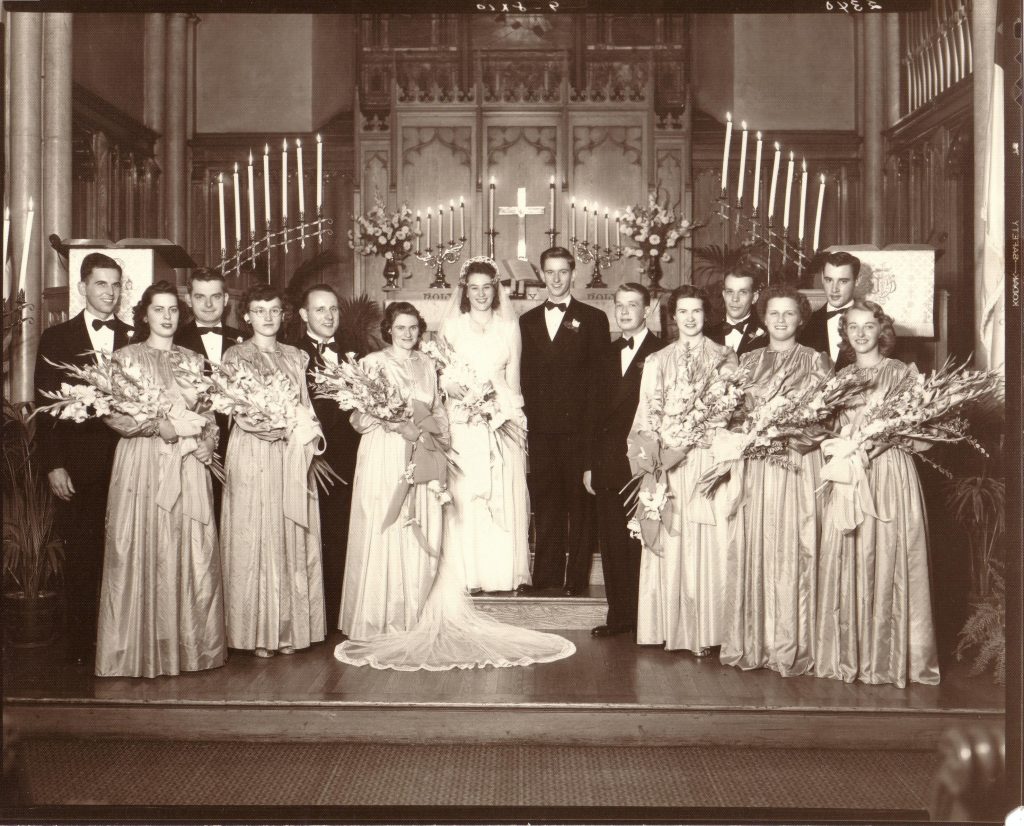
Donald and Kathleen Meals’ wedding in 1946. The bridesmaids dresses are all made from parachute silk.
The Faces Behind the Dress
Lorraine Harris Humer came from a loving, respectable family in the Carlisle, PA, area. For years, Lorraine upheld her family values, following her across all avenues of life. She graduated from Carlisle High School in 1940, where she realized what her career would entail: helping others through medicine. With a passion for serving others and helping those in need, her personality fit admirably to the United States war effort, serving as a student nurse in the Cadet Nurse Corps during World War II. After being discharged from the Cadet Nurse Corps in 1945, she attended and graduated from the Johns Hopkins School of Nursing as a Registered Nurse the same year. Coming back from Baltimore, Maryland, her training was put to the test as she served as a Visiting Nurse in Carlisle from 1946 to 1951. While she enjoyed helping others through her passion for nursing, no other aspect of life was more important to Lorraine than her love and support for friends and family.
On August 28, 1946, Lorraine attended the wedding of Donald W. Meals and Kathleen Briner Meals, two of her close friends. Her husband, James R. Humer Sr., a WWII Army veteran, accompanied Lorraine to the wedding. James played an essential role in the design of the wedding, as his contribution of an Army parachute from his service overseas provided the materials for the bridesmaid dresses. Lorraine’s dress was one of six parachute dresses made from the same parachute for the event, reflecting the increased awareness of parachute clothing post-World War II. She wore the same dress at a different wedding three weeks apart from Don and Kathleen Meals’ that year. In 2008, Lorraine donated her dress to the Fashion Archives & Museum, becoming an important example of repurposed wartime parachutes.
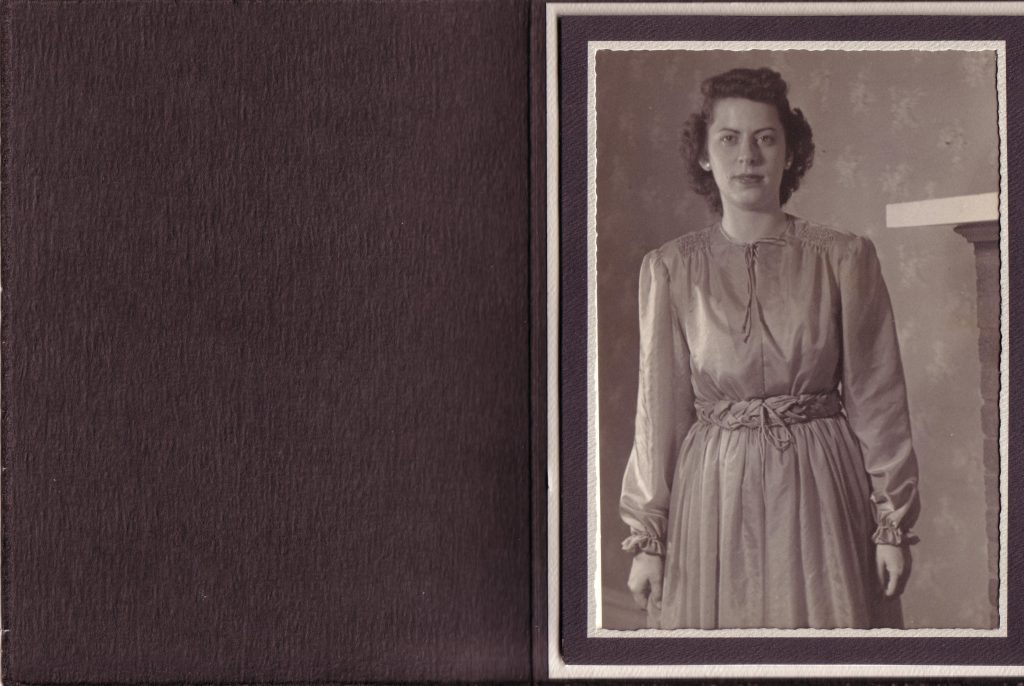
Lorrainne Harris Humer in the bridesmaid dress, 1946
The Meals
Dr. Donald W. Meals, Ph.D., was born in Carlisle, PA, on June 5, 1922. He graduated from Carlisle High School and earned a B.A. from Dickinson College. He was a U.S. Army Veteran, fighting in WWII with the 94th Infantry Division in the European theater. He was part of the D-Day invasion and fought in the Battle of the Budge; he received a Purple Heart and a Bronze Star for his actions during the war. After the war, he married Kathleen Briner (Meals) in 1946. In 1950, he earned a doctorate in psychology and management from the University of Pennsylvania. Dr. Meals worked in the field of education management for a variety of organizations until his retirement in the 1990s. He split his retirement between Bedford, Massachusetts, and Holmes Beach, Florida. He died on April 22, 2013, and is buried with his late wife in Westminster Memorial Cemetery in Carlisle, PA.
Mrs. Kathleen (Briner) Meals was born on June 10, 1922, in Carlisle, Pennsylvania. She graduated from Carlisle High School and earned a B.A. from Dickinson College. She earned a master’s degree from Bryn Mawr College. Mrs. Meals was a professor at Drexel University in Philadelphia. During WWII, she was a cryptanalyst for the U.S. Army Signal Corps. She married Dr. Donald W. Meals in 1946. She split her retirement between her home in Bedford, Massachusetts, and Holmes Beach, Florida. She died on December 2, 1998, and is buried with her husband in Westminster Memorial Cemetery in Carlisle, PA.
Cultural Influence
Lorraine Harris Humer’s bridesmaid dress is one of the many remaining pieces of parachute clothing from WWII that still exist. Adapting parachutes into clothing reflected the economic material shortages of the post-war years, with many American soldiers cognizant of these issues for their loved ones back on the home front. American soldiers’ resilience and triumphs on the battlefield symbolized patriotism and heroism; the repurposing of parachutes into clothing reflected these ideals, embodying social, creative resourcefulness. Parachute dresses helped create the connections between critical historical events and the lives of ordinary people with adhering to the wartime principles of “make do and mend,” as well as recycle. Through practicality and elegance, while two different descriptions, parachute dresses exemplified a new transition within the social sphere, from soldier to civilian and past to future. Lorraine’s bridesmaid dress was one example of clothing that resembled this transition under the nature of ART: Adaptation, Resourcefulness, and Transformation. Without ART, the truth behind this dress and a post-war wedding’s influence on it could never be reached.
Something Old, Something New…
This dress, made of overdyed nylon parachute fabric, was created in 1946 along with five other bridesmaid dresses and one wedding dress. This was a common trend post World War Two, when consumer products, particularly clothing, were still subject to shortages as the American economy shifted to non-military production. People got creative with their wedding attire, and parachute dresses walked down the aisle.
The common expression “parachute silk” is a misnomer, since the dress is made of nylon. This change in production is a result of growing tensions between Japan and the United States before and during World War II. With the flow of silk dwindling steadily prior to the attack on Pearl Harbor, Americans had to find a different material. In 1939, nylon was created in New York as a material for women’s stockings. The Pioneer Parachute Company, based out of Manchester Connecticut, started testing this newly created nylon as a potential silk substitute and quickly realized that nylon was a stronger and tougher material compared to its silk counterpart. On June 6th, 1942, the Pioneer Parachute Company conducted the first test of the nylon parachute: a volunteer named Adeline Grey jumped from around three thousand feet and landed safely. After this successful test, the Pioneer Parachute Company undertook mass production, constructing upwards of three hundred per day. With so many parachutes in production and circulation, it was only a matter of time before people in the post-war economy started to recycle them into other objects, resulting in parachute dresses.
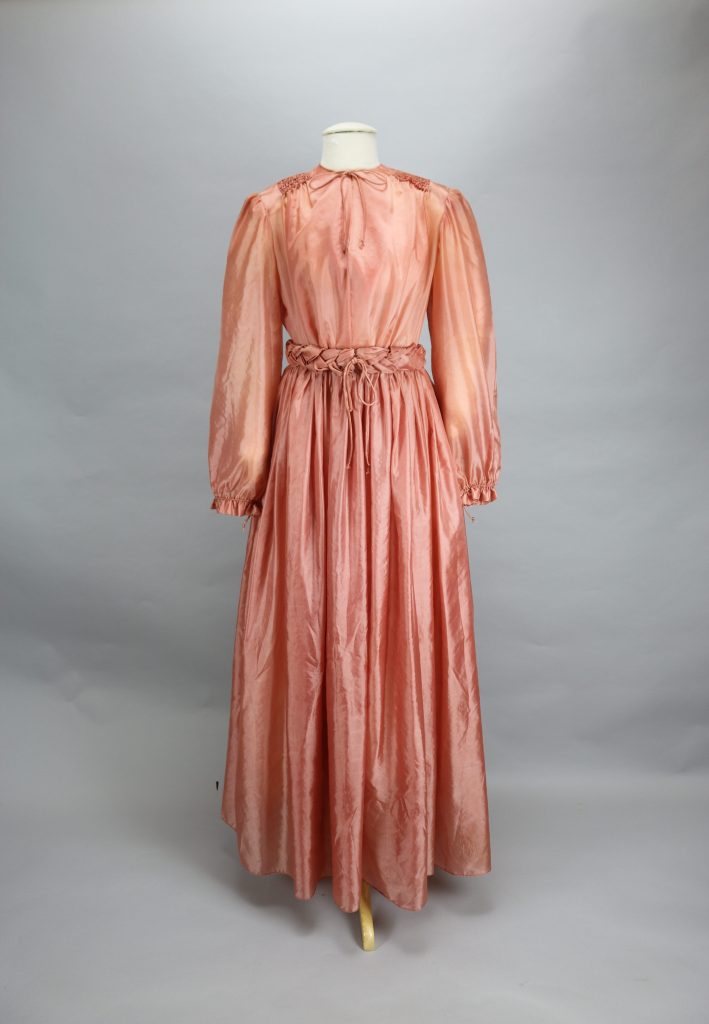
1946 Parachute dress from the Fashion Archive and Museum in Shippensburg PA.
Written by Hannah Borkenhagen ’23, ’24M, Daniel Lewis ’23, ’24M, Dominic Curcio ’25M, and James Smetzer ’21, ’24M for Dr. Blooms HIS501 class, October 2023
Bibliography:
Air Force Materiel Command. “A Look Back….at the Development of Parachutes to 1945,” January 5, 2021. https://www.afmc.af.mil/News/Article-Display/Article/2462753/a-look-backat-the-development-of-parachutes-to-1945/https%3A%2F%2Fwww.afmc.af.mil%2FNews%2FArticle-Display%2FArticle%2F2462753%2Fa-look-backat-the-development-of-parachutes-to-1945%2F.
Find a Grave. “Donald W. Meals” Westminster Memorial Cemetery. Accessed October 5, 2023. https://www.findagrave.com/memorial/147161337/donald-w-meals.
Find a Grave. “Kathleen (Briner) Meals.” Westminster Memorial Cemetery. Accessed October 5, 2023. https://www.findagrave.com/memorial/95674103/kathleen-meals.
Find a Grave. “Lorraine Harris Humer” Westminster Memorial Cemetery. Accessed October 4, 2023. https://www.findagrave.com/memorial/186458328/lorraine-humer
Howard, Vicki. 2008. Brides, Inc.: American Weddings and the Business of Tradition. University of Pennsylvania Press.
Humer, Lorraine Harris. “Obituary of Lorraine Harris Humer 1922-2018.” Carlisle Sentinel, January 7, 2018.
Jellison, Katherine. 2008. It’s Our Day: America’s Love Affair with the White Wedding, 1945-2005. University Press of Kansas.
Magazine, Smithsonian, and Kat Eschner. “Meet the Daredevil Parachutist Who Tested the First Nylon Parachute 75 Years Ago.” Smithsonian Magazine. Accessed October 1, 2023. https://www.smithsonianmag.com/smart-news/meet-daredevil-parachutist-who-tested-duponts-first-nylon-parachute-180963527/.
Meals, Donald W. “Obituary of Donald W. Meals 1922-2013.” Carlisle Sentinel, April 30, 2013.
Meals, Kathleen. “Obituary of Kathleen (Briner) Meals 1922-1998.” Carlisle Sentinel, December 4, 1998.
Ofgang, Erik, and eofgang@connecticutmag.com. “How a Connecticut Company’s Parachutes Helped Launch D-Day.” CT Insider, May 22, 2019. https://www.ctinsider.com/connecticutmagazine/news-people/article/How-a-Connecticut-Company-s-Parachutes-Helped-17044641.php.
“Ortensie – 1945 – DEVELOPMENT OF PARACHUTES TO 1945.Pdf.” Accessed October 2, 2023. https://media.defense.gov/2021/Jan/05/2002560252/-1/-1/1/LOOKBACK_PARACHUTE%20DEVELOPMENT.PDF.
Wagner, Carolyn. “Material Memories: The Parachute Wedding Gowns of American Brides, 1945-1949.” PhD Dissertation, University of Cincinnati, 2015.