AMERICA ON THE EVE OF THE BICENTENNIAL
Grappling with Transition and Reflection
What happens to a nation’s identity when optimism turns to doubt?
A decade of change and collective soul-searching decade preceded our nation’s 200th birthday. Political scandals, economic malaise, and social upheaval deeply eroded the optimistic outlook that most Americans enjoyed in the prosperous decades after World War II, giving way to ambivalence and pessimism. By the mid-1970s, the United States grappled with a profound sense of transition and self-reflection.
Civil Rights Movement: Persistence and Change
How far would you go to demand fairness and equality?
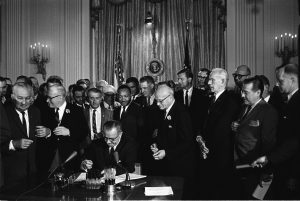
[1] The Civil Rights Act of 1964 passed the final legislative hurdle and received the President’s signature on July 2. Wikimedia Commons
The civil rights movement saw direct action against racial inequalities ingrained in American society, and not exclusively in the south. Black Americans faced segregation in public schools, exclusion from private businesses, limited employment opportunities, and endless other limitations and exclusions, leaving them as second-class citizens and stakeholders in society. The movement achieved significant legislative victories in the years leading up to 1976, including the Civil Rights Act of 1964 and the Voting Rights Act of 1965, but the struggle for racial equality persisted. Cities erupted in protest and occasional violence. Not only the Black community, but women, LGBTQ+ individuals, and Indigenous communities increasingly demanded recognition and equal rights. Dr. Martin Luther King, Jr. best exemplifies the period. King’s persistence in the face of relentless danger and adversity for the sake of justice and equality evidenced his personal courage. Despite the risks, he led nonviolent marches, protests, and boycotts in some of the most hostile regions of the segregated South. He endured arrests, threats to his family, and acts of violence—including the 1963 bombing of his Birmingham campaign headquarters and his own home. King’s life, brought to a premature end by an assassin in 1968, testified to the depth of his courage and vision for America, challenging audiences to reflect on what they would risk to stand for justice. It brought America face-to-face with its own shortcomings.
Vietnam War: A Polarized Nation
When war ends, what scars remain?
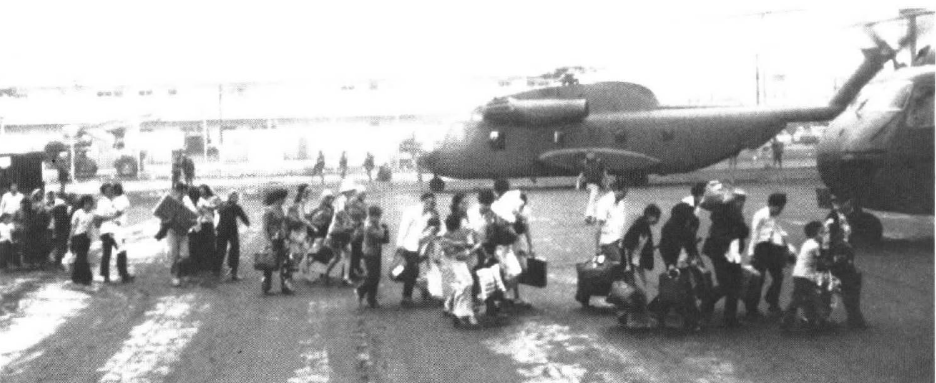
[2] Helicopters takes refugees from the collapsing Republic of South Vietnam. Department of Defense
America’s grinding, decade-long engagement in the Vietnam War polarized the nation as casualties and costs spiraled. American involvement ended only one year before the Bicentennial, leaving scars on the national psyche and prompting debates over America’s global role and domestic priorities. As the last helicopter left the U.S. Embassy in Saigon in 1975, Americans contemplated the costs of the war: in lives lost and shaken, in returned veterans with physical and mental wounds, and in the loss of American prestige and unity.
Watergate: A Crisis of Trust
How would you feel if you could no longer trust your leaders?
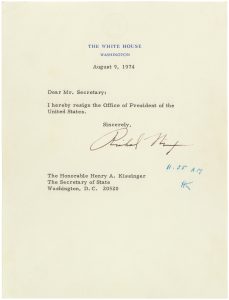
[3] Richard Nixon, the only US President to resign the office, did so with the above letter on August 9, 1974. National Archives & Records Administration (NARA)
In politics, the Watergate scandal shattered public trust in the government leadership at its highest office. President Richard Nixon’s 1974 resignation, the first of its kind in U.S. history, left a bitter aftertaste as Americans questioned the integrity of their leaders. Nixon’s successor, Gerald Ford—a politically unexciting but respected thirteen-term congressman from Michigan—rose to prominence as House Minority Leader. In 1973, he unexpectedly thrust into the national spotlight when he was appointed as Nixon’s second Vice President following Spiro Agnew’s scandal and resignation. Less than a year later, amid Nixon’s own resignation, Ford became President, inheriting a deeply shaken nation with a crisis of confidence in its government. When the new President pardoned Nixon shortly afterwards, many Americans questioned whether justice really applied equally to the nation’s most powerful.
Economic Instability: OPEC and Stagflation
How does a nation cope when its economic engine stalls?

In the midst of civil, political, and international turmoil, economic instability added to the sense of discontent. The 1973 oil embargo by the Organization of the Petroleum Exporting Countries (OPEC) slammed the global economy, triggering energy crises and rampant inflation. Americans who had never experienced shortages since the Great Depression and WWII waited in long lines to fill their cars with expensive gasoline, when they could find it at all. Dubbed “stagflation,” the unusual combination of high unemployment and stagnant growth became a defining economic characteristic of the decade and challenged the popular notion of America as a land of perpetual economic growth and plenty.
Cultural Shifts: A Nation in Flux
How do music, fashion, and media reflect who our identity as a people?
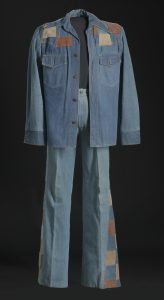
The country underwent a dynamic cultural shift in the 1960s and ’70s. Popular music reflected escapism and introspection, from the disco craze epitomized by the Bee Gees and Donna Summer to the raw storytelling of singer-songwriters like Joni Mitchell and Bruce Springsteen. Fashion veered toward individualism as bell-bottom jeans, leisure suits, and bold colors become symbols of self-expression. Popular entertainment took on grittier realities, with shows like All in the Family tackling difficult societal issues in American living rooms each evening, while films like Taxi Driver portrayed urban alienation.
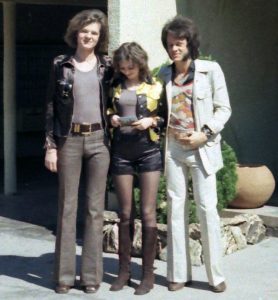

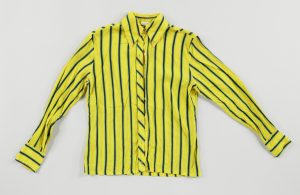
How far have civil rights taken us? What are the movements that made us?
Besides entertainment, news media outlets amplified the conflicts of the 1960s and ’70s like never before possible, sharing wider perspectives on the news and current events more quickly than in the past. Anchors like Walter Cronkite startled Americans with broadcast footage from Vietnam in a way that reporters of previous conflicts could not. Americans responded with social and political reforms. President Ford officially recognized Black History Month in 1976, acknowledging the contributions of African Americans to the nation’s history. The feminist movement achieved significant gains in women’s individual rights and bodily autonomy as the Supreme Court’s decision in Planned Parenthood v. Danforth struck down a requirement for written spousal consent before a woman could obtain an abortion. Not to be ignored, Native Americans followed the route of the Bicentennial Wagon Train along “The Trail of Self-Determination” in a reverse movement of the 19th-century White settlers who rode covered wagons in their expansion westward.
Bicentennial: Seeking Renewal
What does it mean to celebrate freedom when the foundations feel shaky?
Americans celebrated independence and freedom during a time of national uncertainty in both an act of resilience and a reckoning with the meaning of liberty itself. The 1976 Bicentennial unfolded as Americans faced economic instability, political disillusionment, and cultural fragmentation. With the Watergate scandal and the Vietnam War fresh in memory, many questioned the integrity of their government and the direction of their country. Against this backdrop of doubt, the Bicentennial became a nationwide effort to reaffirm collective identity and shared values.
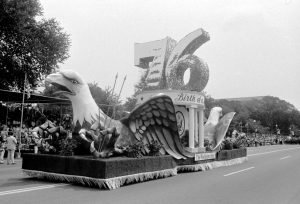
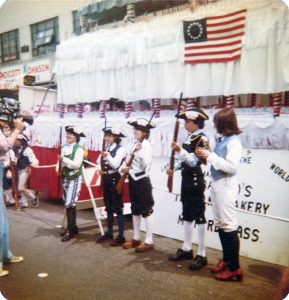
Communities across the country held parades, historical reenactments, and fireworks displays that symbolized a longing to connect with the ideals enshrined in the Declaration of Independence and the Constitution. The celebration embraced nostalgia, invoking the “Spirit of ’76” to remind citizens of the enduring struggle for freedom and democracy. It also provoked reflection on how fully we realized these principles in a nation grappling with systemic inequality and global uncertainty.
In reflecting on our question, “What does it mean to celebrate freedom when the foundations feel shaky?” the Bicentennial shows that commemoration can serve as both a unifying act and a call to accountability. It prompted Americans to ask themselves not just what they were celebrating but also how they could better live up to the promise of liberty and justice for all. This duality—honoring the past while confronting the present—gives the Bicentennial its enduring significance, challenging each generation to preserve and sharpen the definition of their cherished national ideals.
Celebration
How did people celebrate the Bicentennial of America?
In the midst of so much conflict, America turned to the comforts of celebrating and the hope of a brighter future. Cities and towns across the country held elaborate parades featuring floats adorned with American flags, historical symbols, and representations of key moments from the Revolutionary War. Major cities like Philadelphia, Boston, and Washington, D.C., hosted large public gatherings, concerts, and fireworks displays. Philadelphia, where the 1776 signing of the Declaration of Independence took place, held a reenactment of the signing, and prominently displayed the Liberty Bell as a symbol of freedom.
The celebration extended beyond traditional parades and fireworks. Local communities held fairs, historical pageants, and reenactments of colonial life, allowing people to experience and appreciate the nation’s early years. Cultural and educational events emphasized America’s diverse heritage and democratic ideals. The Smithsonian Institution in Washington, D.C. hosted special exhibits showcasing American history and culture. The Smithsonian’s Folklife Festival included 8 programs running for several weeks each, such as “Old Ways in the New World,” “Native Americans,” “Working Americans,” “African Diaspora,” and more. Just a few days shy of the Bicentennial, the National Air and Space Museum opened up to the public for the first time.
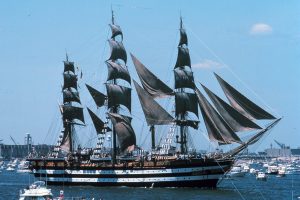
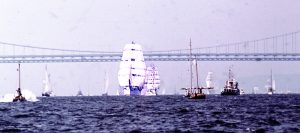
In one of the most memorable moments of the Bicentennial, known as “Operation Sail,” majestic sailing ships from around the world sailed into New York harbor, symbolizing international goodwill and peace. The event drew millions of live spectators and reached millions more by national broadcast, adding a sense of grandeur and unity to the celebrations. On land, a Freedom Train on the railways and Bicentennial Wagon Train on the roadways took route across America bringing even small communities the chance to celebrate.
Bicentennial Merchandise
Any national celebration inspires commemorative merchandise and the chance to make a buck. The Bicentennial included endless objects and commemorative articles made for the occasion.
The United States Post Office tapped into the nation’s long tradition of stamp collecting and produced a series of Bicentennial stamps, including the examples below. In 1840, the United Kingdom introduced the modern postage stamp, and America followed in 1847 with its own set. By the 1850s, philately (the formal term for stamp collecting) had taken hold.
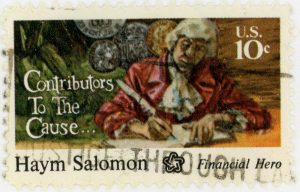
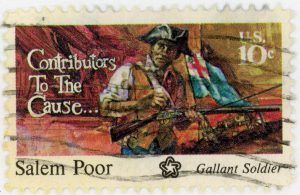
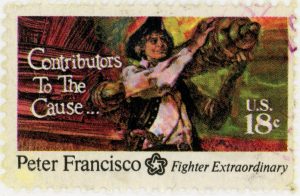
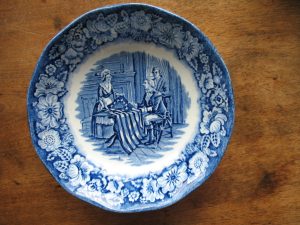
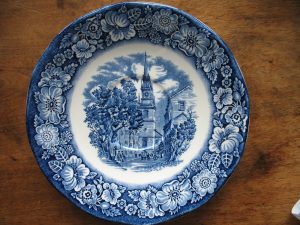
You can probably still find commemorative Bicentennial dishware in your local thrift shops without much difficulty. Surprisingly, although ceramics make up some of humanity’s oldest artifacts, the tradition of creating, selling, and collecting commemorative ceramics dates a few decades later than philately. A Dutch-Englishman by the name of Patrick Palmer-Thomas receives much of the credit for popularizing these items in the late 19th century. Like the plates displayed below, Palmer-Thomas’s designs featured famous events, places, and persons.

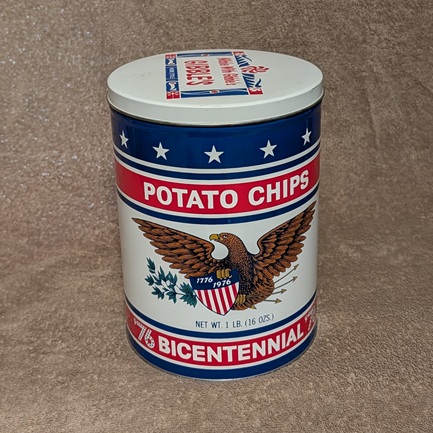
Besides the more classic souvenirs like stamps and dishware, companies and other organizations produced endless types of merchandise and objects to celebrate the Bicentennial and promote commerce. Nibble With Gibbles, Inc. near Chambersburg, PA sold this tin of potato chips with a patriotic motif and message as just one example of the ways that businesses of all sizes used the Bicentennial to engage with customers.
What can past celebrations of America’s milestones teach us about how we define and preserve our national identity?
The United States has commemorated its milestones in ways that reflect its evolving identity and the historical context of each celebration.
The 50th anniversary in 1826 marked the deaths of both John Adams and Thomas Jefferson who both passed on July 4th, an event imbued with symbolic significance. Celebrations focused on the Founders’ ideals, with speeches, parades, and patriotic displays emphasizing unity in a nation barely recovering from conflict over states’ rights and sectionalism.
Those conflicts culminated in devastating Civil War, ending just over a decade before the 100th anniversary in 1876 and the eve of a new industrial boom. The Centennial Exposition in Philadelphia–the nation’s first official World’s Fair–served as its centerpiece. This grand event highlighted technological progress and the country’s growing global ambitions while also glorifying its historical roots. While the nation had ended the odious practice of slavery, the centennial celebrations still excluded many marginalized groups, including Indigenous people and Black Americans, illustrating contradictions in the nation’s self-image and the work for equality and fairness yet to be done.
The 150th anniversary in 1926 saw a less centralized celebration notable for its emphasis on education and historical preservation, including the restoration of key Revolutionary War sites. As the country approached the yet-unseen Great Depression, the Sesquicentennial leaned heavily on nostalgic patriotism, underscoring a desire for stability in uncertain times.
By the Bicentennial of 1976, the United States faced a crossroads. With the Vietnam War and Watergate scandal fresh in memory, the nation sought unity through reflection. Events like the traveling Freedom Train and the Festival of American Folklife showcased the diverse stories that made up the American experience. Bicentennial celebrations embraced grassroots participation, from local parades to major events like Operation Sail, where tall ships from around the world gathered in New York Harbor, reinforcing both national pride and international goodwill.
America at 250: How do we celebrate our Semiquincentennial in 2026?
What parallels can you draw between the challenges faced during the Bicentennial era and the issues confronting us today in our nation’s 250th birthday, the Semiquincentennial?
What lessons from the past can help us navigate questions of political integrity, social justice, economic stability, and cultural identity in our own time?
As the nation passes another milestone, how can Americans ensure that our ideals of liberty, democracy, and unity endure and evolve meaningfully for future generations?
Do our commemorations reflect the inclusivity and complexity of our diverse nation, or do they seek simpler narratives? Each milestone created a mirror of its own time. Fifty years ago, the Bicentennial celebration allowed a nation in conflict and social change the chance to reflect and reunite, to consider the ways that America could address its shortcomings while honoring and reflecting on its its successes, on its future, and on the work yet to come.
In 2026, what does our milestone reveal about us?
Select Bibliography
National Park Service. “The Trail of Self-Determination, 1976.” In The Struggle for Sovereignty: American Indian Activism in the Nation’s Capital, 1968-1978. Accessed Fall 2024. https://www.nps.gov/articles/000/trail-self-determination.htm.
Newspapers.com, accessed May 12, 2026. “Commemorative BICENTENNIAL CANNISTER”, Public Opinion, July 15, 1976; and “Back to School Commemorative BICENTENNIAL CANISTER,” Public Opinion, Chambersburg, PA, September 4, 1976.
Dunlan, Gorge R. & David E. Quinlan. US Marines in Vietnam: The Bitter End, 1973-1975. Washington, DC: History & Museums Division Headquarters, United States Marine Corps, 1990. https://www.marines.mil/Portals/1/Publications/U.S.%20Marines%20in%20Vietnam_The%20Bitter%20End%201973-1975%20%20PCN%201900310900_1.pdf.
Smithsonian Folklife Festival. “African Diaspora.” In Past Programs: 1976 Programs. Accessed Fall 2024. https://festival.si.edu/past-program/1976/african-diaspora.
Smithsonian Folklife Festival. “Regional America.” In Past Programs: 1976 Programs. Accessed Fall 2024. https://festival.si.edu/past-program/1976/regional-america.
Toda, Mitch. “Happy Birthday USA!” Smithsonian Institution Archives, July 4, 2013. https://siarchives.si.edu/blog/happy-birthday-usa.
Images
[1] Photographer Cecil Stoughton, White House Press Office (WHPO), https://commons.wikimedia.org/wiki/File:Lyndon_Johnson_signing_Civil_Rights_Act,_July_2,_1964.jpg.
[2] Department of Defense photo A150961, in George R. Dunlan & David E. Quinlan, US Marines in Vietnam: The Bitter End, 1973-1975 (Washington, DC: History & Museums Division Headquarters, United States Marine Corps, 1990), 197, https://www.marines.mil/Portals/1/Publications/U.S.%20Marines%20in%20Vietnam_The%20Bitter%20End%201973-1975%20%20PCN%201900310900_1.pdf
[3] “Richard M. Nixon’s Resignation Letter,” Record Group 59: General Records of the Department of State, Series: Letters of Resignation and Declination of Federal Office, NAID 302035, US National Records and Archives Administration (NARA), Washington, D.C., https://catalog.archives.gov/id/302035.
[4] ” “NO GAS” SIGNS WERE A COMMON SIGHT IN OREGON DURING THE FALL OF 1973. THIS STATION ON THE COAST WAS OPEN FOR ANY BUSINESS OTHER THAN SELLING GASOLINE. MANY STATIONS CLOSED EARLIER, OPENED LATER AND SHUT DOWN ON THE WEEKENDS,” Record Group: Records of the Environmental Protection Agency, Series: DOCUMERICA: The Environmental Protection Agency’s Program to Photographically Document Subjects of Environmental Concern, NAID 555415, NARA, https://catalog.archives.gov/id/555415.
[5] “Denim and suede suit jacket and bellbottoms worn by Charley Pride,” Collection of the Smithsonian National Museum of African American History and Culture, Gift of Charley Pride. Record ID nmaahc_2012.125.50ab. https://www.si.edu/object/denim-and-suede-suit-jacket-and-bellbottoms-worn-charley-pride:nmaahc_2012.125.50ab, accessed May 10, 2026.
[6] Photographer C. Erik Ridderstedt, “Lars Jacob et al & fashions in San Diego 1971.jpg”. Archives of Lars Jacob Prod. Stockholm, Sweden: Southerly Clubs, March 1, 1971. Wikimedia Commons, https://commons.wikimedia.org/wiki/File:Lars_Jacob_et_al_%26_fashions_in_San_Diego_1971.jpg.
[7] Photographer Suzanne Szasz. “SMALL, WELL-CARED-FOR GARDENS WITH WROUGHT-IRON FENCES ADORN THESE HOUSES ON 3RD STREET NEAR PROSPECT PARK, BROOKLYN,” National Archives & Records Administration, Record Group 412 Records of the Environmental Protection Agency 1944 – 2006, Series DOCUMERICA: The Environmental Protection Agency’s Program to Photographically Document Subjects of Environmental Concern 1972 – 1977, NAID 551729, https://catalog.archives.gov/id/551729. See also Wikimedia Commons, https://commons.wikimedia.org/wiki/File:SMALL,_WELL-CARED-FOR_GARDENS_WITH_WROUGHT-IRON_FENCES_ADORN_THESE_HOUSES_ON_3RD_STREET_NEAR_PROSPECT_PARK,_BROOKLYN_-_NARA_-_551729.jpg, accessed May 10, 2026.
[8] “Yellow blouse with green and blue vertical stripes,” Collection of the Smithsonian National Museum of African American History and Culture, Gift of the Black Fashion Museum founded by Lois K. Alexander-Lane. Record ID nmaahc_2007.3.855. https://www.si.edu/object/yellow-blouse-green-and-blue-vertical-stripes:nmaahc_2007.3.855, accessed May 10, 2026.
[9] Smithsonian Institution Archives, Neg. no. 76-8181-30A, https://siarchives.si.edu/blog/happy-birthday-usa.
[10] Wikimedia Commons, user “Noncentz,” May 16, 1976, https://commons.wikimedia.org/wiki/File:Endicott-Johnson_Store,_1976_Bicentennial_Cake,_Milford,_Massachusetts.jpg.
[11] Private collection.
[12] Private collection.
[13] Private collection.
[14] Photographer Harley D. Nygren, National Oceanic & Atmospheric Administration Digital Collections, Image corp2248.jpg, https://www.noaa.gov/digital-collections/photo-library/corp2248.jpg, accessed May 10, 2026. See also Wikimedia Commons, https://commons.wikimedia.org/wiki/File:Amerigo_vespucci_1976_nyc_aufgetakelt.jpg.
[15] Photographer Isaac Newton, on Wikimedia Commons, https://commons.wikimedia.org/wiki/File:10_view_to_seaward_Pde_of_Sail_4_July_76.jpg.