Ideas of hosting a 150th anniversary in Philadelphia, PA, started in 1916 with John Wannamaker, the lone survivor of the 1876 Centennial committee. A new committee began work in 1920, with positions offered to women who engaged in fundraising and obtained support from Congress. The Sesquicentennial Exhibition Association was officially formed in 1921 under the leadership of Philadelphia mayor J. Hampton Moore.
Conflict clouded the work almost immediately as factions with different visions for the exposition quarreled with each other. The mayor resigned from the association after a coup attempt. Protests against the initial choice of location in the Fairgrounds, as well as generally negative public sentiment, meant that little was done in the way of planning until 1924, when W. Freeland Kirk took charge as the new mayor of Philadelphia.
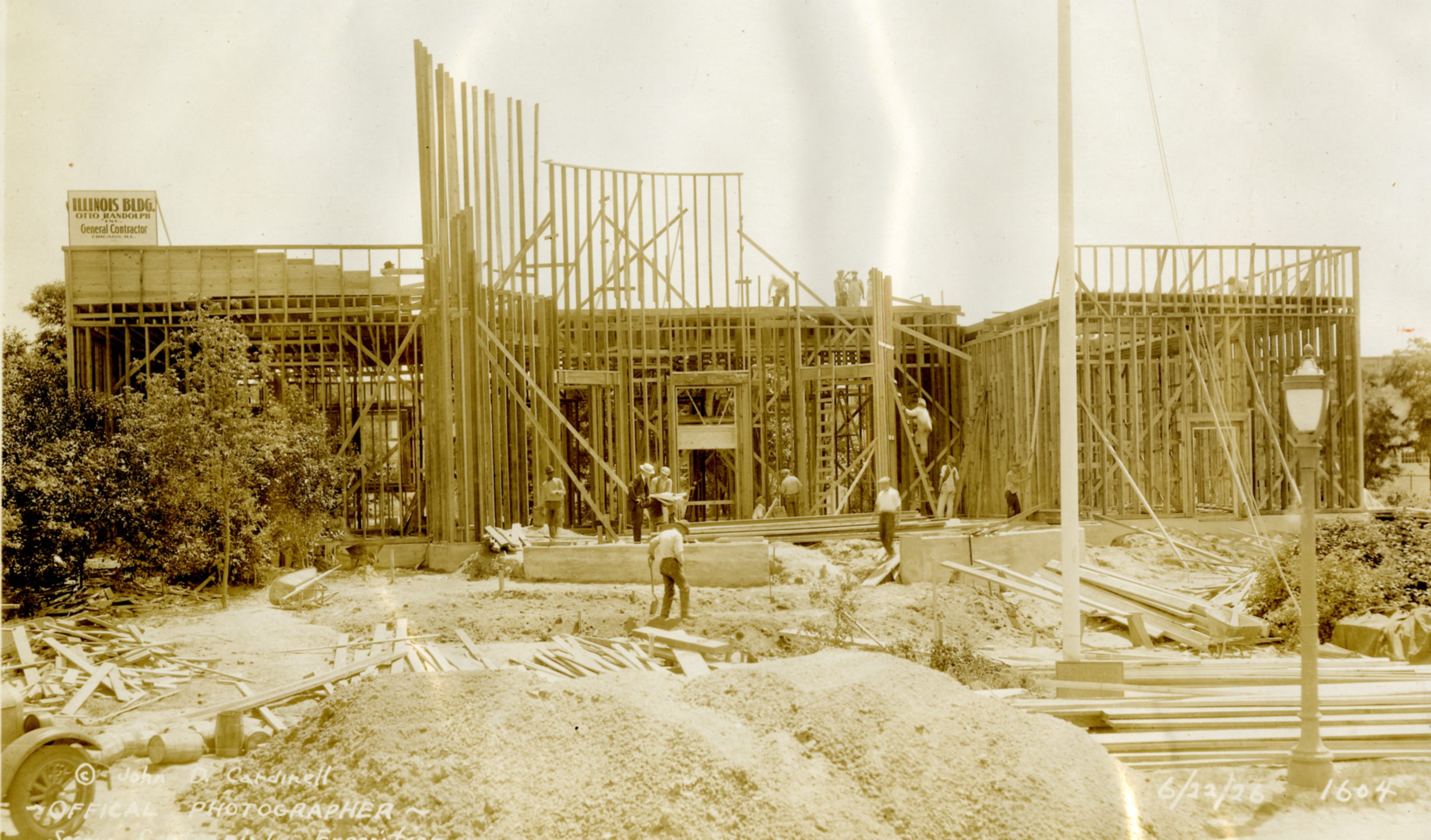
Even then, Kirk prioritized lucrative city contracts and property value enhancement around the new site near the Philadelphia Navy Yard over real progress on the grounds themselves. Construction only began in the fall of 1925, not nearly soon enough for the grand opening on May 31st, 1926. Several buildings, including the Illinois building, the Persian building, and the Talbot Lagoon, remained under construction into mid-June, weeks after the Exposition opened.
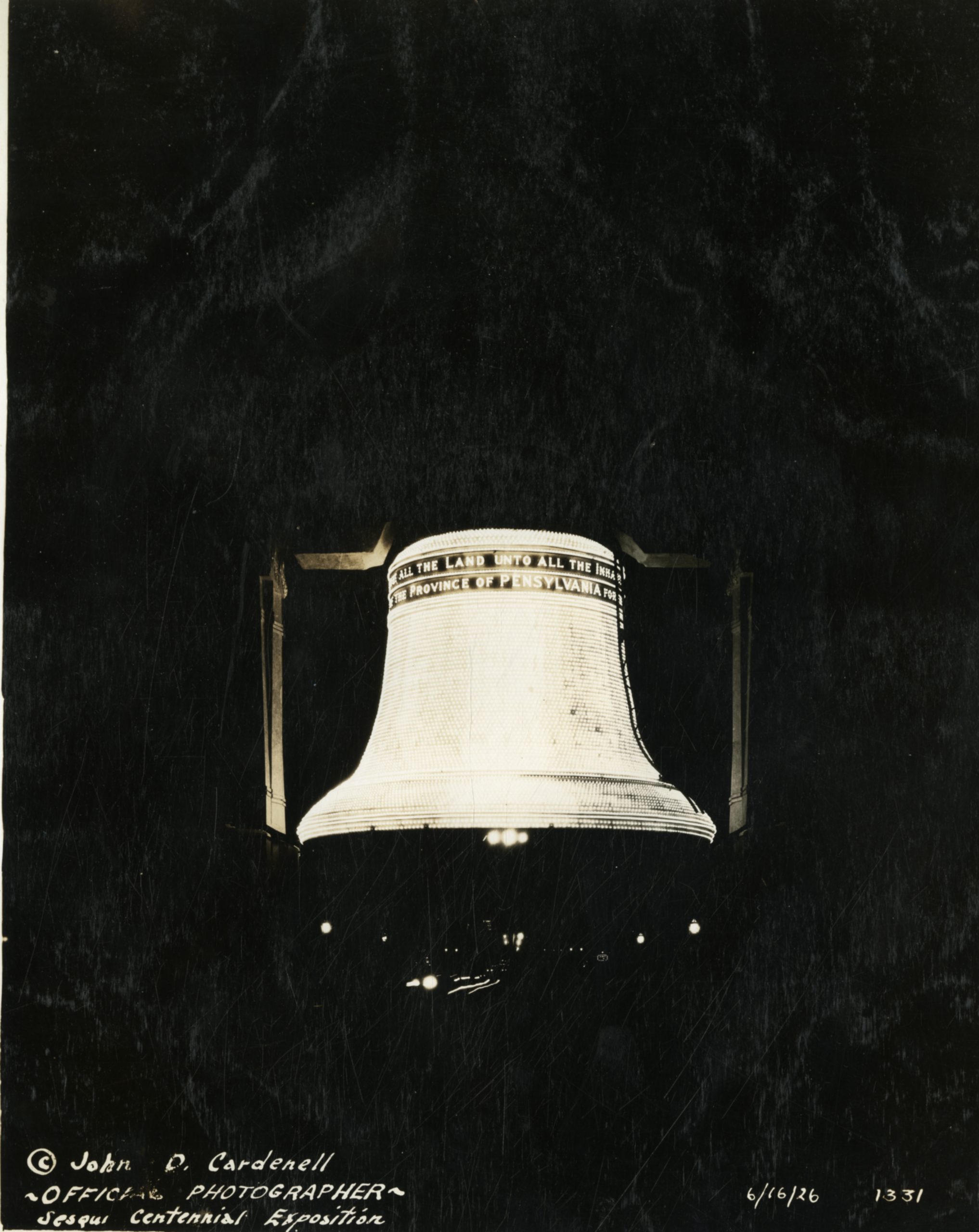
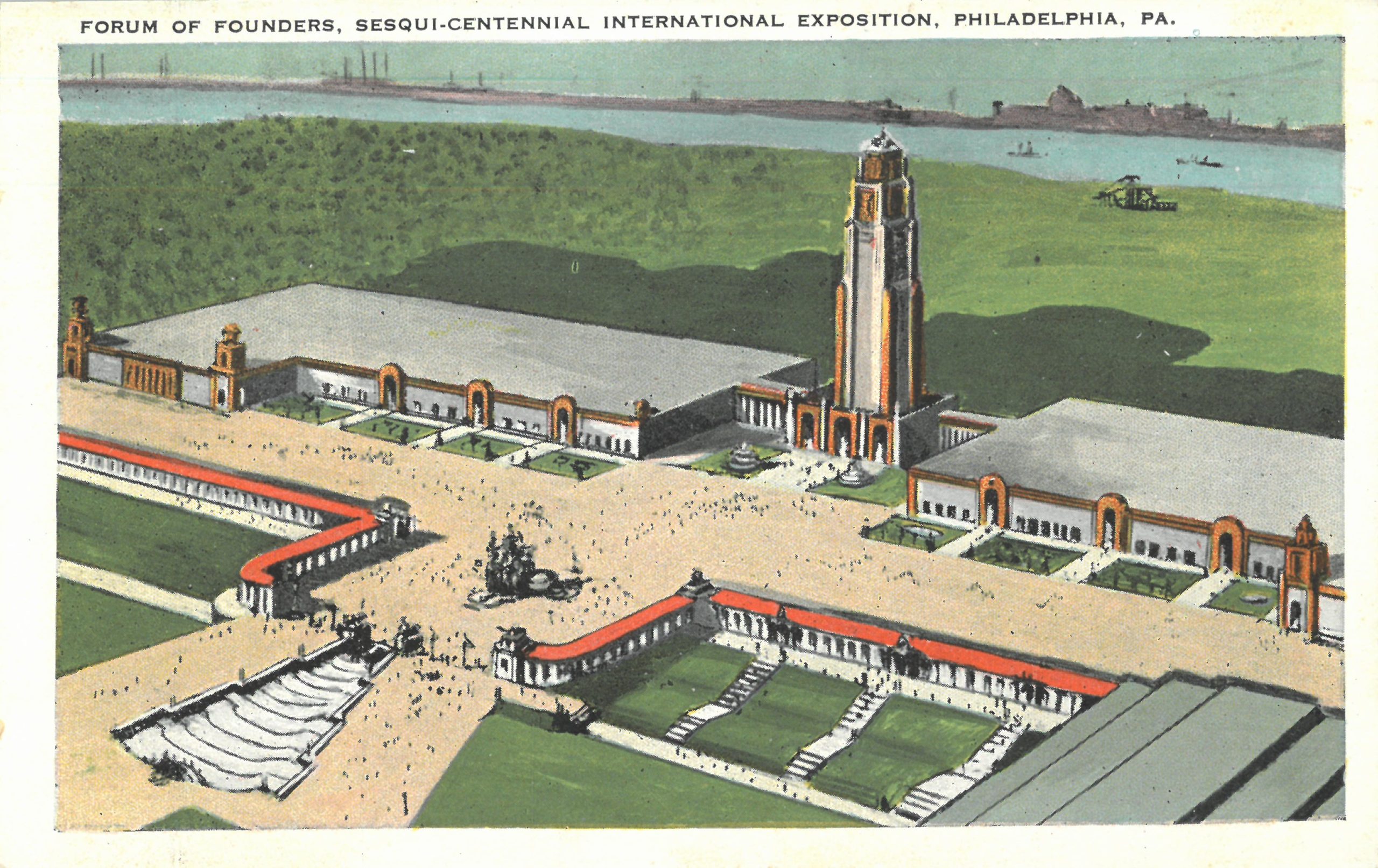
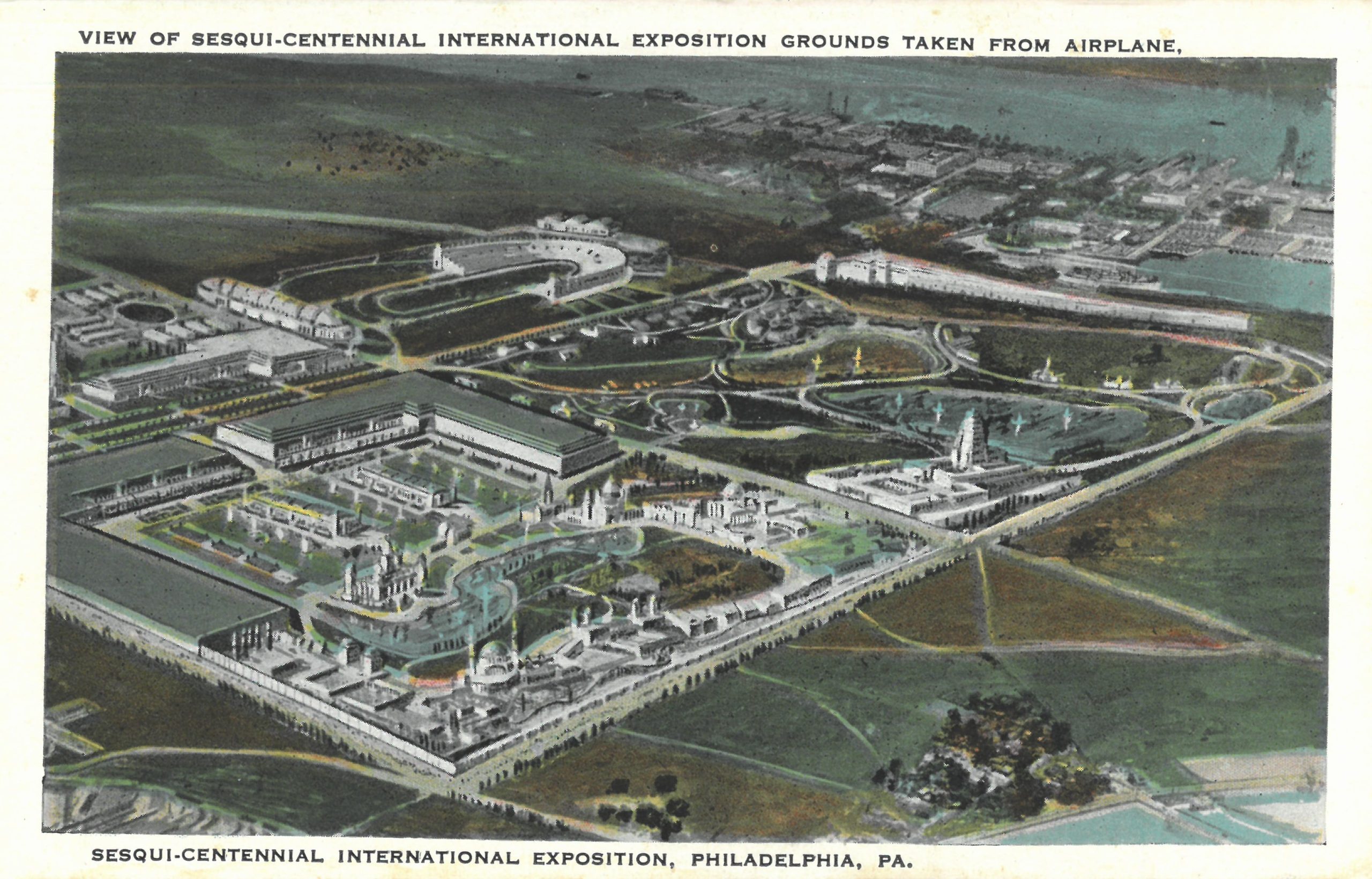
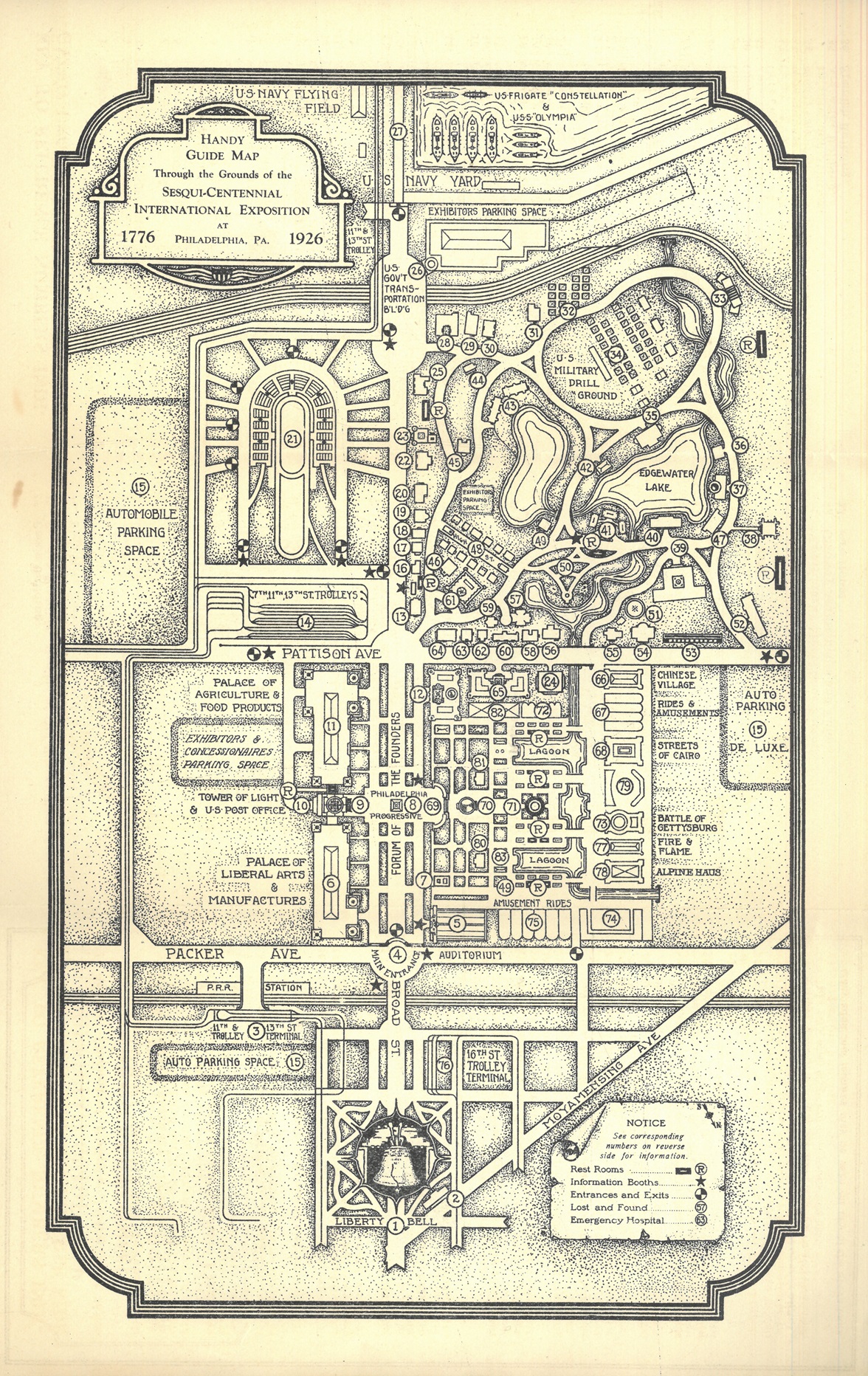
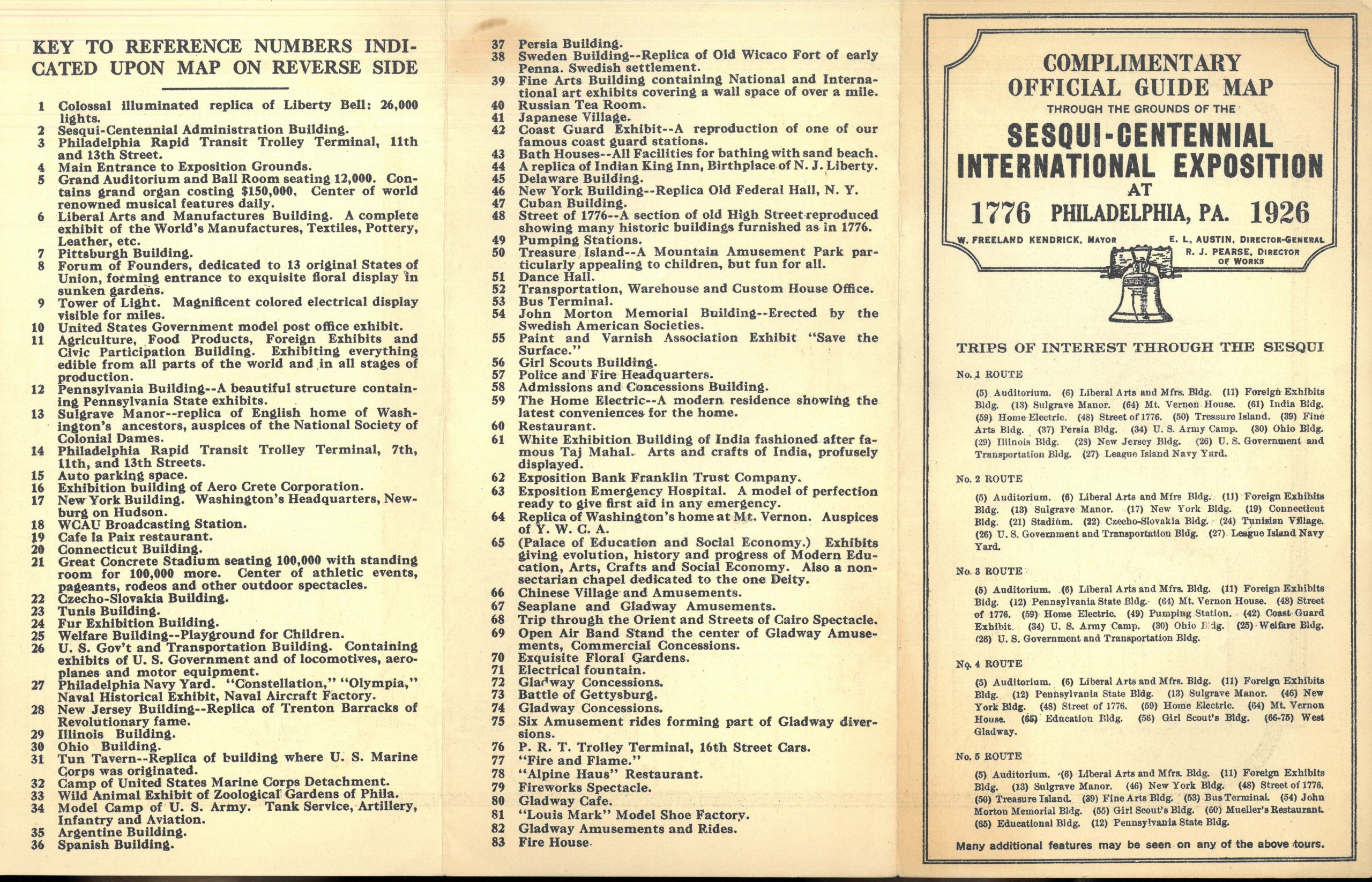
Despite the complications, by the end of the show, the 1926 Exhibition had an incredible array of buildings, including a full stadium and its own hospital and fire department. Keeping with the style of a world’s fair, 31 states, 4 US territories, and 9 foreign nations officially attended with their own exhibits. An 80-foot-tall Liberty Bell replica illuminated the evening sky with 26,000 individual bulbs!
Lousy weather plagued the 1926 Exposition, with 107 rainy days out of 184. Compounded with poor public impressions of the events from the chaotic planning period, the weather resulted in low attendance. About 6.4 million people attended the Exposition, though only 4.6 million paid. The Crown Prince and Princess of Sweden attended, and others include Jan Ciechanowski, Prime Minister of Poland, and Dr. Hernan Valerde, Peruvian Ambassador to the United States. Compared to other expositions of the era, however, foreign interest in the Sesquicentennial suffered as well as domestic interest.
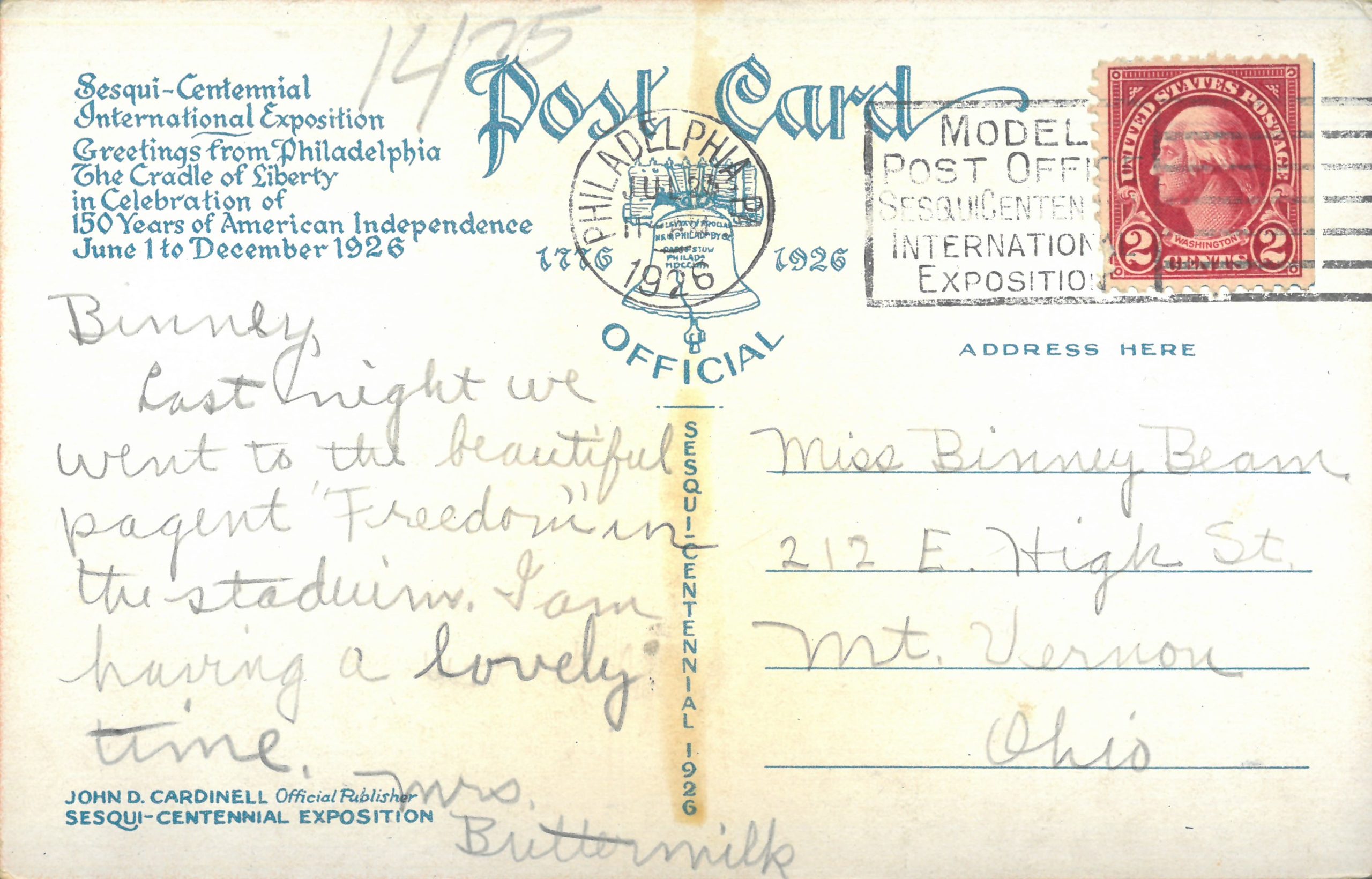
Still, those who attended still enjoyed the Exposition, describing their experiences on specially-designed sesquicentennial postcards sent to friends and family at home. A woman named Hilda, who visited the Nuremberg Building, wrote to a B.C. Mueller, and described “lingering over a stein” (of near beer, thanks to Prohibition) served by the German staff. A “Mrs. Buttermilk” (probably a nickname) attended the Freedom Pageant and overall enjoyed a “lovely time.”
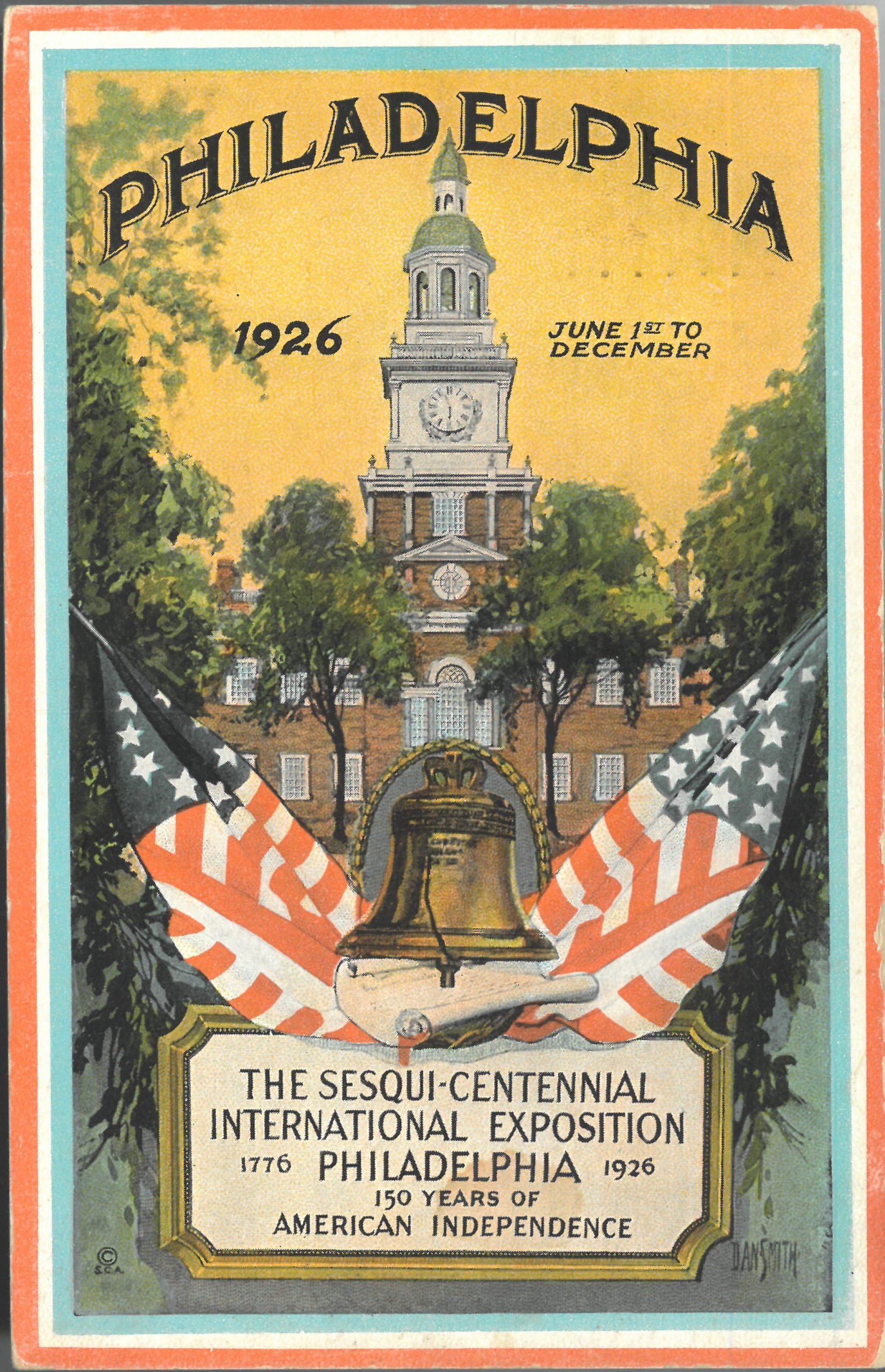
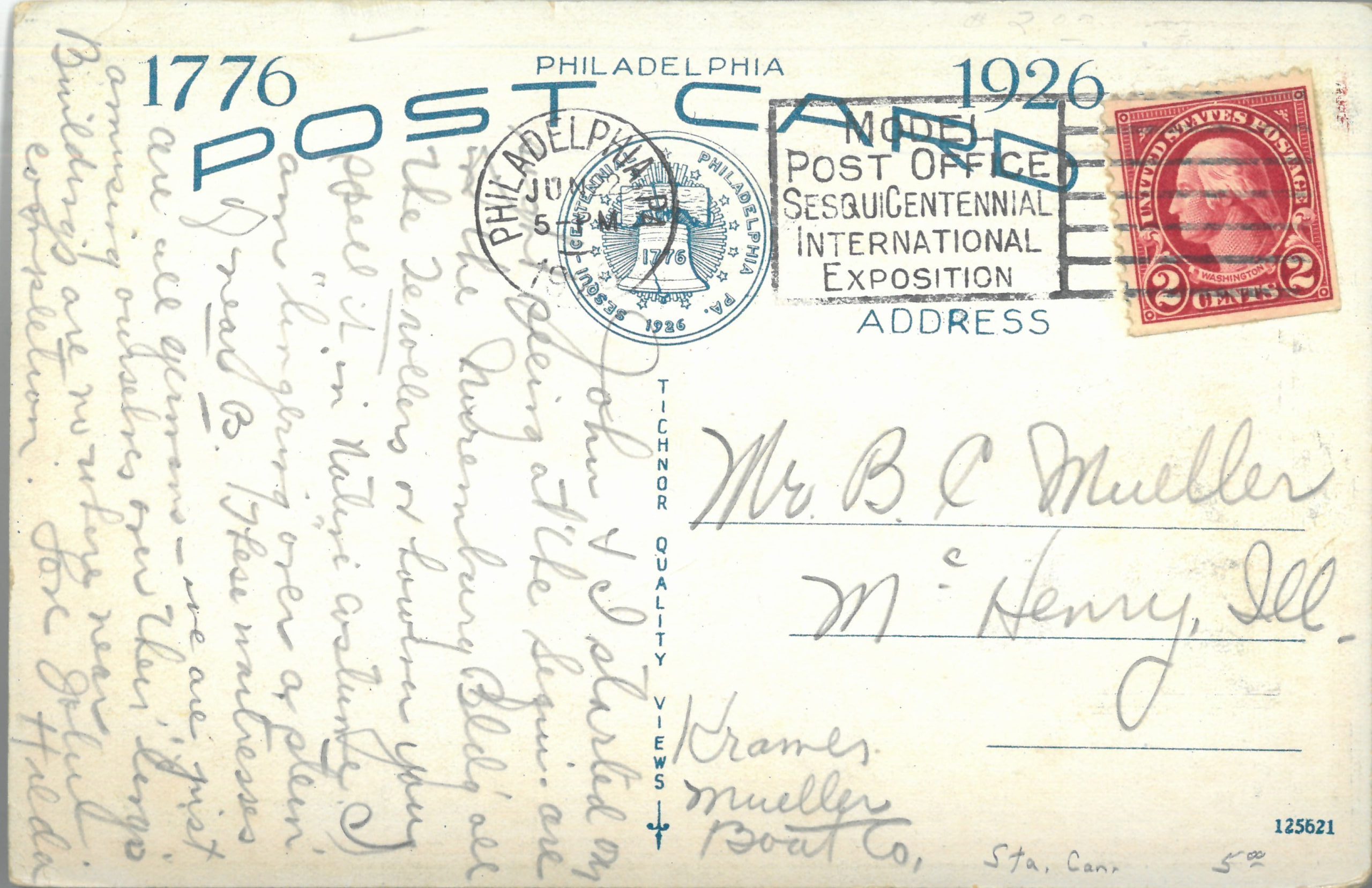
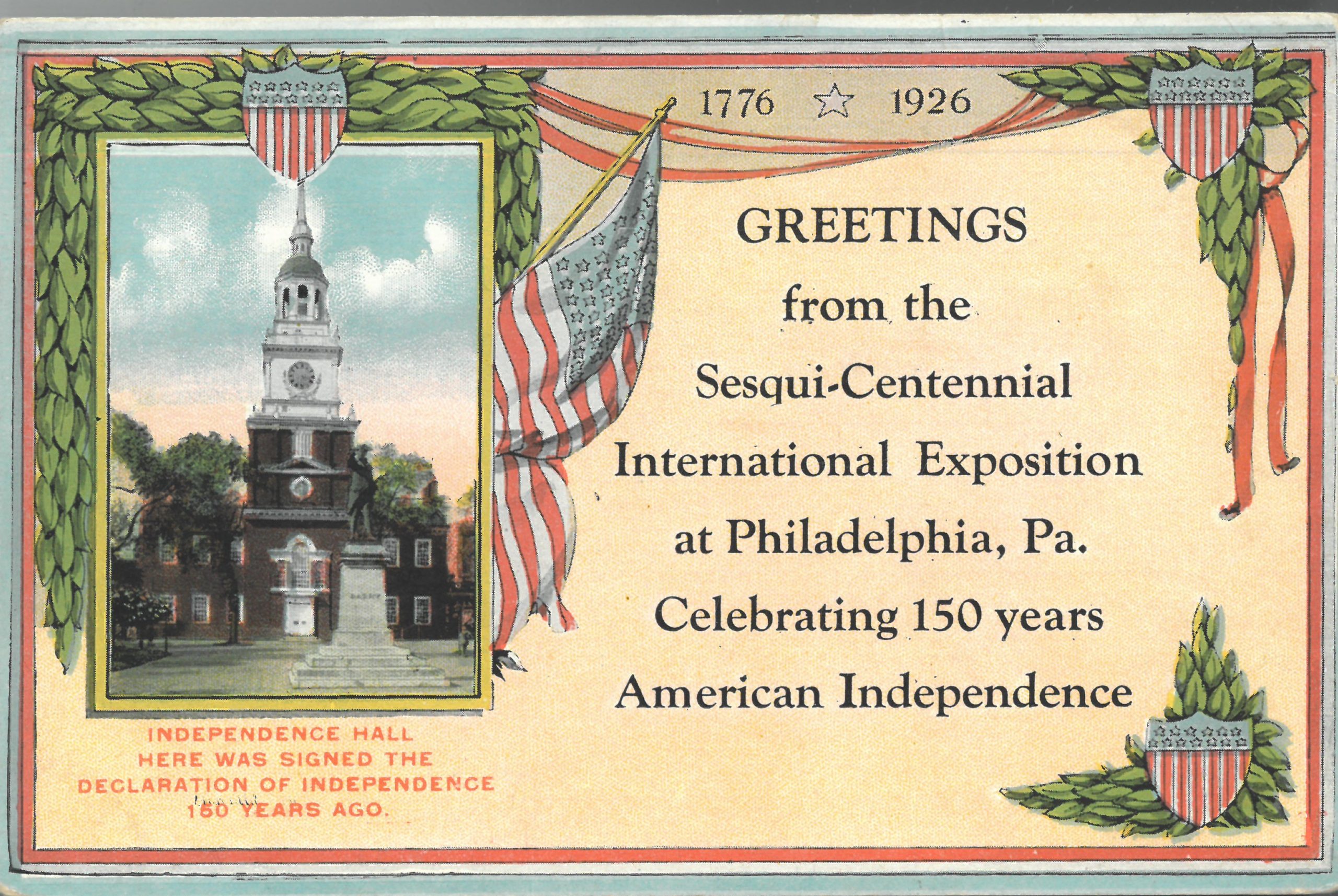
Unfortunately, as a corporate venture, the event suffered rather spectacularly from poor planning and execution. The Sesquicentennial Exhibition Association went into debt to host the celebration, failed to take in enough proceeds to cover its costs, and entered receivership in 1927 before selling off its assets. The former fairgrounds became FDR Park, sports complexes, and the Packer Park Neighborhood.
Like the rest of America, 1920s Philadelphia experienced increasing police activity to enforce the Volstead Act’s prohibition of alcohol. Between 1924 and 1925, Marine Brigadier General Smedley D. Butler became the head of the Department of Public Safety, appointed by Republican Mayor W. Freeland Kendrick. By appointing Butler, a Democrat, Kendrick intended to display a non-partisan approach to Prohibition. Butler, in turn, took the lead on alcohol enforcement, and he, even more than Mayor Kendrick, remains the key figure to understanding Prohibition during the Sesquicentennial celebration.
Butler seemed the perfect candidate that Kendrick sought: hard-headed and honest, stubborn, and an advocate for discipline. Kendrick believed that with these traits, Butler could best enforce the law in Philadelphia. Butler hesitated, concerned that the new job might undermine his career advancement, but in December 1923, he took the position under the following conditions: Butler required the authority to hire and terminate policemen directly, an increase in police salaries, the freedom to work independently without interference from the mayor, and retention of his military rank. Butler made known that Kendrick would receive his resignation should the Mayor violate their agreement. The independence that Butler demanded proved to aid both his and Kendrick’s downfall.
Butler went right away into enforcing the prohibition laws in the city with genuine enthusiasm for his new authority. Under his surveillance, the police raided and padlocked saloons and cafes known to sell alcohol, or placed them under the supervision of assigned police officers. Special “hotel detectives” snooped through overnight establishments, looking for off-the-menu intoxicants. Butler wasted no time–under their new chief, Philadelphia police conducted 484 raids in just the first week of office!
Brewing companies seemed to play a game of tug-of-war against Butler’s enforcement. Outwardly, the brewers switched to producing “near beer,” boiling down standard 5% alcohol content to 0.5% or less, but in secret, these companies had other plans. In spite of Butler and his hotel detectives, truckloads of real beer regularly disappeared from the breweries.
Mayor Kendrick quickly blamed the unpopular Prohibition crackdowns on General Butler. Kendrick declared that he knew no more about the Department of Public Safety’s activity and operations than the average citizen. He finally replaced Butler with a new man, Elliott, who nevertheless went on to follow similar practices by continuing to employ men who had previously worked for the former Department Head. The fight over Prohibition in Philadelphia, as in the rest of the country, continued throughout the 1920s.
Pennsylvania’s “blue laws” remained in force from 1794. Nearly all Christians consider Sunday the Sabbath day of rest, and in a state originally founded by William Penn, the idea of limiting commercial and other activities on Sunday appealed to Quakers, Presbyterians, and other influential denominations. These religiously motivated regulations restricted numerous activities on Sunday, including athletic games.
In 1926, July 4th fell on Sunday, and this unique occasion allowed an opportunity to relax the blue laws so that teams like the Philadelphia Athletics Professional Baseball Club could experiment with Sunday games. John B. Shibe, vice president of the Athletics, took the opportunity to host a baseball game that very day. The news rules allowed the Athletics to generate additional income, but in 1926, many religious groups still opposed the idea of entertainment on the Sabbath.
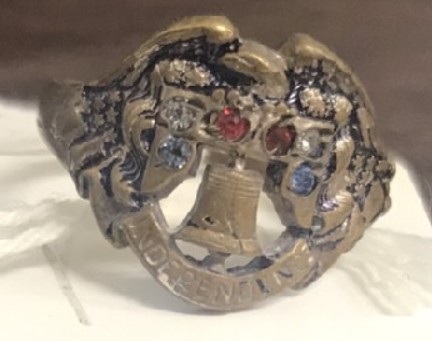
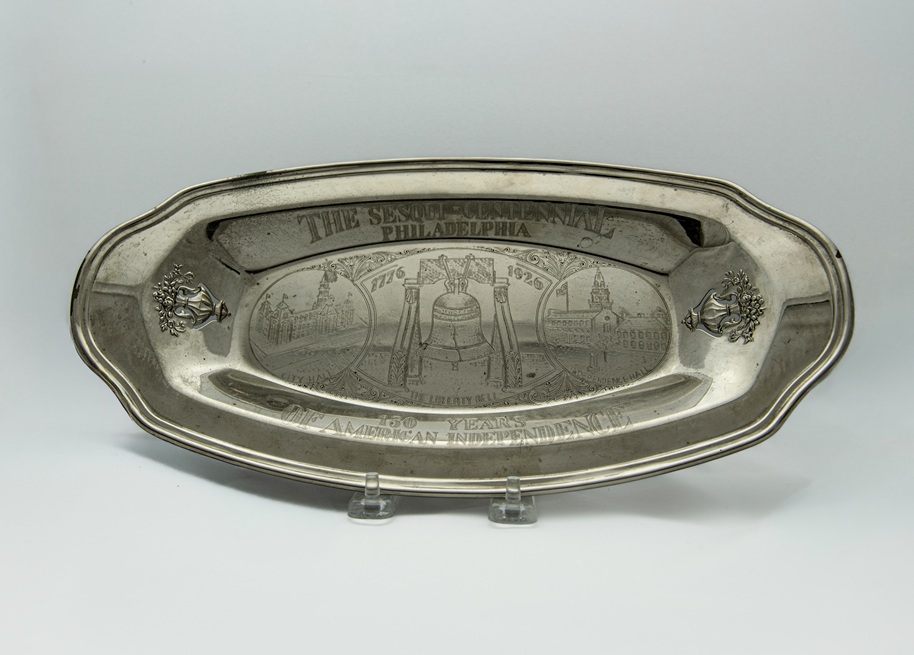
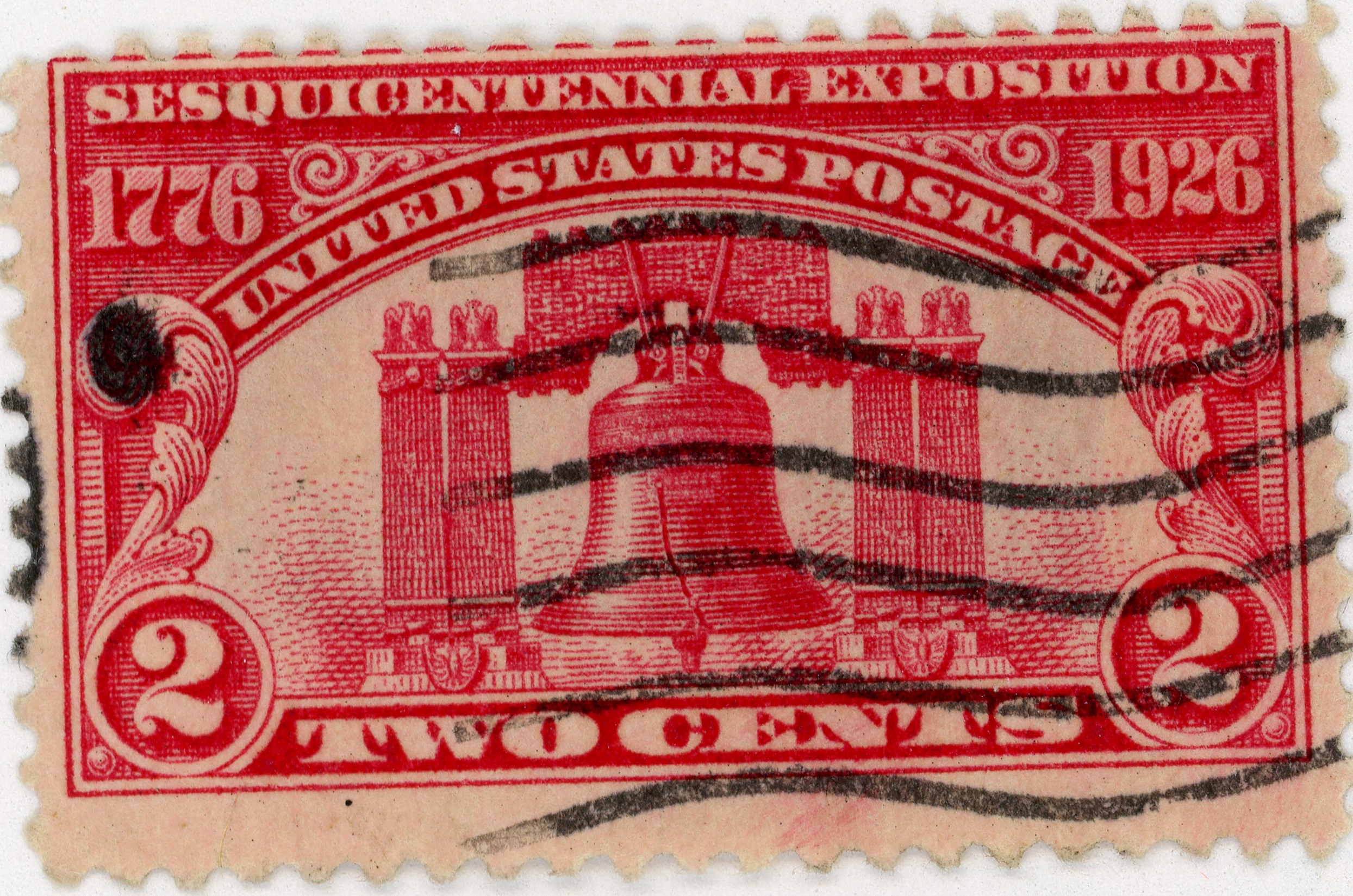
No exposition would be complete without its souvenirs! Postcards that could be sent from the on-site post office, complete with commemorative stamps issued by the United States Postal Service. Visitors received an official guide that doubled as a souvenir. Items available for purchase included a commemorative ring featuring the Liberty Bell with red, white, and blue stones on the yolk of the bell. Other examples include a commemorative fob watch embossed with 1776 on the cover, and silver serving trays with Independence Hall and the Liberty Bell etched into the tray. The Exposition presented endless merchandising opportunities, and patrons bought all types of items.
The Exposition planners famously arranged commemorative coinage made for the event, made across town at the Philadelphia mint! Congress authorized the minting of one million pieces, with samples flown via airmail to Washington DC for examination. These half-dollar coins featured Presidents Washington and Hoover on the obverse (front) of the coin, and the Liberty Bell (1776-1926) on the reverse side–the first time that a living president appeared on US currency.
Commemorative coins had not yet caught on with the American public. The half dollars sold even worse than entry tickets due to a general lack of interest and the fact that the sales price amounted to twice the coins’ face value of 50 cents. Of the one million offered for sale at $1, only around 150,000 sold, and the Mint melted down the remainder to recover the silver.
America celebrated its Sesquicentennial with a few other events beyond the Philadelphia Exposition. On December 7, 1925, Congress created the Sesquicentennial of American Independence Commission and the Thomas Jefferson Centennial Commission in preparation for the one hundred fiftieth anniversary of the signing of the Declaration of Independence and the one hundredth anniversary of Thomas Jefferson’s death.
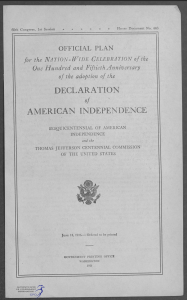
The official plan published by Congress in 1926 and signed by President Coolidge highlighted the duties of the commission and outlined the nationwide preparations leading up to Independence Day. Nineteen members served on the committee: “the President of the United States, the Vice President of the United States, the Speaker of the House of Representatives, ex officio; eight persons to be appointed by the President of the United States; four senators by the Vice President; and four Representatives by the Speaker of the House of Representatives.” In an address to the public, President Coolidge emphasized the importance of the Declaration of Independence as an “immortal document” and praised Jefferson’s achievements in crafting it, along with other Jeffersonian accomplishments, such as his reforms in Virginia and the Louisiana Purchase. Coolidge thus dedicated the week from June 28 to July 5, 1926, as American Independence Week. Each day represented a theme or idea in which the commission called for all communities in the United States to observe the Sesquicentennial through various celebrations:
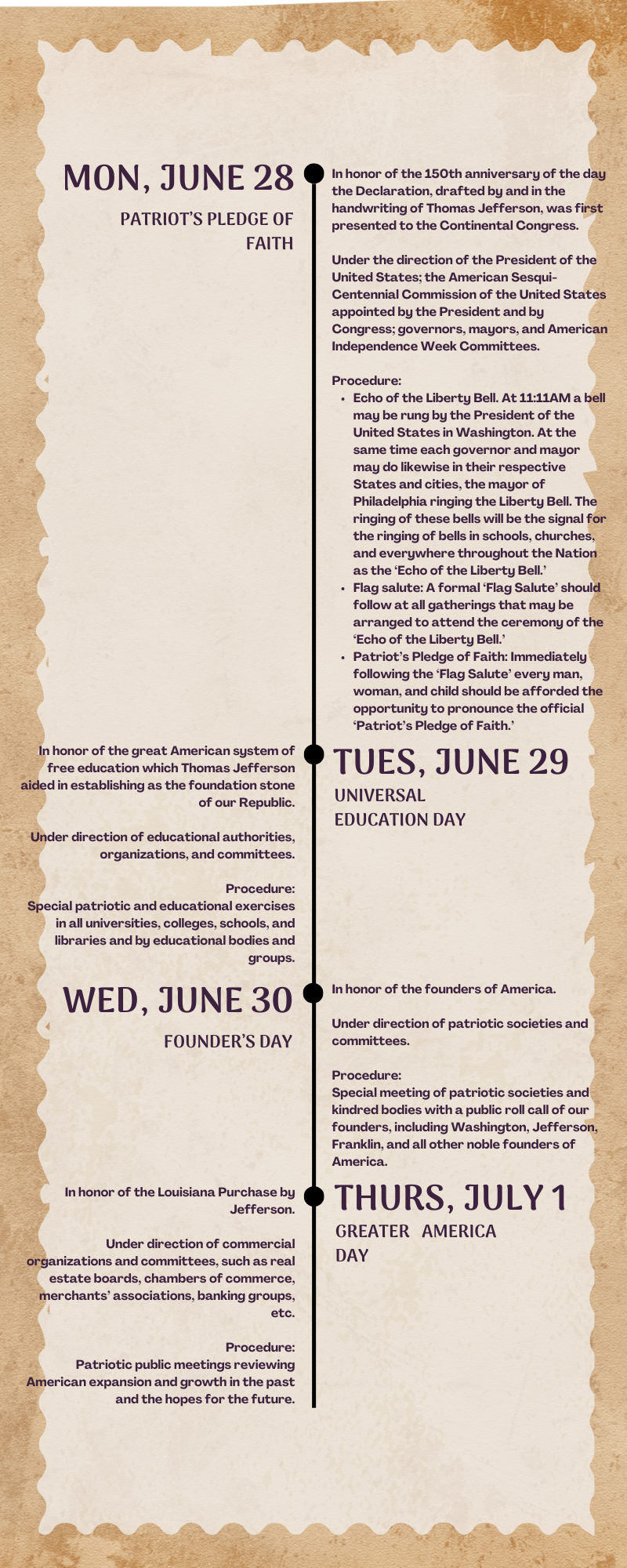
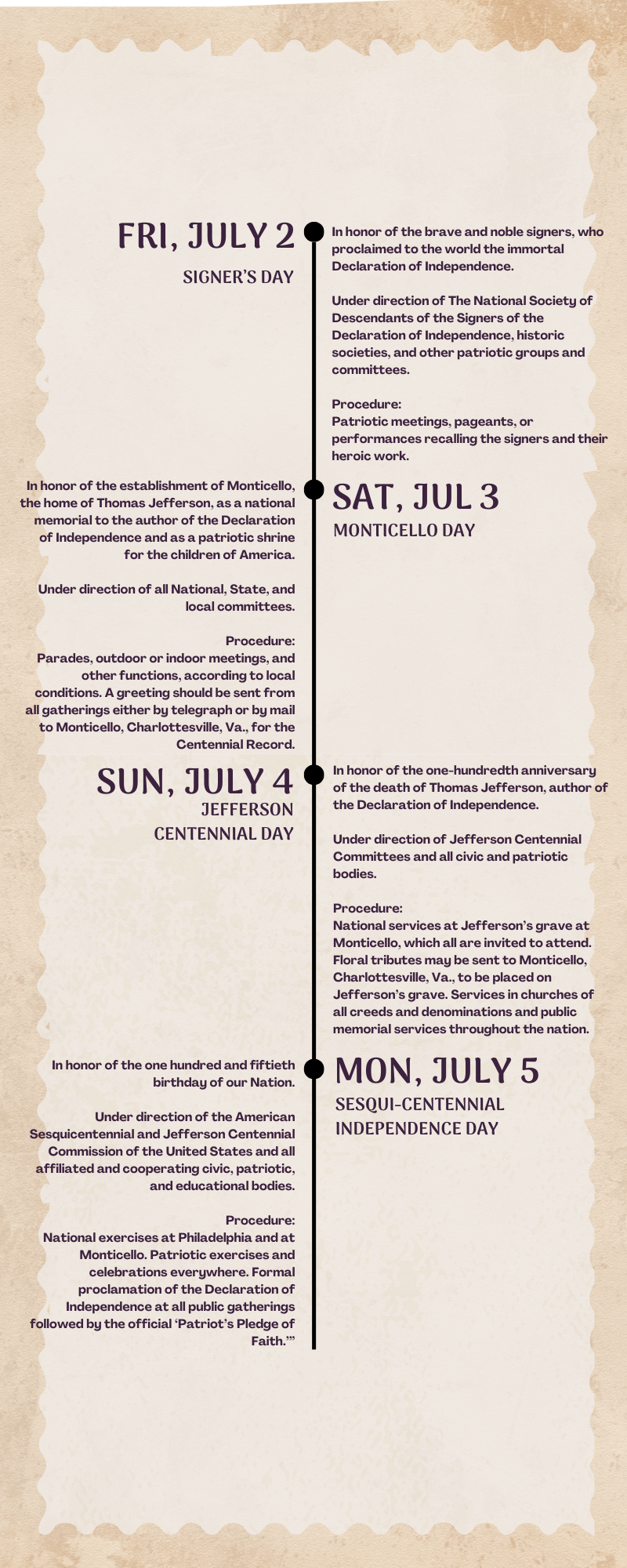
The commission recognized the achievements of Thomas Jefferson with events like Universal Education Day, Greater America Day, Monticello Day, and Jefferson Centennial Day. The official plan document concluded with instructions for how to carry out these celebrations, and urged participating local committees to “adopt only such parts of the program as you can reasonably expect to carry out successfully, bearing in mind that the purpose is educational and patriotic.” The commission aimed to educate all Americans on Jefferson’s legacy and his impact on American history and ideals. The plan outlined by Congress and President Coolidge gives insight into the values that influenced Sesquicentennial planning, including education, patriotism, and the military.
Patriot’s Pledge of Faith Day marked the start of WWI, which escalated from the assassination of the Austro-Hungarian Empire’s Archduke Franz Ferdinand in Sarajevo on June 28, 1914. Twelve years later, under the Centennial Commission’s guidance, bells rang across the United States at 11:11 am. While the date coincided with the beginning of the Great War twelve years prior, the chosen time honored its end. The armistice took effect at exactly 11:11 on November 11, 1918, marking the end of the war as well as the beginning of an independent Polish state. In 1926, the United States received 111 volumes of signatures from nearly 5.5 million Poles, including government officials, dignitaries, and schoolchildren, known as “The Polish Declarations of Admiration and Friendship.” Poland presented the unique document to President Calvin Coolidge as a thank you for U.S. aid during the war and as a pledge of friendship between the two allied nations.
Poland, indeed, ranks as one of America’s oldest allies, as individual Poles fought alongside Americans in the American Revolutionary War. Thaddeus Kościuszko and Casimir Pulaski, for example, fought with the Americans and contributed to the Revolutionary effort by using their tactical and cavalry knowledge, respectively, to advance the American cause. Thus did Poland assist the young United States’ independence.
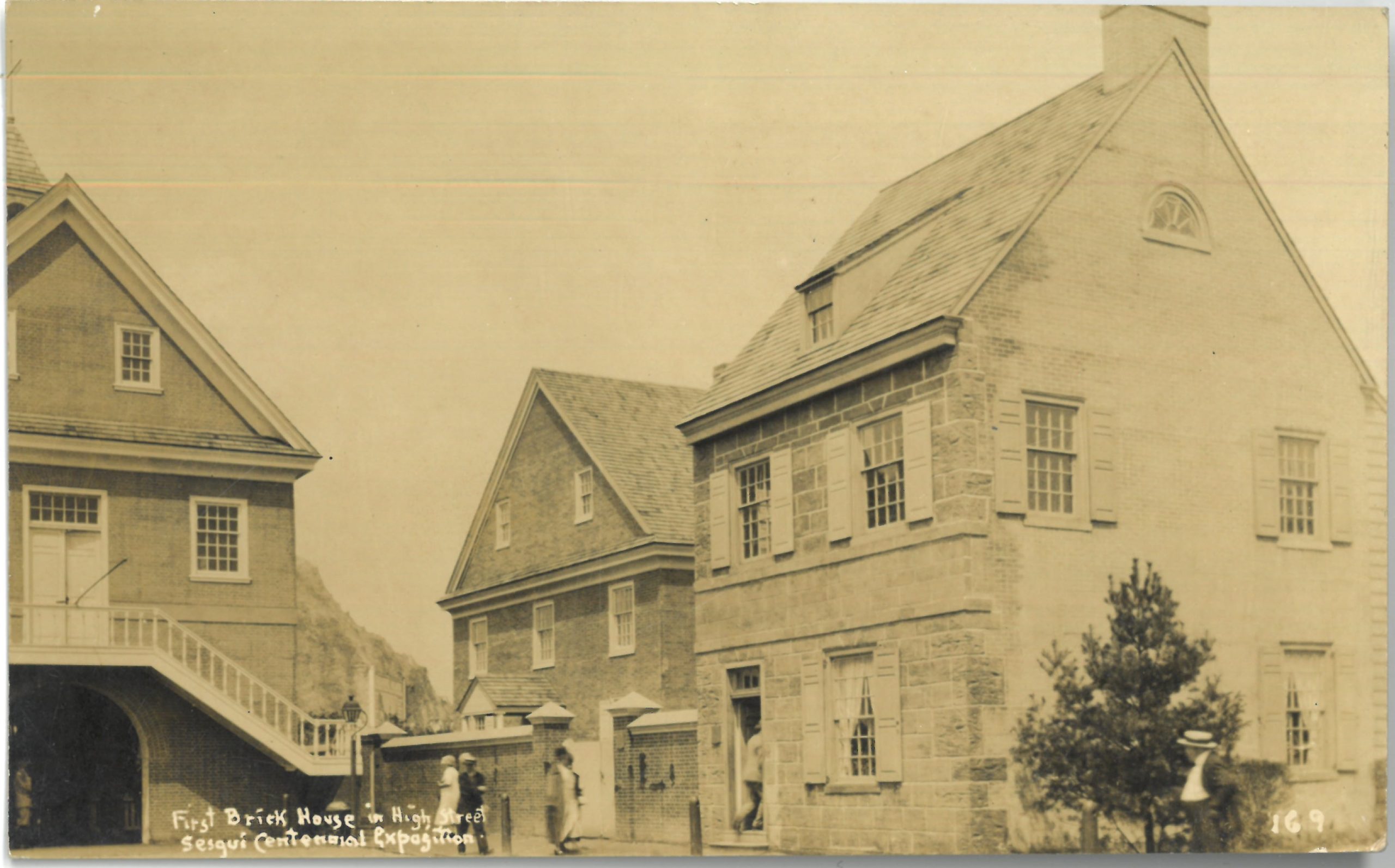
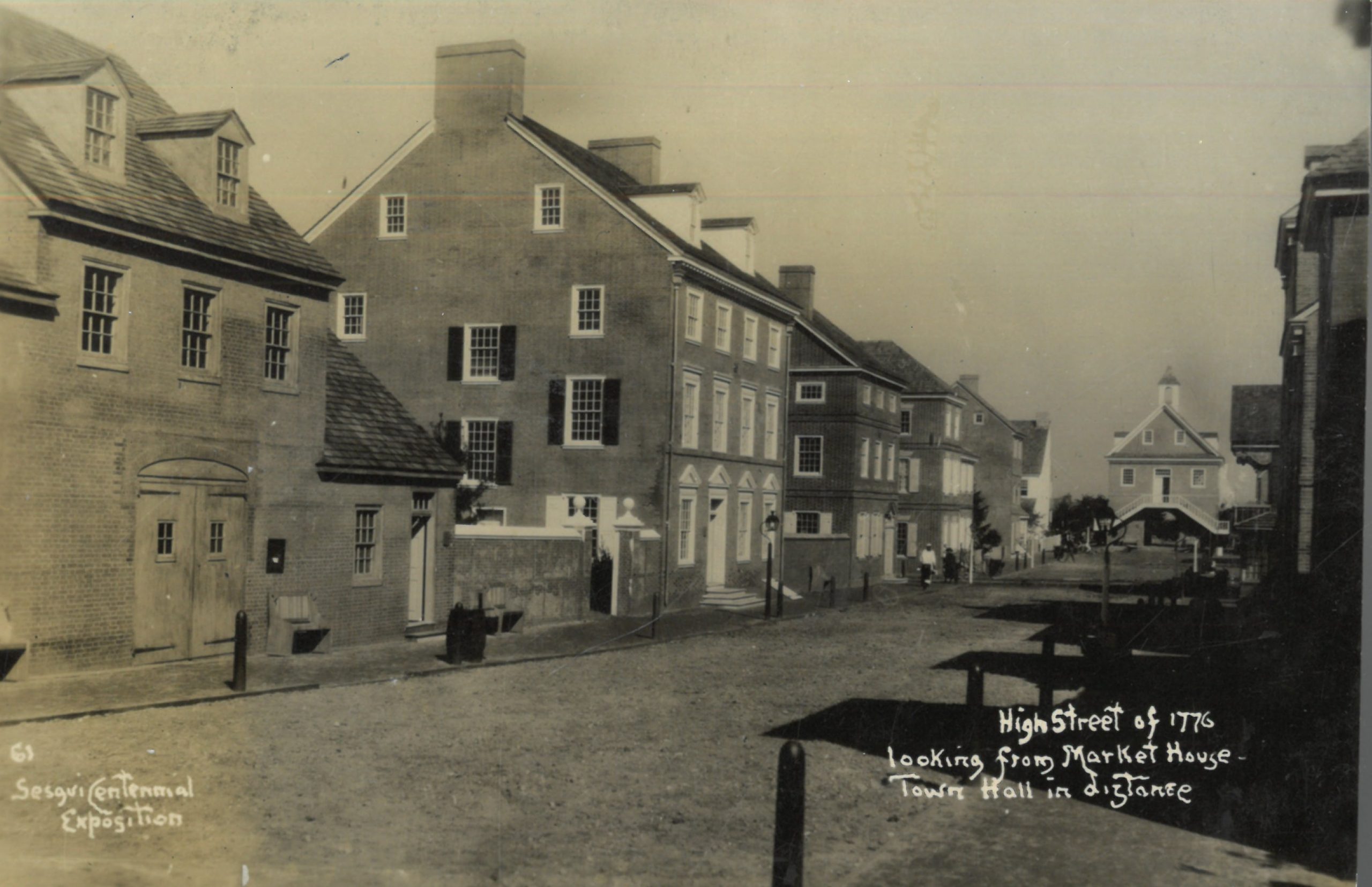
One of the Exposition’s most popular displays, the High Street Exhibit, could not have been completed without the dedication of women’s groups committed to educating the public on American life and the history of the eighteenth and nineteenth centuries. Once the Expo was finished, they established the Committee of 1926 to continue their efforts beyond the Sesquicentennial and create a museum to showcase early Philadelphia history.
Sidney Fiske Kimball, an architect and director of the Philadelphia Museum of Art, assisted the Committee by suggesting that they lease the Strawberry Mansion from Philadelphia. Judge William Lewis originally constructed Strawberry Mansion in the 1780sand occupied the house until he died in 1819. It then passed to Judge Joseph Hemphill and his wife, followed by Mr. George Crock, who sold it to the city of Philadelphia. The women oversaw the restoration process to recapture the house’s appearance from the 1830s. Elizabeth Price Martin served as the first chairwoman of the Committee of 1926 and as the leading force in conceiving the High Street exhibit and the restoration of Strawberry Mansion. Sarah D. Lowrie, who also assisted greatly with the High Street Exhibit, played a leading role in the restoration of the mansion, and Mrs. Harrold Gillingham donated significant items for the home’s interior.
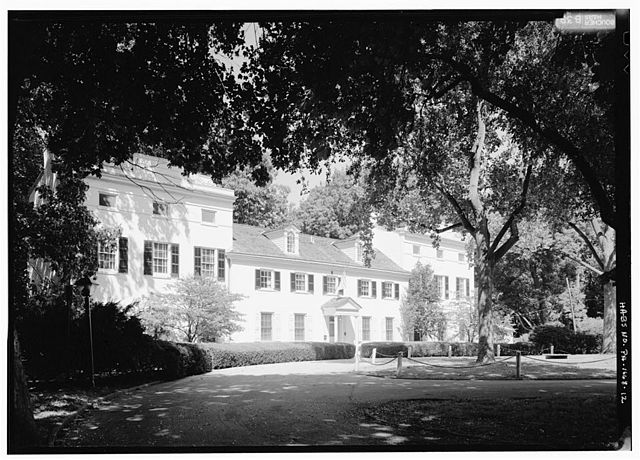
Strawberry Mansion opened to the public in 1931, hosting social functions and parties. The women of the Committee continued to dedicate their time and skills to the house and its collection. Despite the struggles and downfalls of the Sesquicentennial Exposition in Philadelphia, the event led to the further preservation efforts of historical sites like the Strawberry Mansion, which still stands today, 100 years later.
Many of the buildings and exhibits at the Sesquicentennial were named after countries and states. Use the word bank to locate some of the places visitors could experience through the Exposition.
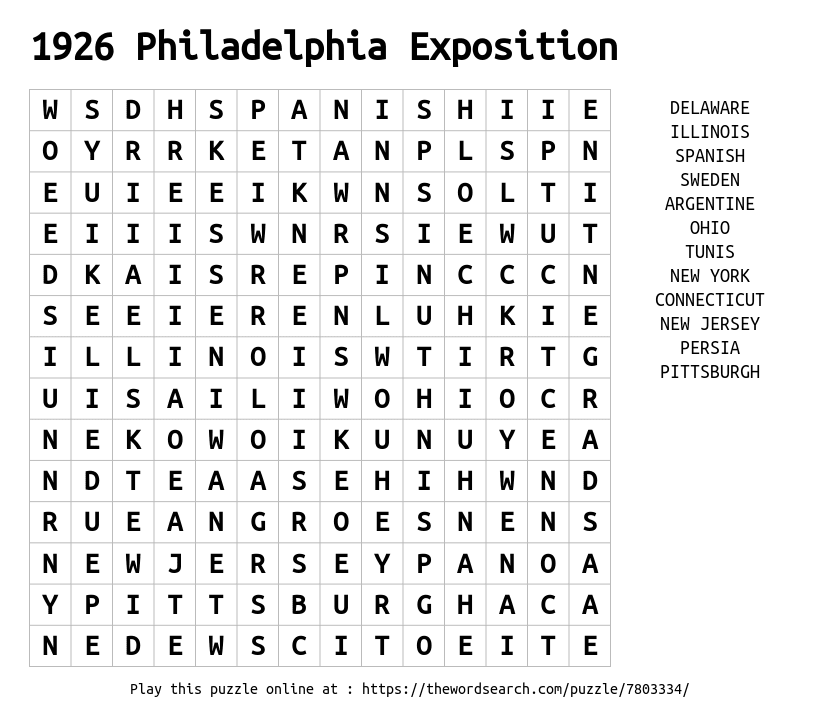
Print the word search or play it at https://thewordsearch.com/puzzle/7803334/1926-philadelphia-exposition/
Use the template below to make your own postcard. Write a message to someone as if you were visiting the Philadelphia exposition. What might you have seen?

Historic Strawberry Mansion. “The Committee of 1926.” Historic Strawberry Mansion Official Website. https://www.historicstrawberrymansion.org/history-and-timeline/the-committee/.
Leichtman, Ellen C. “The Machine, The Mayor, and the Marine: The Battle over Prohibition in Philadelphia, 1924-1925.” Pennsylvania History: A Journal of Mid-Atlantic Studies 82, no. 2 (2015): 109-39. https://doi.org/10.5325/pennhistory.82.2.0109.
Minnesota Polish Medical Society. “On Gratitude: How 5.5 Million Poles Celebrated America’s 150th Independence Anniversary.” November 7, 2023. https://www.pamsm.org/post/how-5-5-million-poles-celebrated-america-s-150th-independence-anniversary.
Pennsylvania Newspaper Archive. https://panewsarchive.psu.edu/lccn/sn83045211/1920-11-18/ed-1/seq-4/#words=SESQUICENTENNIAL.
PhillyHistory Archive. https://www.phillyhistory.org/PhotoArchive/Home.aspx.
“Poland and the American Revolution.” Museum of the American Revolution. https://www.amrevmuseum.org/poland-and-the-american-revolution#:~:text=Two%20of%20the%20most%20recognized,skills%20to%20the%20Revolutionary%20cause.
United States Congress. House, Calvin Coolidge, United States President, and United States National Sesquicentennial Exhibition Commission. “Official plan for the nation-wide celebration of the one hundred and fiftieth anniversary of the adoption of the Declaration of American Independence, Sesquicentennial of American Independence and the Thomas Jefferson Centennial Commission of the United States.” Washington, D.C.: U.S. Government Printing Office, 1926. https://www.loc.gov/item/2022692683/.
U.S. Army Military History Institute. Music in our Army: The Soul of the Service, Sesqui-Centennial Exposition 1776-1926 Philadelphia. https://www.agcra.com/blog/army-bands-during-the-1926-150th-celebration-of-the-united-states.
[1] Photographer John C. Cardenell, June 26, 1926. Photo courtesy of PhillyHistory.org, a project of the Philadelphia Department of Records.
[2] Photographer John C. Cardenell, June 22, 1926. Photo courtesy of PhillyHistory.org, a project of the Philadelphia Department of Records.
[3] – [11] Private Collection.
[12] Library of Congress, https://www.loc.gov/item/2022692683/.
[13] – [14] Private Collection.
[15] Photographer Jack E. Boucher, “PERSPECTIVE VIEW OF EAST FRONT FROM SOUTHEAST – Strawberry Mansion, Philadelphia, Philadelphia County, PA” Library of Congress, Prints & Photographs Division, HABS PA, 51-PHILA, 219–12, https://www.loc.gov/pictures/item/pa0919.photos.137235p/. See also Wikimedia Commons, https://commons.wikimedia.org/wiki/File:Strawberry-Mansion-HABS_PA,51-PHILA,219-12.jpg.