1820s Men’s Coats
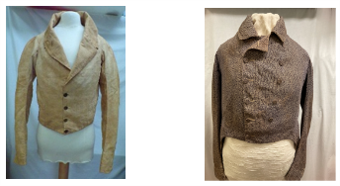
These two garments from the 1820s are products of an era that witnessed significant social and economic changes. Linen was the primary textile for soft fabrics in the British Colonies and the early United States. Linen was used to make undergarments, bedding and lightweight summer clothing. Produced from flax, linen was an expensive and time-consuming fabric to produce. Between cultivation and tedious processing of the flax plant, it could take a year to make linen. Approximately a quarter of linen produced from one crop would be suitable for clothing. Linen fibers could not hold dye, so a consumer’s options were limited to the natural or bleached color of the fabric. Some linen was produced in the Colonies, but the majority were initially imported from Great Britain. Slowly, the colonial industry of linen products grew. Boycotts of goods in response to the Intolerable Acts rejected the mandatory import of British goods under the mercantile system. This pushed the need for higher domestic production of many products including linen. By the time of the American War of Independence there was a strong linen manufacturing economy flourishing in the British Colonies. This industry continued after the United States gained independence, but technological advances during the Industrial Revolution challenged linen’s place in the textile industry.
The Industrial Revolution continued to gain momentum and new manufacturing techniques coupled with additional technological advances of the time allowed for greater accessibility to quality clothing materials. Cotton specifically emerged as a prominent fabric. Adding to the astonishing improvement in cotton production as result of Ely Whitney’s cotton gin in 1793, the introduction of the power loom in the U.S. in 1816 fueled an 1820s economy increasingly supported by the rapid growth of cotton production in the South and cotton textile manufacturing in North. By 1821, cotton comprised nearly half of the country’s exports and by 1830 the U.S. produced about half of the world’s cotton production. These facts contributed to the growing divide in the United States.
Textile manufacturing, as well as the consumer, also benefited from improvements in transportation. The number and reach of developed roads continued to grow; the importance of the steamboat continued unabated, and the Erie Canal opened in 1825. It was the latter event that rocked textile manufacturing. The 364-mile canal, stretching from Lake Erie to the Hudson River, reduced the transportation costs of goods between Buffalo, NY and New York city from $100 per ton to $5 per ton. The success of the Erie Canal launched a canal building boom. With improvements in transportation, as well as technology—quality, fashionable clothing became increasingly available to the average person. One might even be able to purchase a tailcoat in a shade of purple.
The White Linen Jacket
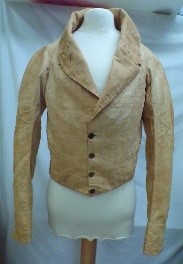
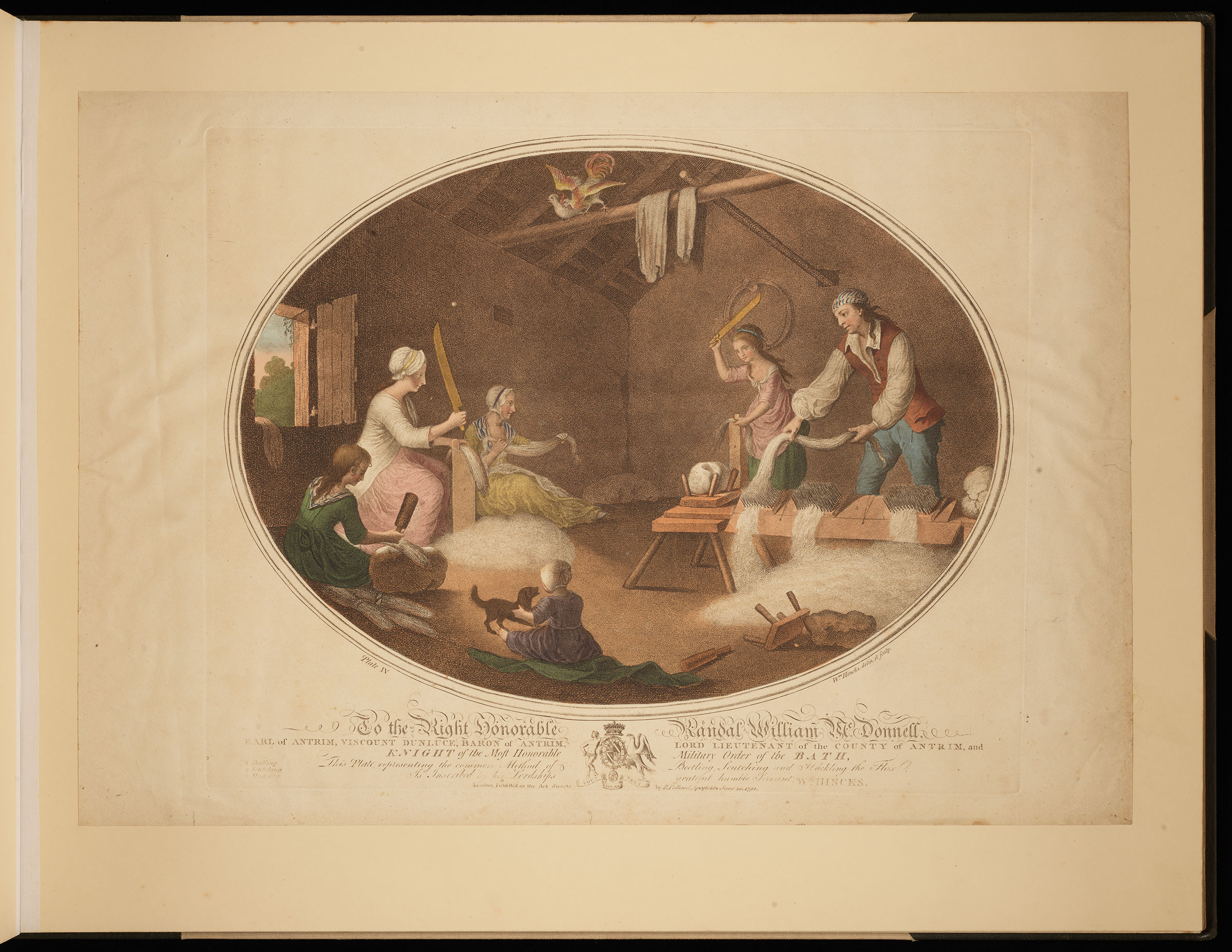
Linen was the primary textile for soft fabrics in the British Colonies and the early United States. Linen was used to make undergarments, bedding and lightweight summer clothing. Produced from flax, it was predominantly a homegrown product. Some linen was produced for commerce in the Colonies and the British Isles, but more often European settlers would grow and process their own flax for the linen goods they needed. Boycotts in response to the Intolerable Acts drove the need for more domestically produced linen. By the time of the American War of Independence there was a strong linen manufacturing economy flourishing in New England colonies.
Linen was an expensive and time-consuming fabric to produce. Between cultivation and tedious processing of the flax plant, it could take a year to make linen. Approximately a quarter of linen produced from one crop would be suitable for clothing. Linen fibers could not hold dye, so a consumer’s options were limited to the natural or bleached color of the fabric.
Utilitarian Gentleman
The linen jacket is an example of a gentleman joining comfort with limited fashion options in the early 19th Century. The linen would be more comfortable over wool to wear during summer months, but a colorful pattern would not be an option. The jacket has a single row of four buttons. The high collar and wide lapels were the fashion of the time. Ultimately the design of the jacket is practical attire over vogue. Not very common civilian fashion for the time is the jacket’s lack of tails. This feature was more common on contemporary military uniforms and demonstrates a possible functional intent for the jacket. The original owner wanted a jacket that offered less encumbrance for an active day.
The Purple Tailcoat
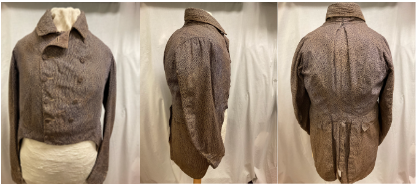
The purple tailcoat is a sign of the times, reflecting the social changes emerging from the 1820s. With clothing becoming more accessible, men’s fashion began to express more of a personal style. This coat is made of calico cotton, a lightweight plain-woven cotton fabric especially suitable for the dying process. It has a wool liner to give the cotton fabric additional shape. The high collar and slight gathering of fabric at the shoulder seam were common features of 1820s style. The coat would have been part of an ensemble that included a colorful under-waistcoat, lighter colored pantaloons or trousers, and folded cravat or stock neckwear. Stock was a shaped band covered with silk, satin, or velvet, secured around the neck by a fasten in the back. The figure below illustrates a full ensemble.
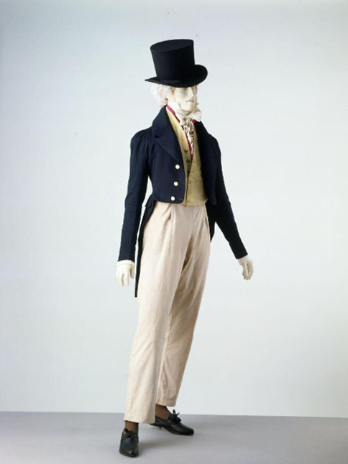
While individual style began to emerge in the 1820s, the purple tailcoat is still unique in at least two ways. First, the shape of the coat is unusual for that era, or any era. The back of the garment is of an unusual shape and has a pleat in the center to allow for additional room, possibly indicating that its owner might have had a curvature of the spine or other condition. Second, black or dark colored tailcoats were still common in the 1820s. The purple tailcoat does not fit that description. So how did our dandy get a purple tailcoat?
Dying To Be an Individual
Along with the Industrial Revolution and improvements in moving goods, the 1820 textile industry benefited from the continued advances in cloth dying techniques. The purple in the tailcoat most likely came from a madder dye, a versatile dye created from the dried ground roots of the madder plant. The red-colored madder when coupled with just the right level of iron mordant produces different shades of purple. Mordant, a metallic salt, was vital to the binding of dyes to fabric to create permanent colors. Without the mordant, the dyes simply wash out. Creating good madder purples required a great deal of experience and skill. Another skill was applying the color prints to the madder purples.

Roller Printing
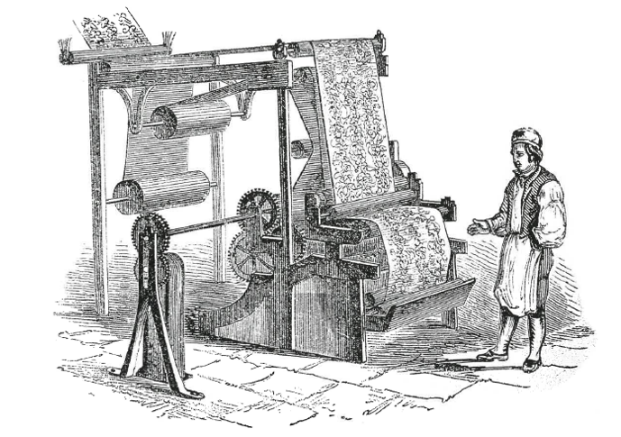
Colorists printed designs on calico cotton by drawing the fabric through a series of rollers on a printing machine. As many as eight colors were applied at the same time by having the same number of engraved rollers each with its own color-trough. The skill was to get the rollers to print the cloth at the precise spots. Once aligned, the rollers produced a pattern with consistency. High quality printed fabrics were available to the masses.
 Weaving It Together
The white linen and purple cotton coats reflect the social, economic, and political issues of the United States in the 1820s. Linen, with a longer production process and failing to keep pace with advances in technology, was eventually replaced by cotton as the fabric of choice. Additionally, cotton fabrics were more conducive to the popular fabric dying process that enabled the creation of the purple tailcoat. With the cost of fashionable clothing decreasing, the working class had more options in terms of dress, significantly influencing U.S. culture in the 1820s and beyond.
The purple tailcoat was a product of the ever-growing divide between the North and the South. The advances in technology and transportation during the ongoing Industrial Revolution in the 1820s elevated the cotton industry to an economic powerhouse with unintended consequences. Cotton growing and harvesting is labor intensive. Plantations in the South relied on enslaved individuals to meet the ever-increasing demand for labor that cotton production required. The textile industry in the North had a completely different economic model. This contrast between two of the most important sectors of the economy at the time—cotton production in the South and textile manufacturing in the North—contributed in no small part to the social and political differences that would eventually lead to the U.S. Civil War. The white linen and purple cotton coats may have their own individual stories, but they are stories that in their own way contribute to the story of the United States.
Coons, Martha, and Katherine Koob. Linen-Making in New England, 1640-1860: All Sorts of Good Sufficient Cloth. North Andover: Merrimack Valley Textile Museum, 1980.
Edwards, Lydia. How to Read a Suit: A Guide to Changing Men’s Fashion from the 18th to 20th Century. New York: Bloomsburg Publishing, 2020.
Fashion Institute of Technology, State University of New York. 2020. “Fashion History Timeline, 1820-1829.” Accessed September 18, 2025. https://fashionhistory.fitnyc.edu/1820-1829/
Greene, Susan W., Wearable Prints, 1760-1860: History, Materials, Mechanics. Kent: Kent State University Press, 2014.
Irwin, Douglas A., Clashing Over Commerce: A History of U.S. Trade Policy. University of Chicago Press, 2017. https://www.nber.org/books-and-chapters/clashing-over-commerce-history-us-trade-policy
Partridge, Virginia Parslow. The Story of Flax. Cooperstown: New York State Historical Association.
Smithsonian American Art Museum. “Transportation Revolution.” Accessed September 27, 2025. https://americanexperience.si.edu/wp-content/uploads/2016/02/The-Transportation-Revolution_.pdf
Taylor, George, R., The Transportation Revolution, 1815-1860, New York: Rinehart, 1951. https://babel.hathitrust.org/cgi/pt?id=mdp.39015014391216&seq=84
Tozer, Jane, Sarah Levitt, and Mark Colby. Fabric of Society: A Century of People and Their Clothes, 1770-1870: Essays Inspired by the Collections at Platt Hall, the Gallery of English Costume, Manchester. Carno: L. Ashly, 1983.
University of Houston. “Accelerating Transportation.” Digital History. Accessed September 27, 2025. https://www.digitalhistory.uh.edu/disp_textbook.cfm?smtID=2&psid=3509